The gossip about the earth and her neighborhood.
Eight planets and three dwarf planets and their moons and several thousand asteroids and comets orbit the 4.5 billion-year-old sun in our solar system.
Our sun rotates slowly around the Milky Way, our spiral galaxy’s center, along with the other stars. Our galaxy’s sun is only one of 200 billion other suns in The Milky Way. The sun is a gigantic ball of gas held together by gravity and kept hot by atomic reactions.
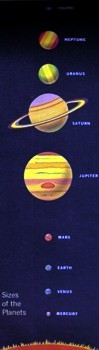
Our 4.5 billion-year-old earth is the third planet from the sun and the fifth largest in our solar system. The earth’s moon is one of the largest.
Three-fourths of the earth’s surface is water. The atmosphere that envelops the earth is made up of 78% nitrogen, 21% oxygen, 1% other gases and extends several miles into space.
The center of the earth is iron and the rest of her 2,100-mile thick core is liquid. The interaction between the solid core and the liquid generate the earth’s magnetic field.
The continents are adrift in the earth’s silicone rock mantle.
Mercury, the planet nearest the sun has cliffs and craters similar to our moon. It has a weak magnetic field and temperatures range from 950ºF facing the sun and -950ºF away from the sun. The polar regions appear to have ice and she has no moons.
Venus, the second closest planet to the sun and the earth’s neighbor, is permanently covered in thick clouds. Venus is 800ºF atmosphere is 96% carbon dioxide resulting in a greenhouse gas effect that prevents the heat from escaping. She has active volcanoes, is the brightest planet visible to earth and has no moons.
Mars, the fourth closest planet to the sun and the earth’s neighbor, has a cold, transparent atmosphere. The reddish hue of Mars is the oxidized (rusted) iron in the surface material.
Her temperatures range from 80ºF at the equator during the day and -199ºF at the poles at night. She has huge volcanoes, deep chasms and thousands of pockmarks from meteor hits. Mars’ atmosphere is mostly carbon dioxide and nitrogen, her gravity is one-third of earth’s and she has two small elliptical shaped moons.
Jupiter is 1,300 times the size of the earth and is the largest planet in the solar system.
This gaseous planet is 89% molecular hydrogen and 11% helium. Her turbulent striped clouds run parallel to her bulging equator. Large gray clouds surround the poles. Lightning bolts and auroras have been observed in her clouds. Jupiter’s atmospheric storm the "Great Red Spot" rotates counter-clockwise and is larger than planet earth. The winds of the spots outer rim blow at speeds reaching 225 mph.
Her faint rings have microscopic particles formed by the disintegration of interplanetary meteorites. Jupiter has 63 known satellites or moons and emits 67% more heat than it absorbs from the sun.
Jupiter’s large magnetic field interacts with the Sun’s magnetic field flow of charged particles. Her intense radiation field is fatal to humans.
Twenty-one fragments of comet Shoemaker-Levy 9 hit the cloud-covered lower surface of Jupiter in July, 1994.
Saturn, the second largest planet, is primarily composed of liquid metallic hydrogen. Her atmosphere consists of dark and light cloud rings and swirls and her temperatures range from -312ºF to -202ºF.
Saturn’s spectacular rings are made up of billions of tiny particles of mostly ice water. Saturn radiates about 80% more energy than she receives and her equator winds usually blow in an easterly direction at 1,100 mph.
Saturn’s magnetic field has a well-defined north and south and she has 56 known moons.
Uranus has a 97º tilt and is the seventh planet from the sun. Because Uranus is nearly on its side its poles receive more sun. The equatorial and polar temperatures are similar around -344ºF and the winds flow parallel to the equator.
Ninety-eight percent of the upper atmosphere is hydrogen and helium and the lower atmosphere water, methane and ammonia. The methane is responsible for Uranus’ blue green color and she has 11 rings of fine dust and 27 known moons.
Although Neptune is the smallest of our solar system’s four gas giants it is 60 times larger than the earth. The methane in Neptune’s atmosphere gives her a blue color.
Her atmosphere is mostly hydrogen and she has several large dark spots. Light, bright clouds appear above the methane and most of the winds on Neptune are in a westerly direction.
The atmosphere above Neptune is hotter near the equator, cooler in the mid-latitudes and warm at the south pole. Temperatures range between 900ºF to -360ºF.
Neptune has 13 known satellites or moons and her magnetic field goes through dramatic changes as she rotates in the solar wind.
It’s been 50 years since humankind first ventured into outer space to discover the secrets of the heavens. For many of us it has changed the way we see ourselves.
I feel both humbled and awed. The mystery of the universe has strengthened my faith for I believe God is in all creation.
|