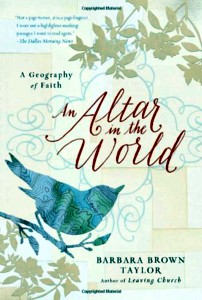
Barbara Brown Taylor says she forgot the whole world is the House of God before she woke up to God. She wondered who persuaded her that God preferred four walls to wide-open spaces, that God's home is a church and that the world was a barren place full of lost souls needing help. She now believes the people in churches need saving from the idea that God sees the world the same way they do.
Like Francis of Assisi Taylor says we can read the world as reverently as we read the Bible. She sees reverence as the awaking of awe. It's the reminder of our true size. The easiest way to practice reverence is to sit outside and pay close attention to everything that lives nearby. With luck we'll feel a tenderness and wonder for the struggles of ants and acorns. We may even feel the beat of our heart.
Taylor shows how our spiritual lives depend on engaging the most ordinary physical activities with exquisite attention. What we lack for this treasure is a willingness to imagine we already have everything we need.
She says all the world's great faiths are meant to teach us what it means to be more fully human. We live in the world that is waiting for us to notice the holiness in it. Faith is not just a way of thinking. Bodily practices should remind us that faith is a way of life. Our spiritual practices should bring us back to our body. To have gratitude for life as God's trusted flesh and blood. To bring divine love to earth. She asks us not to dismiss the body's wisdom because it does not use words.
Taylor says when people ask about her prayer life she sometimes describes hanging laundry on the line. As the breeze tosses the clothes in the wind she imagines her prayers spinning away over the tops of the trees. This work is good prayer.
Taylor says walking is the most available spiritual practice. We have difficulty recognizing where we really are as we spend most of our time thinking about the past. There are spiritual teachers who teach attentiveness including walking meditation. The four gospels give many accounts of Jesus walking by the sea of Galilee and even walking on water. Going barefoot is also a spiritual practice. Moses was told to remove his sandals as the place he was standing on was holy ground. Taylor says the spiritual practice of going barefoot can take you around the world and wake you up to your place in the world.
The Practice of Getting Lost was one of my favorite chapters. We, like Taylor's cows, follow the same tracks in a field. It's normal and there are good reasons. However, it also allows us to stay unconscious. Getting lost is a good remedy for the deadening habit of taking the safest, shortest path. It leads us to new people, places and things. It makes us more aware of our steps, forces us use to all of our senses and to make new choices. When we are alert, our senses come alive, we become more aware and see more. Choosing to get lost is a low-risk way to develop new skills for managing panic. Taylor recommends looking at being lost as a spiritual practice, a way to build the muscles for radical trust. God does some of His best work with people who are truly, seriously lost. Even Jesus chose to become lost when he spent 40 days being tested in the desert. She says the best way to grow empathy for those who are lost is to know what it means to be lost yourself.
Her chapter on community was particularly helpful. I too am an introvert and feel grateful when people draw me out of myself. Taylor says the main impediment to living a life of meaning is being self-absorbed.
She also speaks of the Christian mystical tradition of divine union. It can happen alone, with other people or with the natural world. The light of wholeness makes no distinction between God, other people or trees. Everything exists and lives in wholeness and light. She says the hardest spiritual work is to love your neighbor as yourself. Unfortunately, in our world nothing strengthens community like a common enemy. Yet, what we have in common is our humanity.
Concerning work Taylor says it's not what we do but how we do it that matters. Our work not only includes loving God and neighbor as myself but the vocation of becoming fully human. To turn gratitude for being alive into some common concrete good. Taylor sees housework as a domestic art. It's a powerful way to return to our senses.
Keeping the Sabbath can be part of the practice of saying No. A way to resist the our culture's killing rhythms of drivenness, depletion, compulsion and collapse.
Taylor says there is grace in physical labor when it is done as a spiritual practice. She points out how spikes in our pain bear some relationship to leaps of growth. To make peace with pain can require as much energy as fighting it. She says for those willing to stay awake, pain remains a reliable altar in the world.
There is profound, life-changing wisdom on every page of Barbara Brown Taylor's book “An Alter in the World.”