Rebetika is a very emotional, genuine music of the early 20th century, played along the coasts of the eastern Mediterranean.
Some eight years ago I visited my just-divorced wife Guell. We had managed to stay friendly, perhaps even loved each other a bit again. We both believed that life was too short for battles of hatred. We didn’t want to charge our kids. We also refrained from feeding our divorce lawyers with our broken hearts, and our money (that’s all they do care about, anyhow).
It was getting dark already and she said to me: “Make yourself comfortable, I’ll serve you tea, and please listen to this…” She just had arrived from Turkey, and held a few CD’s in her hands. “It’s old Rebetika music from Istanbul, and Izmir,” she said.
I stretched my legs. The CD crackled and yielded a deeply emotional music. Oriental sound waves from a long-gone world reached out to me and touched my soul. Music reverberated from a time, where songs were always recorded ‘life’. Playback, amplifiers, filters didn’t exist. That’s why these old songs have such a unique character. It’s genuine music without all the silly make-up. In those days, the shear power of the human voice made a steel needle vibrate and grind through a rotating plate made of wax. Madonna’s lousy peep voice wouldn’t have made it, then.
My love for oriental culture has at least three roots.
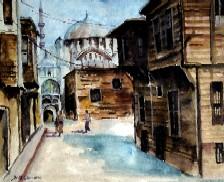
- I lived in Istanbul for a couple of years. Though a fairly ugly place particularly during the winter months, this city has something which creeps under your skin – a picture, a smell: white run-away horses galloping through town, a cab driver reciting the sad story of his wife that had run away, too. And after midnight, down at the Bosporus, someone would grab a Bouzouki and play Rebetika music.
- Married to a lady from Istanbul, I learned a lot from her. She knew a lot about the many layers of this old city. She was deeply interested in anything related to Byzantium, Rome, and the older, mysterious cultures of Anatolia. She equally despised the official, propagandistic and distorted vision of history, which gave a lot of credit to the nomadic Turks, and Islam. Looking into her dark eyes I saw the same generous, soft and romantic hue that shone from the mosaics of the Byzantine empress Theodora.
- There was Grandpa Franz, too. I never met him, he died too early, and I was born too late. He repaired old and designed new railway bridges in the period of Sultan Abdulhamid II. Grandpa’s rail bridges are still up, and the blue express rattles over them. We had a few Ottoman coffee cups at home, and some jewelry. Dad always proudly talked about Grandpa, and made me recite the stations along Grandpa’s railway line: Filipopoli, Adrianopoli (Edirne), Constantinopoli (Istanbul), and Smyrna (Izmir). It made me wish to visit these places. I would love to have known more about Grandpa’s Istanbul years.
With so many ropes tying me to that culture, to that place, I cannot escape easily. As I type these lines on my computer in the middle of a rainy tropical night, I feel a bit haunted by the past. This music always unleashes a kaleidoscope of emotions, rooted both in my personal field, my family, and beyond.
What is Rebetika? It’s a highly emotional, articulate and improvised music of the early 20th century, often played in bars of doubtful reputation, and performed by a small group of musicians (one or two mandolins, one or two bouzoukis, and one singer). Tonight I’m listening again to Rebetika, and absorb her oriental softness. Its bittersweet melodies are sung by heartbroken people- full of longing for a lost world. In the 1920-22 Anatolia Wars, many Greek were driven out of coastal Anatolia, the burning Smyrna. The surviving fled, and settled in Greece, or found new homes in New York, in Texas, but never forgot their roots.
Heartbrokenness and nostalgia are feelings that unite all kinds of refugees on this globe.
Metaphorically it applies to all of us humans, as we are orphans of change. Listen to the voices of Roza Eskenazi, Rita Abaci in the attached soundtrack, and you will better understand the point I’m trying to make.
The producer of the Rebetika disks, Muammer Ketencoglu, is kind of a hero. His love for the genuine and hidden roots of his county’s culture made him dig into the past, and capture the vanishing traces of Anatolia’s rich musical culture. Publishing Greek music in Turkey wasn’t quite politically correct. Demonstrating the historical truth that Greek music and culture were integral parts of the (highly civilized, cosmopolitan and tolerant) Ottoman Empire is breaking a taboo on both sides– such findings deeply antagonized the political elites in today’s Turkey and Greece, burdened with their respective nationalistic agendas. Persecuted by an ignorant government, Ketencoglu managed to publish a number of highly praised records. These always sold out before (a tacitly slow-moving Istanbul) police had finally to seize the production.
For those, who love genuine Ottoman music and Rebetika, I happily recommend the records “Rebetika I, and II”, Kalan Muzik Yapim LTD, Unkapi, Istanbul. I hope it can still be found somewhere.
© 2004 for article/text/photo by Franz L Kessler
|


A very descriptive, very well-written, and informative article - wonderful!!
Robert