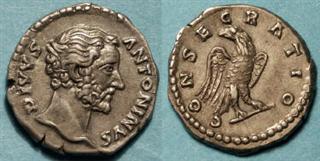
I collect old coins, including those of the ancient Romans, who were the first to excel at the mass-minting detailed coins. I few years ago, I acquired the above fine example of an Antoninus Pius denarius.
This coin was minted during the reign of Antoninus’ son, Marcus Aurelius, as a kind of memorial to his father. While I do not know the story of this particular coin, there is an interesting history of the events that preceded the minting of this coin.
Antoninus was born Titus Aurelius Fulvus Boionius Arrius Antoninus on September 18 in the year 86. He became one of the Aurelian Emperors.
Long before Roman government had declined to debased features such as mercenary armies, and such as the Emperor of the Month Club, Antoninus had shown that he was a man of ethical principles. He also had connections. His beloved wife, Annia Galeria Faustina the Elder, was the half-sister of Empress Vibia Sabina. Annia set an example for Antoninus, by her devotion to the care of poor and disadvantaged citizens.
Antoninus succeeded at one government post after another, and he was eventually promoted to a proconsul by the Emperor Hadrian. Antoninus was even adopted as a son, when Hadrian’s first adopted son died. Antoninus himself was told, in turn, to adopt Hadrian’s nephew, Marcus Annius Verus.
Adoptions of this sort had long been a feature of Roman life by this time in history. Childless men of importance could always adopt and groom a son to inherit their their estate, and maybe their wisdom as well.
When Hadrian died in the year 138, Antoninus was made emperor. This was not a done deal, just because he was the adopted son of Hadrian; however, Antoninus was already fifty-two, which was quite old for any Roman citizen of the time, so the senate simply decided to make the old guy emperor, thinking that Antoninus would soon die, giving them time to find a more desirable choice.
However, Antoninus ruled for 23 years, which was the longest reign since the Emperor Augustus. The same period was an extremely prosperous time in Roman history. Antoninus did not waste his time on fruitless endeavors, and he shared power well with all the regional governors.
When he died in 161, his adopted son Marcus Aurelius carried on his legacy. Marcus was a great stoic philosopher and a statesman. He went so far as to share power with his brother, Lucius Aurelius Verus. Marcus’ reign was plagued with foreign wars and insurrections, especially in Germany and Parthia. Since Marcus was not cut out for military matters, Lucius handled all military affairs.
When Marcus Aurelius died in 180, the great five-emperor dynasty came crashing down. It was preceded by the Antonine Plague from 169 to 180, which had also claimed the life of Lucius. The plague was probably small pox or measles carried by returning Roman legions.
Lucius Aurelius Commodus Antoninus succeeded his father Marcus Aurelius. Emperor Commodus was not a statesman, and his lack of attention for any details led to a government plagued with intrigue and plotting. He was also obsessed with gladiatorial games and even being a gladiator, which people thought was way below the conduct of any emperor.
So began the decline of the Roman Empire.