Knee Injuries: Sprains, Strains, Patellar, ACL and MCL Injuries
By: Peter Egan
While most casual sports fans could probably tell you which players on their favorite team(s) are injured at any given point in time, perhaps even being able to name the general area of the injury on the athlete's body, noticeably fewer people are knowledgeable about the nuances of certain relatively common sports injuries and how they can impact recovery times.
 For the sake of this discussion, we'll narrow our focus to the topic of knee injuries, something most every adult has suffered at least once in their life.
The example I find most illustrative of this point is that relating to a simple strain, a sprain, an injury to the patellar tendon (and/or patellar tendonitis), and an injury to either the Anterior Cruciate Ligament (ACL) or Medial Collateral Ligament (MCL).
We often read or hear about injuries to players on our favorite sports teams, at times befuddled over how a player could return to action so soon for an injury that looked so debilitating in the slow motion replays; while simultaneously deriding a different player whose knee injury didn't look as severe on camera, but whose season was ended by what at first glance seemed a minor injury. In cases such as these, the reasoning behind how one could return to action within days if not same-day while another whose injury didn't even look to be as severe is somehow out for the duration of the season more often than not has to do with the anatomy of the knee and which specific parts of it were damaged.
First, let's distinguish between strains and sprains. A strain involves a simple muscular injury and is generally not serious. Professional and even high-level amateur athletes play through injuries such as strains day-in-and-day-out. They typically are not excrutiatingly painful, and do not inhibit one's strength or freedom-of-motion to such an extent as to render an athlete a liability to his or her team. Only the most severe strains can keep an elite athlete off of his/her playing field of choice for more than a few days.
A sprain involves the joint itself, and in particular the ligament(s) associated with said joint(s). The wrist and ankle are the most commonly sprained joints, however sprains can occur in any joint and are not altogether uncommon when occurrning in the knees and in some cases even elbows.
Three Classes of Sprains
Additionally, not all sprains are created equal. There are three different classifications/groupings of various sprains separating them based upon severity of the injury itself:
- 1st Degree Sprain: is a tear of only a few fibers of the ligament.
- 2nd Degree Sprain: is a tear of part of a ligament, from a third to almost all its fibers.
- 3rd Degree Sprain: is a complete tear of the ligament.
Second Degree and Third Degree Knee Sprains (ACL and/or MCL sprains) will sideline even the toughest of athletes, with the latter (3rd degree sprains) typically requiring surgery to repair and a lengthy healing and rehabilitation process.
Noteworthy about these various sorts of knee injuries is that there are certain workouts and training exercises designed to strengthen the muscles surrounding the knees in hopes of preventing them before they happen, however no exercise is foolproof.
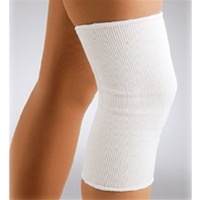
Certain products likewise exist which are designed to among other things provide compressive support to the joints (in this case knees) of athletes across all levels of competition in similar hopes of helping prevent an injury that might otherwise occur were the compressive supports not a factor in the equation. These include such products as knee sleeves, including both neoprene and elastic knee supports. While knee sleeves certainly do not offer a guarantee against a sprain or any other injury for that matter, they do provide some measure of support, which at least in theory (and lilely also in practice) helps to reduce the number of serious ACL and MCL injuries in those wearing such supports as a preventive measure. They are also often used during rehabilitation to thelp add targeted support so as to avoid reinjury during the early rehab phase.
Now, patellar injuries are another matter altogether. Generally speaking, these tend ot be more of a nuisance than anything (although like everything else there are exceptions). While the pain can get to be intense enough to definitely be noticeable and even cause someone substantial discomfort, they also are nowhere near as debilitating as are ligament injuries, and compressive soft orthopedic goods such as the GelBand Patella Strap, Patella Support (Neoprene) by FLA Orthopedics and neoprene knee sleeves (open or closed patella depending upon the nature of the injury), are often all that is needed aside from perhaps some topical pain reliever such as BenGay, Icy Hot or better yet, Biofreeze; are all that's needed to get a top-tier athlete back onto the field of play.
Back to ACL and MCL tears, these generally require surgery to reattach the torn ligament. This is typically followed by either in or out-patient physical therapy, often conducted in the home by a home health agency.
The recovery time is extensive, and it could be the better part of a year before an athlete can even begin to run on the injured knee. When he or she finally does begin to ease back into athletic competition, heavy-duty knee supports and knee braces are needed to keep the fragile joint intact and in place while gradually rebuilding strength in both the ligament and surrounding tissues. In instances such as these, a heavy-duty knee stabilizer should be worn until such time as stabilization of the knee joint is no longer necessary in order to prevent reinjury or to protect against inhibited healing resulting from stress. A knee stabilizer, unlike the other types of knee braces mentioned above, is designed to keep the knee joint still and in-place until the brace is removed. The brace should not be removed during rehabilitation exercises or mild exercise or competition until the joint is fully healed.