America Should Embrace the Bidet
By: Peter Egan
In the United States, the common assumption amongst the vast majority of the population it seems is that anything that isn't popular within U.S. borders isn't worth being popular. In at least one example, nothing could be farther from the truth.
Some Americans may be shocked to learn that scores of people who reside in other countries, are members of different cultures and who often speak different languages aren't in fact inferior human beings, nor are their cultures inferior cultures. To the shock of every American citizen with whom this author has discussed the topic chronicled herein, many Europeans and Asians (especially Japanese) view the prospect of vacationing in the United States as something akin to traveling to some third-world country where running water may or may not be present, and the modern amenities we all enjoy in the developed world are nowhere to be found.
The reason for this? In the United States, a simple device known as a bidet is about as hard to find as an honest politician. This can be a non-starter for those who've grown accustomed to having a bidet in each restroom and view the very notion of toilet paper the way Americans would view sandpaper being used in the same manner in which toilet paper is used in the States. While there are no official statistics or studies to reference, it is same to say that this fact alone costs the U.S. considerable tourism each and every year.
The main advantage of toilet paper is that a roll of it can be obtained for about a dollar. However, when one stops to consider how many roles he or she will go through throughout the course of a year, five years, a decade; it becomes clear that while the initial price tag on a bidet will be well in excess of the cost of a single roll of toilet paper, when those costs are spread out over time a bidet might and actually likely will cost less than traditional TP.
However, it is the sanitary benefits of bidet use as an alternative to toilet paper which make it such a vastly superior post-restroom personal hygiene alternative to the soft paper that tears easily. Consider the following:
- Toilet paper requires the user to actually, manually apply the paper to the affected area, often leading to bacterial transfers which could have been avoided had a bidet been used instead.
- Toilet paper tears easily. Bidets don't tear at all.
- Toilet paper requires a physical contortion of the body that can be difficult and even dangerous for some elderly, disabled and pregnant individuals.
- Toilet paper is a contributing factor to the development of hemorrhoids, whereas bidets help relieve hemorrhoids.
- Toilet paper must be applied by hand. Bidets ensure the hand need go nowhere near the posterior region.
- Children often struggle to use toilet paper properly, potentially increasing the spread of disease. Bidets can only be used one way, although settings such as strength of the jet and water temperature can be customized with some models.
The bottom line is that a bidet offers a superior bathroom experience to traditional toilet paper, can accommodate large and disabled individuals, help stop the spread of disease and help end the perception so many other cultures hold with regard to Americans when it comes to bathroom habits.
In many parts of Europe and Japan, bidets are found just about everywhere toilets exist. Americans should make it a point to demand the same in the United States, for the sake of hygiene, cleanliness, comfort and last but not least national reputation.
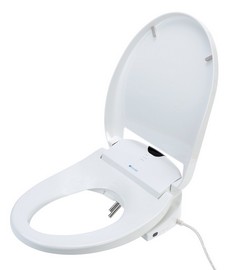
One of the better bidets on the market is the Swash 1000 Bidet Spa. It retails for around $700-$1,000; however one can purchase it at EGAN Medical for just $599.00 with free shipping to destinations located within the continental United States.






On the other hand, my first view of bidets was that they were separate appliances making it difficult to fit them in small bathrooms. I don't have one at home, but my attendant accomplishes the same thing with a flexible spray shower head from my shower. She also uses toilet paper to dry me off rather than leave me with a wet bottom.
In all the years I used toilet paper (at a premium price per sheet in the Cairo airport with 1 inch of overflow on the entire bathroom floor) I never encountered any of those difficulties mentioned in your six points… Unless I stretch the truth quite a bit.
Ron