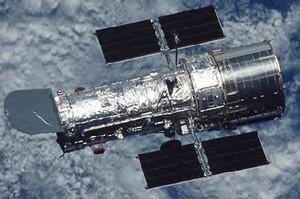
The Oak Park Public Library was the location Friday, October 19, 2012, for the screening of a remarkable film by an award-winning documentary filmmaker, David Gaynes. “Saving Hubble” documents the near termination of the Hubble Space Telescope and its salvation after a national uproar by common citizens as well as the scientific community.
Unlike all other films about the HST, the 70-minute “Saving Hubble,” while showing many of the wondrous images captured of galaxies, star clusters, interstellar clouds, and the famous Deep Field image, emphasized the humanness of the salvation attempt. Interviewing scientists is mandatory for such films, but Gaynes spent more time interviewing non-scientists and journalists. A high school cheerleader, a cabbie in Nashville, and people on the street all eloquently spoke of the idiocy of turning off the HST.
The film documents this public outcry resulting from the scheduled mothballing of the Hubble Space Telescope in 2004. Gaynes wrote, produced, and directed the film.
The demise of the HST would have resulted from the decision of the head of NASA at the time, Sean O’Keefe, to not use a space shuttle for a maintenance mission. As all “vehicles,” the HST requires maintenance, including replacement of its batteries and installation of new equipment. As the film shows, the news was kept quiet and only a journalist, interviewed for the film, inquired after reading a brief report to that effect.
O’Keefe was a noted bean counter, but his motivation was to avoid deaths of astronauts, following the 2003 Columbia disaster, on what he considered a non-essential mission. Only with his retirement, which he joyfully announced, and the naming of a new NASA head, was the decision reversed. I admit that the tape of that news conference, met with a standing ovation, brought tears to my eyes. The film certainly affected me, as a great film should.
Gaynes’ film and Gaynes were introduced by Dr. Les Golden of Oak Park, a Cornell University and University of California, Berkeley-trained astrophysicist and retired astronomy professor at the University of Illinois, Chicago, who now heads the Center for Computational Astrophysics in Chicago. His textbook, Laboratory Experiments in Physics for Modern Astronomy, will be published in October, 2012, by Springer-Verlag.
Complementing the subject of the film, Golden used his introduction of Gaynes to expound on the manners in which human beings strive to acquire truth. Noting that human beings first gained consciousness between 50,000 and 100,000 years ago, Golden said that faith, revelation, authority, reason, and observations have been those techniques. He then described how Galileo used the newly developed telescope to show that the truths about the solar system expounded by the Church were patently false, a momentous contribution to mankind that resulted in his imprisonment for life. The microscope, particle accelerators, and the HST were also developed to help mankind observe nature, allowing Golden to introduce Gaynes.
Gaynes had a background in public policy and journalism but soon discovered a love for film-making. He has won numerous awards as a filmmaker, including the prestigious Vail Film Festival award for best documentary.
His approach to the Hubble film is novel. He has embarked on a now six-month long national tour, which he calls the “Hubble Roadshow,” to bring the film to audiences. He was in Chicago to screen the film in Oak Park as well as on a minor league ballfield in Crestwood, Illinois.
The screening in Oak Park was enthusiastically received, with the audience staying quite a long time after the official 9:00 p.m. closing time of the library to ask questions of Gaynes.
We wished that the library had provided some books on astronomy and perhaps the history of astronomy for those interested in the subject to check out. After all, the purpose of a library is to encourage reading.
Nonetheless, the film was enthralling and the evening was entertaining and educational. As Golden said in his introductory comments, Gaynes is approaching legendary status as a brilliant documentary filmmaker. We expect “Saving Hubble” to reap its own share of awards at film festivals.