AuthorsDen.com   Join | Login    
Where Authors and Readers come together!

SIGNED BOOKS    AUTHORS    BOOKS    SAMPLE CHAPTERS    AUDIOBOOKS    eBOOKS    STORIES    ARTICLES    POETRY    BLOGS    NEWS    VIDEOS    SUCCESS    TESTIMONIALS

Featured Authors:  Tracey Morait, iD. Enise, iBethany Peterson, iDavid Clure, iLisa Loucks Christenson, iShirley Woods, iTom Kitt, iOdin odin@aflx.com, iDave Tabler, iRobin Ouzman Hislop, i

  Home > Literary Fiction > Articles Popular: Books, Stories, Articles, Poetry      Authors: A B C D E F G H I J K L M N O P Q R S T U V W X Y Z     

Douglas R. Skopp

 Follow Me  

· Contact Me
· Books
· Articles
· Poetry
· News
· Stories
· 40 Titles
· 101 Reviews
· Save to My Library
· Share with Friends!
·
Member Since: Aug, 2012

Douglas R. Skopp, click here to update your pages on AuthorsDen.


Where fiction and history overlap...
by Douglas R. Skopp   
Rated "PG13" by the Author.
     
Recent articles by
Douglas R. Skopp

• Lake Placid High School Commencement Ceremony, Lake Placid, NY, June 2013
• Remarks at the Dedication Ceremony of the Holocaust Memorial Gallery
• Holocaust Fatigue
• Remarks at Memorial Ceremony for Victims of the September 11, 2001 attacks
• Why did I write Shadows Walking?
           >> View all

Why do some readers like descriptions of violence in fiction, but avoid it if they they believe it really happened?

I recently spoke with a woman who, just minutes before, finished reading Stieg Larssen’s The Girl with the Dragon Tattoo:
 

“What a wonderful, gripping book,” she said.
“Yes,” I said, “so I’ve heard. I’ve not read it.”
“Oh, but you must. It’s wonderful.” Her enthusiasm was all over her face.
“Why is it so wonderful?” I asked.
“It’s so real. So gripping.”
“Really. I’ve just written a book based on my research,” I said, hoping to persuade her to read my novel, Shadows Walking. “Everything in it either happened, or could have happened. Some of the characters and the dialogue, of course, are fictional. But the historical setting in which they make their choices and the consequences of those choices—I didn’t invent any of that. It’s as ‘real’ as I could write it.”
“What’s it about?” she asked.
“Nazi Germany. How a well-meaning, intelligent doctor decides to join the Nazi Party, then does what Nazi doctors did, and finally tries to understand why he made those awful choices.”
“Oh, no. I won’t read anything like that,” she said with a shudder.
“Why not?” I could not resist asking.
“Because it’s true . It’s too real. It really happened.”
“But you just told me, Larssen’s book is wonderful because it is so real.”
“That’s different. It’s fiction. It didn’t happen.”
That conversation set me to thinking. People, myself included, sometimes read a fictional work because it is “so real,” but we know it’s really not “real.” I love to read fantasy, magic realism, contra-factual histories, science fiction, fairy tales, and more. I love the imagination so many authors bring to their subjects: their vivid creation of these alternate realities becomes as real as this world’s. Those who bring this off are praiseworthy in great measure just because their works are so real. Reading them gives me another way of seeing, not only the world they create for my pleasure, but the world in which I really exist. Escaping reality is fun in itself, and can be cathartic when we return to our real world. I am sure Larssen’s works do this, too.

Still, I am an historian, devoted to telling, to the best of my ability, what “really” happened. But no human being can tell what really happened. The past is too intricate, too tightly knotted. Evidence is either missing, or so vast that no one can comprehend it all. Instead, historians must be content to tell stories about the past—hoping, of course, that what they tell is as true as they can make it. In other words, history is not what happened, but what historians say happened. It’s not supposed to be fiction, of course. A good historian cannot violate what is known to be a fact. But the story about those facts—seeing a pattern among them, saying one or another caused a subsequent fact, emphasizing some and leaving others out—that’s what makes an historian like a novelist. Both are eager to tell their stories. Good history and good fiction overlap.

So why is my telling of a story, as true as I can make it historically, but organized around fictional characters making choices within fictional plot, not as appealing to some readers as a story that is praiseworthy because it is so “real” but wasn’t real at all?

In graduate school, I had a history professor who said, often many times during the course of a lecture, “What you must realize is…” He meant, of course, “what you must make real” in studying history, what we needed to do to leap into the era he was describing and actually see it, smell it, feel it, fully sense the reality of it. Larssen apparently does that with brilliance in his novels. Violence, pain, anguish, revenge and whatever else the reader encounters in his work is as believable as it needs to be, in order for a willing reader to actually sense reality. That’s exactly what I wanted to achieve in Shadows Walking—both as an historian and as a novelist.

The violence in Stieg Larssen’s novels did not happen, but he succeeds in making his readers think that it did. Just because this violence appears to be real, but is not, he offers us an escape from a reality that is all too real. Fine enough. As I say, I know how satisfying it is to enjoy fantasies, to escape reality. And I know, my novel is not enjoyable in this sense. In another sense, though, I do hope it is worthwhile.

 
The painful events in Shadows Walking—the larger events, in which my characters are enmeshed—are true . Telling them, making them as real as I can, is important to me. I believe that we must attempt to “realize” in our minds what it actually meant to suffer the horrors of the Nazi era, and not just from the perspective of its victims. If we can, we should also try to “make real” why the perpetrators did what they did. After all, those perpetrators were human beings. Some, like Hitler, Himmler, Eichmann, Mengele and too many more, were motivated by grotesque brutality and indifference to their victims. Others, like Johann Brenner, my protagonist in Shadows Walking, made choices that brought them to the edge of a slippery slope. They were human beings of “good will” and the best intentions, “normal” (whatever that means) and very much like you and me, ultimately doing great harm to other human beings also very much like you and me, for reasons that at the time seemed compelling, but with hindsight, we know, were indefensible. My novel describes how Johann Brenner made his choices and became a Nazi doctor. In learning about him, I believe we can learn about ourselves. Doing so, we might, we just might be able to stop ourselves from future genocides. At the very least, I hope, we will find more reasons to be compassionate and merciful toward one another. This is the reality—the overlapping of fiction and historical fact—that I seek, and the purpose I had in writing Shadows Walking. 


Want to review or comment on this article?


Need a FREE Reader Membership?
Reviewed by Keith Rowley
Reviewed on September 2, 2012
That's a very interesting and well presented viewpoint, Douglas. I guess the same phenomenon appears when we discuss sex, inasmuch that we can be quite titillated by imaginary sexual scenarios that would appall us were they real; we call this fantasy!

Popular Literary Fiction Articles
  1.  A Call for the Dissolution of the Wash
  2.  Why I Write - An Author's Confession
  3.  Short Storyteller
  4.  Book Review: The Jewel by Stan I.S. La
  5.  When is a short story not a short stor
  6.  The City never Sleeps; a Study in Blac
  7.  The Boys Going West
  8.  Dallas
  9.  I Never Knew Him
  10.  A Warm Late Spring Sunday
  11.  The Wait
  12.  Take my Hand, Daddy!
  13.  Downtown Sloanville
  14.  Jane Austen and Blackadder
  15.  I Remember a Young Girl
  16.  I Was Created For This
  17.  Dickens, Thurber, Andersen, London and

Free Book Review Program
Select a book to read and review today!

He Was Weird by Michael LeFevre

My second book is about a boy who has Asperger's Syndrome and is bullied to the point to where he shoots up his school. I have divided the excerpts from it into three parts: Before, during and after the shooting.  
Member BookAds

I Made My Boy Out of Poetry by Aberjhani

I Made My Boy Out of Poetry is a powerful literary vision of rare scope, beauty and emotional intensity composed of stories and poems that flow in and out of each other like the most lucid and articulate of dreams. These are portraits and studies of  
Member BookAds

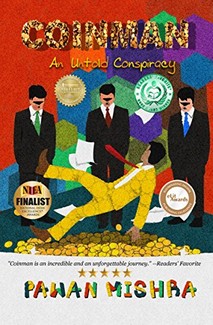
Coinman: An Untold Conspiracy by Pawan Mishra

In this eccentric tale set in a small town in northern India, Pawan Mishra masterfully weaves ingenuity and sarcasm in a manner that’s simultaneously hilarious and tragic.  
Member BookAds