ANGLO-AMERICAN RELATIONS
“England and America are two countries separated by a common language” - George Bernard Shaw
Until last year, when I started making lots of American friends, I had no idea how true that quote was. It not so much that we have different words for things. It's that we use the same words to mean something completely different. For instance, an American might be quite shocked to hear an Englishman say, “I'm just going outside for a fag.” when he only means he wants a cigarette. And it can be equally embarrassing the other way round. The word fanny may be slightly vulgar in America, but it's downright rude in England, where it is a euphemism for a woman's private parts. The first time I heard the American usage was in a radio interview with a recently-divorced starlet, in which she said she first realised her marriage was going wrong when he stopped patting her on the fanny. I was shocked rigid! She said fanny! On the BBC!
And then there's all the things you have in America that we don't have in England like Independence Day and Thanksgiving and English muffins (I have yet to meet an English person who knows what an English muffin is!).
But we can comfort ourselves with the knowledge that you don't have Pancake Tuesday, the Royal Family or faggots (a kind of meatball made from liver and served in a very rich gravy).
But the thing that worries me most is the English sense of humour. It is based on sarcasm. We often say the exact opposite of what we mean because we find it amusing, as in “Isn't it a lovely day!” to describe a passing hurricane.
And we think it's funny to insult each other. A dear friend of mine, on being pursued by a rather unattractive man and having tried to put him off several times, retaliated with, “I admire your taste, but I'm afraid I find you repulsive!” I didn't stop laughing for days!
And that same friend couldn't stop laughing when a work colleague said to her, “Haven't you got a lot of freckles? Disfiguring, aren't they?”
I am so afraid I'm going to get carried away and say something sarcastic to one of my lovely new American friends. I can't tell you how many times I've deleted an email or a comment at the last minute because I suddenly realised that only an English person would know it was supposed to be funny.
So I would like to say RIGHT NOW, if I have ever said anything to anyone that was insulting, blasphemous or just downright rude, that I didn't mean it. Honest. I thought I was being funny. I can't help it. I'm English.
Despite all the problems and possible misunderstandings, Jenny got together with Tara Fox Hall, who lives in New York State, to produce the anthology Bedtime Shadows, which came out in September and is already doing well on both sides of the pond. They are not only still speaking to each other, but have become even firmer friends.
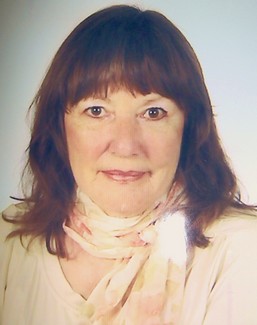
Jenny Twist was born in York and brought up in the West Yorkshire mill town of Heckmondwike, the eldest grandchild of a huge extended family. She left school at fifteen and went to work in an asbestos factory. After working in various jobs, including bacon-packer and escapologist’s assistant, she returned to full-time education and did a BA in history at Manchester and post-graduate studies at Oxford.
She stayed in Oxford working as a recruitment consultant for many years and it was there that she met and married her husband, Vic.
In 2001 they retired and moved to Southern Spain where they live with their rather eccentric dog and cat.
Tara was born in the United States, earned her bachelor’s degree in Mathematics with a double minor in science at the State University of New York at Binghamton, and is currently an OSHA-certified safety and health inspector at a metal fabrication shop. In addition to speculative fiction, Tara Fox Hall’s writing credits include nonfiction, action-adventure, and contemporary and historical paranormal romance. She is the author of the paranormal action-adventure Lash series and the vampire romantic suspense Promise Me series.
EXCERPTS
THE MAN WITH NO FACE
Jenny Twist
I read somewhere that most people have no memory before the age of five and that very few indeed can remember anything before the age of two. It's not that babies can't think. It's that they haven't learnt how to save their thoughts as memories.
But I have a memory much earlier than that.
I am sitting in my pram. I know I am in a pram because the hood is up and the view in front of me is framed by the edge of the hood. I can see this very clearly. It has a trim of elasticated material, black with a white pattern. The pattern may be writing. I can't tell because I am too young to read. Through the hood, in front of me, is a garden, bounded by a high brick wall. The wall is covered in a riot of red flowers. I know now the plant is Japonica but in the memory I have no words for anything. In the middle of the garden there are two people locked in a clumsy embrace. Either they are standing very still or the memory is a still picture – a snapshot in time.
I can see the woman very clearly. She is wearing a white cotton frock with a pattern of tiny blue flowers. Her face is turned towards me and it bears an expression of anguish. I think she is my mother.
But I can't see the man clearly at all. I'm not even sure it is a man. But I think it is. He is a shadowy figure, one hand gripping my mother, if she is my mother, the other held over his head. He is holding something aloft, something long and thin – a stick perhaps. I can't see it clearly at all. Everything about the man is out of focus.
I have always believed that if I could just see his face, if I could identify him, I would understand everything.
TAKE THE CHANCE
Tara Fox Hall
The lessons of history were there. We just didn’t see them.
It began a long time ago, when I was young. I distantly remember going to school, playing outside with my friends, and having a small dog. Then everything changed. Groups began fighting in our government. Instead of working together to find a solution, each side blamed the other for its woes, and for the troubles of the rest of the world. The tensions mounted, both in the halls of our founding fathers, and in the lands around them.
There was no large-scale attack by an aggressing country, or any terrible carnage. But the fear seemed to grow in every one of us anyway. We began to distrust those around us, the ones who spoke their minds, unafraid of the consequences. We kept to our own families more and more, shunning those that demanded action.
People began disappearing. At first, it was the wilder ones, the ones who caused trouble, who insisted on freedoms. That was sort of a relief, to not have them around anymore, telling us constantly that we needed to stand up for ourselves. We had families and belongings. We had to protect them. It was a small price to pay, just to conform.
Instead of peace, the fear grew. It was an unnamed fear that came from inside, immobilizing and sucking the happiness from everything. It was enough to be safe and have loved ones near. Asking for more than that seemed wrong.
To find out more about the authors, go to:
Jenny Twist
https://sites.google.com/site/jennytwistauthor/home
Facebook Author Page
https://www.facebook.com/pages/Jenny-Twist-Author/291166404240446
Goodreads Blog
http://www.goodreads.com/author/show/4848320.Jenny_Twist/blog
Amazon Author Page
amazon.com/author/jennytwist
Tara Fox Hall
Website: www.tarafoxhall.com
Email: tarafoxhallATgmailDOTcom
Tara's Blog: http://www.goodreads.com/author/show/5286654.Tara_Fox_Hall/blog
Tara's Facebook Page:
www.facebook.com/pages/Tara-Fox-Hall/151813374904903
Twitter: https://twitter.com/#!/TerrorFoxHall
For info on my recently published work, Lash, click here: http://www.amazon.com/Lash-ebook/dp/B007UJ6KGC
For info on my recently published work, Just Shadows, click here: http://www.amazon.com/Just-Shadows-ebook/dp/B006V4HB2Y