Clients often come into my office in the throes of overblown emotion—overreacting to each other, stuck in a power struggle, or confused about why every discussion turns into a drama.
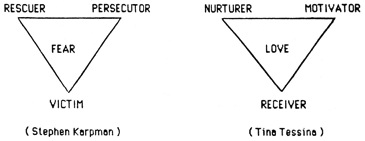
DRAMA TRIANGLE FUNCTIONAL TRIANGLE
| |
|
|
| |
 |
|
| |
|
|
Originally developed by Stephen Karpman, M.D., the Drama Triangle is an illustration of the roles played in dysfunctional families which keep the family energized and busy, and prevent seeing dysfunction or moving into true intimacy and cooperation. It’s an illustration of how the enrergy moves in a dysfunctional family situation.
Roles in the Drama Triangle are Persecutor, Rescuer and Victim, and family members keep switching these roles. The drama is motivated by fear, often masquerading as anger or hopelessness. I created the Functional Triangle to show the roles played in a functional family: Nurturer, Motivator and Receiver. Family members also constantly exchange these roles, and they are motivated by love. A functional family is calmer, and everyone is happier without the unnecessary drama.
One profound way to intervene in the Drama Triangle is for family members to learn not to rescue each other. The other is to stop allowing others to rescue you.
How to Stop Rescuing and/or Being Rescued
You can learn to recognize a “rescue” while you are doing it, and make your unconscious behavior conscious. When you feel an emotional reaction to what is going on, these guidelines will help you stop and think about what is happening and how you are rescuing so you can begin to change that behavior, and to change your automatic responses into more thoughtful interactions.
You can also use these guidelines to review past problems and understand the dynamics, as a guide to changing your future reactions.
Recognize a Rescue While You Are Participating In It
Learn to recognize that you are rescuing when you:
• Do something that you do not want to do because you believe you have to, and feel resentful later.
• Do not ask for what you want.
• Inappropriately parent another adult (giving unsolicited advice, giving orders, nagging, or criticizing)
• Don’t tell your partner when there’s a problem, or when you feel resentful, ripped off, rejected, cheated, depressed, disappointed, or otherwise dissatisfied.
.
• Contribute more than 50% of the effort to any project or activity that is supposed to be mutual, (including housework, earning income, making dates and social plans, initiating sex, carrying the conversations, giving comfort and support) without a clear agreement between you.
• Feel your role is to fix, protect, control, feel for, worry about, ignore the expressed wants of, or manipulate your partner.
• Habitually feel tired, anxious, fearful, responsible, overworked and/or resentful in your relationship.
• Focus more on your partner's feelings, problems, circumstances, performance, satisfaction or happiness than on your own.
Whenever you realize you are rescuing, tell the other person what you're tempted to do or not do for them, (how you want to rescue them) and ask them if they would like you to do that or not. Once you've offered and the offer has been accepted or rejected, (even if your partner is not honest about what he or she wants, or makes a mistake) it is no longer a rescue, it is an open agreement, and can be renegotiated if necessary.
Learn to recognize that you are being rescued if you:
• Think you are not as capable, grown up, or self-sufficient as your partner.
• Find that your partner is doing things “for you” that you haven't requested or acknowledged
• Feel guilty because your partner frequently seems to work harder, do more, or want more than you do.
• Don’t ask for what you want, because your needs are anticipated by someone, or because your partner will not say "no" if he or she doesn't want to do it.
• Act or feel incapable, childish, irresponsible, paralyzed, nagged, criticized, powerless, smothered, or manipulated in your relationship.
• Act or feel demanding, greedy, selfish, out of control, overemotional, lazy, worthless, pampered, spoiled, helpless, or hopeless in your relationship.
• Contribute less than 50% of the effort to any project or activity that is supposed to be mutual, (including housework, earning income, making dates and social plans, initiating sex, carrying the conversations, giving comfort and support) without a clear agreement.
• Feel your role is to be fixed, protected, controlled, told what you feel, worried about, ignored, or manipulated by another adult.
• Habitually feel guilty, numb, turned off, overwhelmed, irresponsible, overlooked, misunderstood and/or hopeless in your relationships.
• Focus more on your partner's approval, criticism, faults, anger, responsibility, and power than on your own opinion of yourself.
• Feel controlled, used, manipulated, victimized, abused, oppressed, stifled, limited or otherwise dissatisfied by your partner.
The more familiar these feelings or actions are, the more frequently they occur, the bigger the habit you have of being rescued in your relationship. Rescuing is a habit that you learned early in life that seems “normal” and is habitual, so it is often difficult to be aware of it. Rescues depend on secrecy or ignorance. The antidote to being rescued is making an open agreement. So, if you suspect you are being rescued, suggest negotiating or talking about it, or just say thank you, if the help is truly OK with you.
How to Avoid Rescues
1. Recognize that what’s going on doesn’t feel good. It’s the best indicator of dysfunctional interaction.
2. Stop and Think. Don’t react automatically. If you have a dysfunctional habit pattern, you’ll need to make a different choice than your automatic behavior. Use the following checklist:
a) Does the situation feel fair?
b) Are you reluctant to say what you want?
c) Do you know what the other person wants?
d) Do you feel uncomfortable?
e) Are you resentful, angry, scared or upset?
f) Are you trying to control someone else’s reaction or feelings?
g) Does this feel similar to other interactions that ended badly?
3. After you’ve taken a moment to think about whether you're rescuing or being rescued, and what clues you are aware of, either ask for what you want, or ask the other person what he or she wants.
4. Offer to work toward a mutual decision.
Taking the rescues out of your relationship removes the drama. Learning to talk about what you want and don’t want, and to offer help instead of just stepping in can make a really big difference in the happiness level of your relationship.
|