ATHENS ,Besides The Ruins
Steve Kerr
Framed in rock on an extreme blue background the creamy stone of the ancient
Acropolis ,crowned by the Parthenon ,observes the modern city of Athens,
respected and loved by the inhabitants as if it were some ancient ,omnipresent
,grandmother who has lived on into eternity in this the cradle of civilisation and
European culture. Reminders of the ancient Greeks are to be found all around
the city from Hadrian’s Arch to the odd column that has recently been
excavated on a busy street. Ancient ruins, an Athenian architect and builder’s
nightmare, when a buildings`foundation is dug , there is a good chance that it
might contain the ruins of an ancient villa or temple, which of course means the
construction is halted, the ruin preserved – and there are literally hundreds of
them in varying shapes and sizes underneath the roads and flats of the modern
city. Athens, the Greek capital, whose identity is so very caught up with those
ruins of antiquity and yet there is so very much more to the Athens of today.
At the very centre of 21 st century Athens is the beating heart of Omonia Square
whose adjacent streets are arteries that pump blood full of buzz, adrenilin and
a zest for life. Athens wakes early and is soon a bed of hyperactivity. On
Athinas Street which connects Omonia and Monastiraki, early morning
shoppers mingle with the odours of the fish and meat markets. The air is also
heavy with the aroma of pistachio nuts, honey, cinnamon, oregano and was
that just a hint of incense? Illegal immigrants congregate on the “platea”
opposite the town hall. Their cheap T-shirts and jeans set them apart from the
local designer clad youths while everywhere flocks of pigeons consume crumbs
from under café tables. Shop fronts ,open to the street, sell cut price shirts,
bags and icons. Street sellers flog potato peelers and mixers. A tiny chapel set
back from the street betrays an abundance of flickering beeswax candles and a
myriad of icons as Athenians file in and out in their hundreds to light candles
and venerate the icons as they pray for health, happiness and an end to the
recent economic crisis that has brought Greece to its knees. The sound of laika
comes from the tatty sad little ouzeries located at the end of narrow closes and
arcades, known in Greek as the cafeneio. The clientele, the low-paid labourers
and jobless from the neighbouring rundown backstreets, the abode of one-euro
shops, cheap souvlakia take-aways, pornographic cinemas and dilapidated flats
with rusty balcony railings. The ouzerie/coffeeshops of Athens , a male
stronghold and bastion of the laika, the distinctly Greek popular music, now so
much influenced by American pop and rock but which, until recently, featured
many Arab and Turkish elements. The Cafeneio where the daily diet of politics
found in newspapers and on television is assured of a heated, lively argument.
1The sun hits the makeshift stalls, sometimes little more than a rug on the
pavement, sprawled out over the extremely narrow sidewalks of Monastiraki,
stained, dirty tapestries that were once some grandmother’s dowry, faded
photos of King Paul and Queen Frederica, torn brown-paged paperbacks,
cracked cups and collectable stamps, coins and once mass-produced
ornaments, all for sale. The flea market, selling this and that for any occasion
or mood, spills out into greater Monastiraki, the sellers begging passers-by to
buy their wares, and often as not, their junk. A former mosque dominates the
square next to Monastiraki station and is a reminder that until 1822 this area
of the world had been for hundreds of years under Turkish rule as part of the
Ottoman Empire. Locals drink retsina and eat souvlakia- Greek fast food,-al
fresco at a popular eatery on the street corner. Tourists look at the menu and
are puzzled by the mannerisms of the clientele and mesmerised by the gravelly
vocals of the Rethbetika, music with its roots in Asia Minor, known as the Greek
blues,.The living Monastirakis selling memories of the authentic and of the old
Greece.
A walk across the road, on the right hand side of Ermou Street, lies the area
known as Psirri. Up to a few years ago Psirri was a collection of narrow, dirty
streets full of graffiti covered crumbling houses, old alleyways littered with
refuse and dead pigeons. A recent rejuvenation and a surge of interest in the
neighbourhood has led to its becoming a hub for trendy, highly rated bars and
eateries. If a few years ago Psirri was a crumbling backwater, it at least had a
favourable display of interesting Athenian period architecture, dotted with
buildings that had avoided demolition by city planners in the 1960s or the
occasional earthquake. Lord Byron was once a resident and it was here that he
wrote ‘The Maid of Athens’. Its sister neighbourhood Gazi however, lacked any
sort of charm whatsoever. A grim, dull area and home to the gasworks, full of
derelict warehouses and faceless flats next to the railway tracks Gazi , like
Psirri, reinvented itself and today is the hip hotspot of Athenian nightlife with
an abundance of bouncy, quirky little bars , restaurants and wall-to-wall trendy
night clubs. These days Gazi ,renamed as Technopolis (Art City),never sleeps
but prefers to dance the night away. A short walk away, situated between
Syntagma Square and Monastiraki, tucked snugly away at the bottom of the
Acropolis, is Plaka, the romantic ,old quarter of Athens which also boasts the
most interesting and intact ancient ruins in the city. A tourist magnet with
numerous hotels, its cobbled pedestrianised streets are chocablock with
trinkets. “ I love Athens,” T-shirts, guidebooks and other items of interest to the
city’s waves of tourists who are inclined to conduct most of their business in the
area ,wandering around the pretty houses in its narrow streets and dining in its
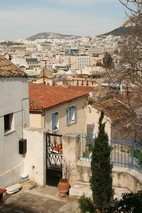
numerous tavernas.Some even manage to find the secluded Anafiotika,a maize
2of twisting streets,a village within a village nestling in a corner under the
Acropolis. The narrow Ermou Street and surrounding thoroughfares that wind
down from Syntagma Square to the old town form the city’s main shopping
precinct where some of Athens’ leading retail outlets are to be found. Several
quaint tiny chapels dating back to the Byzantium era punctuate the route,
dwarfed by their lofty concrete neighbours. They are regularly inspected by
curious tourists and devout shoppers. The former Royal Palace stands
magnificently in Syntagma, its robust proud countenance dominates the
square. Built by the first king of modern Greece, the Bavarian-born Otto, a
descendant of the ancient Byzantine emperors, the building is now where
Parliament meets. From the 1820s to the 1970s monarchs arrived and
departed with great frequency from.this Athenian addresss. In 1974 a
democratic referendum came out in favour of a republic which Greece has been
ever since. Although King Constantine and Queen Anna Maria, the last
monarchs, are long gone the Changing of the Guard can still be witnessed daily
outside the former Royal Palace. Syntagma Square, along with Omonia is one
of the nucleai of Athens. Its sister square Omonia, connected through the wide
boulevards of Stadiou and Panepistimiou ,has a degree of infamy for seediness
and in recent years has acquired even a reputation for being dangerous at
night, Syntagma ,on the other hand,enjoys a far more solubrious status
housing five-star hotels within its boundaries including the Grand Bretagne
where Sir Winston Churchill once set up temporary residence. Yellow taxis drop
off and pick up passengers outside its fast food outlets .Its peripteros decked in
the colourful garb of hundreds of postcards and magazines while trams and an
assortment of other wailing traffic flow past the cool shady palms of the
national gardens as they move gently at the suggestion of a breeze. The
weeping willows at the back of St Paul ́s Anglican Church keep their mournful
watch over Amalias Avenue as the traffic lights change to green beneath the
gaze of a crumbling 19th-century block of flats, its brown shutters broken and
its once noble exterior decayed and covered in political graffiti, the bare
stonework open for all to see as Athenians go hurriedly about their daily
routines. Gypsies beg on the street outside the Zappeion, a large public park
with a few upmarket cafés while outside the gates of the Parliament building a
woman in black yells out her frustration at the current economic crisis and on
how Greece should be governed, to bemused passers-by. A party of primary
school children pass through the coolness of the National Gardens on a daytrip,
a break from lessons. They chant in unison `Nero! Nero! ́- water, water,
followed by ́Koulourakia`- biscuits. They giggle beside the cool pond ́s shady
rill under the tall palm trees as they march along its sheltered paths. Waiters
stride aimlessly back and forth in the precincts of the nearby Oasis Cafe. Birds
3fly gracefully between the trees, they the garden ́s only permanent residents, as
the public wander in and out of this tranquil haven stopping at the café to sip a
medium sweet frappé - iced coffee. A stone’s throw away outside the former
palace, soldiers stand guard dressed in the traditional foustanella, complete
with tassled caps and shoes topped with blood red pompoms.
Athens’ classical shopping thoroughfare, Voukourestiu Street, lies further down
from Syntagma Square just off Panepistimiou. It rises upwards towards a steep
hill populated by high-end jewellers, Haute Couture and classy boutiques
among them an interesting collection of elegant, although somewhat sterile
designer shops. There is, unsurprisingly, a distinct lack of pricetags in the
windows. The street climbs further into the narrow, steep sidewalks of
Kolonaki,on the slopes of Lycavettus Mountain.The gentrified most exclusive of
Athenian neighbourhoods, home to Athenian old money and its aristocrats. A
lone ancient ruin – a small column – sits comfortably between the busy cafés
on Kolonaki Square and from which the name Kolonaki is derived. The
sulubrious elitist cafés, meeting place of Anthenian high society. The cool shade
of the café terraces, cloistered by the thick leaves that sprung from the
creeping branches of the nearby trees protect the clientele from the sweltering
heat of a midday sun. Ageing Athenians with political connections, former big
names in the music business and Greek cinema, former frequent guests at the
Royal Palace, all of them now elderly and frail. Old women in coloured cotton
suits, accompanied by their young Philipino maids, smoke dainty, lady-like
cigars. Portly and bald old men who once held a degree of influence and
power, drool over strong, sweet Greek coffees in miniature white cups, the
noisy ordinary lives of the every day Athenians around them ,a world away.
Nowadays in a more meritocratic, egalitarian society, to have money can open
many doors which were once firmly closed. The cafés, once exclusively the
domain of Athenian high society, now open to all who can afford to pay. The
once beautiful ,elderly aristocratic women, wrinkled and bowed, whose wealth
and status can no longer buy them beauty smoke and order more coffee. The
Café Capo rests on the edge of the square, Kolonaki’s most fashionable and
pretentious coffee house, a mecca for the cream of Athenian posers who clutch
onto bags with Cerrutti, Armani and Versace emblazened on them. It is a place
to people-watch,a ghetto of socialites, a plethora of celebrities -contemporary
Greek pop singers, film producers, writers,actors and would-be’s who come
here to be seen amid the bold and the beautiful on Glitteratti Street. Antiques
smile out of shop windows in the neighbouring narrow, steep streets .Every
where shoe shops.This area of urban chic boasts more than any other area of
Greece.while also in the vicinity stands the flat where the Duke of Edinburgh’s
mother sheltered Jews during the Nazi occupation. A hundred yards downhill
4on Skoufa Street the magnificent dome of St. Dionisis rises into the air as if it
were the Kolonakis’ guardian angel. It is entered from the street by an
impressive array of steps, its interior by far the most stunning of the multitude
of churches found in Athens whose current mayor happens to be an atheist,
born in New York. The church boasts a highly acclaimed Byzantine choir which
can be heard at the Sunday morning liturgy which is ususally televised
nationwide. The ‘Epitaphios’ procession on the evening of Good Friday winds
downhill from St. Dionisis along Panepistimiou and into Syntagma Square.Then
back up Queen Sophia Avenue ,the citys` most graceful street ,full of neo
classical mansions,notable museums and foreign embassies. At the centre is a
bier with an elaborate display of colourful flowers woven into it and in which is
carried the image of the dead Christ through the streets. Such processions are
enacted in every parish of this very Orthodox city . At St. Dionisis,however,
there is a more ostentatious manifestation of pomp and ceremony ,in
that,Christ is given a state funeral with the president and other state dignitaries
in attendance. Military bands accompany the route playing Chopin’s mournful
funeral march. Holy Week which climaxes into Easter, by far the major festival
of the magnanimous and exuberant Greek Orthodox Church, sees Athens
transcend into a location of peace and tranquility as Athenians abandon their
city homes and return to their roots in the mountains or the islands for the
celebration of the “Anastasi.” During Holy Week Athenian restaurants turn into
a gastronomic walhalla for vegetarians as menus fill up with delicious Lenten
fayre. The Anastasi, which takes place at midnight on Easter Eve, ends the
fasting of Lent as on the steps of churches throughout Athens the cry of “Cristos
Anesti!” – Christ is risen - is met with the reply ”Alithos Anesti!”- He is risen
indeed. Colourful fireworks fill the sky and glowing candles the streets ,as
Athenians scurry home for a post-midnight meal of patsas ,(a haggis type soup)
and bright ,red eggs. Athens returns to its manic self by the Wednesday after
Easter. It is again transformed into a haven of peace during high summer when
in August streets empty, offices close and shops put up their shutters as
Athenians leave the sweltering heat behind them and head for the Aegean or
the Ionnian sea Despite the high temperatures this is propbably the best time
to see Athens for what it really is – a beautiful city -devoid of any heavy traffic.
Greece,like Easter is a story of death and ressurection.After Greece’s
resurrection as a nation ,following the war of independance, the pleasant
coastal town of Nafplio in the Pelopponese was made the capital city of the
new Greek state in 1829. It remained so until King Otto moved it for emotional
and historical reasons to Athens in 1834, then a settlement of only four
thousand concentrated around what is now Plaka. Otto then commissioned a
group of architects to build a new stately, elegant city fit for the capital of a
5modern state. The outcome was an exceptional creation of classical orientated
edifices which apart from the old Palace and the Zappeion Exhibition Hall also
included the imposing University of Athens, National Library and the old
Parliament building which apart from the odd political graffiti are as pristine
and pleasing to the eye as the day they were built. Greeks as a people are
passionately political which has given birth to much graffiti, as much an
integral part of Athens as the Acropolis. The city’s population multiplied
greatly in the 1920s when thousands of refugees from Asia Minor poured into
the city following the sacking of Smyrna.,often resented by the locals. They
were followed by a host of other Asian Greeks as part of the population
exchange between Greece and Turkey in 1922. This had a massive impact on
the culture of Athens and gave rise to Nea Smyrni and Nea Ionia, two pleasant
Athenian suburbs that started off as little more than refugee camps.
The city’s population again saw a steep rise in the 1950s and 60s when mass
immigration from rural Greece increased. In the decades that followed the fall
of the Colonel’s dictatorship in 1974, an event that also had a groundbreaking
impact on Greek society, Athens grew in prosperity and developed a robust
confidence that saw a revitalised, renovated city that hosted the 2004 Olympic
Games and the 2006 Eurovision Song Contest .The Kalomarmaro Stadium
,located on Vasileus Constandinou Avenue,– the venue for the first Olympiad of
the modern era - observed the rise of the new Athens from opposite the
Zappeion, as it also witnessed its economic fall from grace in 2007.
The two main arteries that flow from the heart of Omonia Square, Acharnon
Avenue and Patission Avenue head towards the neighbourhood of Patissia.
Among Athens’ busiest streets both are filled with murderous traffic and lined
with shops and cafés. The historic, much scarred Athens Polytechnic lies a short
walk from Omonia, on Patission, a symbol of the price of modern Greek
democracy. It was here that in November 1973 the students barricaded
themselves inside the building in protest at the dictatorship. The brutal
suppression of this act by the military saw the beginning of the end of the
Colonel’s regime. The attractive National Museum lies in a spacious garden
further along just below Exarchia, an area much associated with anti-
establishment and leftist activity. Patission was also home to the great opera
soprano Maria Callas whose house can still be seen.A museum dedicated to her
is to be found in Gazi. Her rendition of Bellinis`Costa Diva, is still heard high
above the roar of the trams and buses. A short journey from Omonia, on the
excellent renovated Metro ,takes you to the working class suburb of Kato
Patissia, centred around Acharnon Avenue, a vibrant lively hive of activity, this
till recently predominantly Greek area ,where the music of Kazanjidis and
Marinella once blared out of quintessentially Greek cafeneions., Kato Patissia
6is now one of Athens’ most multi-cultural areas where you are as likely to hear
Kurdish and Punjabi being spoken as Greek. Here Athens faces a dilemma in
the definition of what constitutes an Athenian and what defines Greekness.
The thousands of immigrants who have swelled the city in the last twenty years
have often been blamed for the steep rise in crime. This has fuelled popular
support for the extreme right wing Golden Dawn Party whose activities led to
the government imposing an outright ban on the organisation in 2013.
Although crime has risen in Athens over the last twenty years it is still much
safer than many other European capitals and Despite its reputation Omonia
Square is perfectly safe during the day.
Kato Patissia’s Acharnon has a pleasant, unpretentious air about it and reflects
the Athens of the everyday average populace as well as the changing face of
the city. The upmarket suburb of Kifissia, at the end of the metro line,with its
graceful tree lined boulevards,the bustling middle class neighbourhood of
Pangrati, close to the centre and thecosmoplitan,southern, seaside suburb of
Glyfada ,with its marinas and beach clubs, are charming areas of the city,
worth a visit. From the hundreds of bakeries in central Athens drifts the
appetising aroma of a diverse range of pastries, for Athens is a pastry paradise
offering scrumptious spinach pasties, cheese pasties and the deliciously sweet
cream pasties powdered with castor sugar, - bougatsa. Athenians, inclined
only to have coffee at breakfast, ravenously tuck into them at bakeries and
take away shops for elevenses.
The electric current that revolves around this extraordinary city reflects its
people. Athenians are by nature passionate, critical, demonstrative,
argumentative and generous, They do not hide their feelings. Happy or angry,
they let it show. A stiff upperlip is not on the Athenian agenda. The Acropolis is
always evident throughout central Athens, Its giant blue and white Greek flag
blesses the capitals` inhabitants.The traditional historic symbol of this modern
city where in popular culture a broken-hearted Cliff Richard sang “The Next
Time” in the 1960s film “Summer Holiday”and Melina Mercouri was
disillusioned by the American Homer’s interpretation of the Greek myths in the
timeless “Never on a Sunday”. It is wise when gazing up at the Acropolis to
remember that in ancient times two Athenian citizens, who so much shaped
our own modern society, Socrates and Aristotle, once walked in nearby streets.
The highspeed ferries await you at the other extreme of the Kifissia metro line
in .the port of Pireaus where”Never on a Sunday “ was set .There, the azure of
the Aegean is your oyster.
78





a thought provoking literary premise, well done
please add more articles, maybe some poetry, perhaps snippets from chapters in your book.
the more items in your den you post the more likely readers will come to read
keep writing!!
m
Athens has, like Cairo and Rome, ancient ruins that draw tourist money. Other European cities like Paris, London, Berlin, and Vienna all have a cultural draw that is particularly intriguing to Americans. What all these cities have in common is that their local tastes in antiques, music, food and drink become prominent sources of tourist commerce, so vividly described in your account, neighborhood by neighborhood. Like all cities, they draw people from the countryside and immigrants from those displaced by political unrest to those seeking fame and/or fortune. This adds diversity to the culture and its richness.
For someone who would spend some time in the city, your article would serve as a guide for anyone interested in Athens beyond the ruins.
Ron