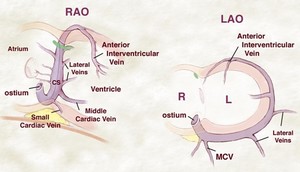
Coronary Sinus Catheter progresses slowly, often without symptoms.
Coronary heart disease refers to the narrowing of the inner diameter of the coronary artery plaque. The plaque is due to long-term damage to the artery chemical (cholesterol, diabetes, smoking) and mechanical factors (hypertension), which leads to inflammation and fat accumulation. As time progresses the process of plaque grows which reduces blood flow through the coronary artery. Blood vessels narrowed atherosclerotic plaque cannot supply the heart muscle sufficient oxygen, especially in the case of increased demand for oxygen as it is in physical stress or stress. Patients can feel like a dull ache in the heart, which is rated angina pectoris. Heart muscle that is not enough oxygen supplied weak function of coronary sinus catheter, which can lead to heart failure. In case the plaque ruptures, at that point in clots that completely interrupts the flow of blood which leads to the dying part of the heart muscle. Thereby, coronary sinus definition can be such – it is a heart attack, or acute myocardial infarction, which can lead to many complications and often death.
What are the symptoms?
Unroofed coronary sinus is a disease which progresses slowly, often without symptoms. The first sign of the existence of the disease are usually episodes of chest pain that can occur under physical stress, but also in the rest. The pain may be present in the form of clamping pressure and the lack of air, and can extend the arms, especially the left, in the shoulders, back, or jaw, may be accompanied by nausea, vomiting and excessive sweating.
How is it diagnosed?
If you have an increased risk of dilated coronary sinus and /or some of the symptoms mentioned above the first step in diagnosing cardiac catheterization, or load test. The test load is continuously recorded ECG loading was immediately after it, and record any changes that indicate the presence of coronary artery disease. Echocardiogram can also show changes characteristic of coronary artery disease. Holter ECG recorded rhythm disorders are often the result of coronary artery disease. In as much as these changes are, the next step is to coronary
angiography. MSCT coronary angiography is a noninvasive test that after administration of contrast medium into a vein in the arm showing coronary arteries.
What is coronary angiography and how it performs?
Coronary angiography is the most useful and important procedure in the diagnosis of disease of coronary sinus function because it allows the doctor to see exactly where the coronary arteries Coronary angiography is performed by first puncture or stings femoral artery located in the groin (usually puncture made in the right groin). After the puncture in the artery is introduced so. gland (a small plastic tube) through which the artery catheters are introduced. A catheter is a long narrow tube, which comes through the aorta to the heart or coronary vessels. The next step is the injection of contrast agent through a catheter which allows the coronary blood vessel narrowing and eventual display on the screen during X-ray.
What is the treatment of coronary disease?
Treatment consists of several different parts to combine and complement each other. General measures for coronary sinus anatomy:
All patients should stop smoking, reduce fat intake and alcohol, make sure that salt intake is within recommended limits, conduct regular physical activity appropriate degree of heart failure, maintain a healthy weight, reduce the impact of stress.
All patients require drug therapy.
In the first place it is necessary to hormonal treatment of risk factors: arterial hypertension (coronary patients must maintain pressure below 130/80 mmHg)
Source:
http://stop-sinusitis.net/symptoms/bacterial-sinus-infection-symptoms
http://www.wisegeek.com/what-is-the-coronary-sinus.htm
http://www.annalsthoracicsurgery.org/article/S0003-4975(00)01639-8/abstract
|