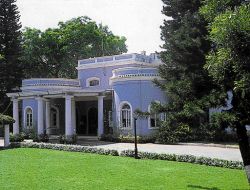
This is an article I wrote for a local newspaper about a prestigious recreational club in Bangalore,India.The Bangalore Club is one of the last bastions of the British Raj with its koi hai culture still intact.This club has a good history with some illustrious members like Winston Churchill and the Maharajah of Mysore.
The Bangalore Club, an important landmark on Residency Road turns 137 this year. It is considered to be one of the most exclusive clubs in the city, boasting of an impressive and chequered history dating back to the days of the British Raj.
The club was formally inaugurated in the year 1868 and known as the Bangalore United Services (BUS) club. Colonel RCR Hill became the longest serving president of the club(1942 to 62) and is considered to be the true architect of Bangalore Club.
He was solely responsible for changing the very character of the club from a services club to a civilian club in the year 1946. Membership of the Bangalore United Services Club was originally reserved for the British and was off -limits to Indian citizens. It was only after the club became a civilian club in the late 40's, that its doors were fully thrown open to Indians.
M Bhaktavatsala, former president and author of the book 'A Club's World' says, “The very first Indian who was invited to use the club was the Maharajah of Mysore.”Between World War 1 and WW2, the membership dwindled. To compensate for this, a decision was taken to admit ladies and Indians in the services to the club.
Illustrious member -
The most illustrious member of Bangalore Club, perhaps, was none other than Sir Winston Churchill. As a young subaltern, he was a member of the club for three years from 1896 to 1899. He left behind him a debt of Rs 13(about 25 cents) which was written off by the Committee as an “Irrecoverable sum”!
Colonial heritage -
The club prides itself on its distinguished colonial heritage. It is an oasis of serenity in an increasingly chaotic and commercialised city. The gardens with their trees, shrubs and well-manicured lawns are a beautiful sight. The main buildings including the Club House and the Colonnade, part of the bachelors’ quarters,the cottage which houses the present library and the racquets (the present squash) court existed in 1897. Says Bhaktavatsala, “In those early days the Club House was also used to play cards. The cottage was an isolated one and was called Dovecot.”
Library -
In 1899, the library was inaugurated in the Dovecot. An annexe to the Dovecot was built in 1907. Known as the Ball Room, it was the place for dances, cinema shows, magic shows, musical performances, flower exhibitions, private parties, and later on even weddings.
The club scenes of the famous British director David Lean's movie 'A Passage to India' were shot in the club.
Affliliations -
Few Bangaloreans are aware that it is the second oldest Colonial club in the country with many affiliated clubs in India and abroad. It has a total of about 7000 members, including permanent members, service members and others. The present waiting list for membership stretches beyond 15 years!
The library has been a focal point. Some of the books are well over a century old and fresh books are added every month. N Ramji, chairman of the library sub-committee, says that many programs are centred around the library.
“There are a variety of sports activities. There is a large air-conditioned gym which is one of the best equipped in Bangalore. The swimming pool and an all- weather tennis court are also very popular with the members,” says Mr Srinivasa Murthy.
|






I had to chuckle at that note about Winston Churchill leaving a debt there.
Ron