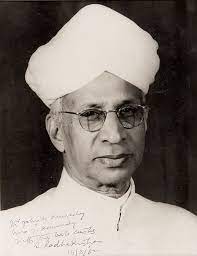
INDIA's PRIDE: The COLOSSUS who bestrode EAST as well as WEST. Even STALIN took his entire cabinet to bid him farewell.
HOMAGE to the truly great who can never ever be forgotten: Sir Sarvepalli RADHAKRISHNAN
HONOURS: "Bharat Ratna", India's foremost civil prize.
TEMPLETON PRIZE, amounting to £1.1 million in 1975, just before he passed away.
Honorary inscription in the "Order of Merit", Great Britain.
16 times proposed for the Nobel Prize in Literature and 11 times for the Nobel Peace Prize.
He led the Indian Delegation to UNESCO from 1948 to 1952, and was elected Chairman of the Executive Board for 1948-49.
Wikipedia: https://en.wikipedia.org/wiki/Sarvepalli_Radhakrishnan
INDIA's PRIDE: The COLOSSUS who bestrode EAST as well as WEST. Even STALIN took his entire cabinet to bid him farewell.
[And he's known (I don't know how far this's true ) to have patted Stalin on the cheek to say, "Now, you'll behave yourself, won't you!"]
The Great Man's last words to the young man were: "Just ponder why any people or any country is always remembered by their great poets, and it's the duty of these poets to behave in such a way as to not let either down."
HOMAGE to the truly great who can never ever be forgotten: Sir Sarvepalli RADHAKRISHNAN [1888 - 1975]
HONOURS: "Bharat Ratna", India's foremost civil prize.
TEMPLETON PRIZE, amounting to £1.1 million in 1975, just before he passed away.
Honorary inscription in the "Order of Merit", Great Britain.
16 times proposed for the Nobel Prize in Literature and 11 times for the Nobel Peace Prize.
He led the Indian Delegation to UNESCO from 1948 to 1952, and was elected Chairman of the Executive Board for 1948-49.
Wikipedia: https://en.wikipedia.org/wiki/Sarvepalli_Radhakrishnan
They said (the representative of those who had sent him on a mission to promote their publications): "Don't take more than five minutes of his time. He is sick and in bed. Prime Minister (Jawaharlal) NEHRU's personal secretary is here waiting to see him on urgent business. You see, he's India's SHOW-CASE !"
The young man, then, turned 26 had had the good fortune of meeting other intellectuals, other luminaries in the arts and academia, but never a man of his stature; a gentle but fearlessly outspoken philosopher, Spalding Chair of Ethics and Oriental Philosophy at Oxford University, 2nd Indian ambassador in Moscow, ex-Chairman of UNESCO in Paris, a Telegu Brahmin (midway between Aryan and Dravidian India in the Deccan) who studied and taught philosophy at Christian College, affiliated to the University of Madras, also taught at Mysore and Calcutta (King George the Vth Chair) Universities and served as the Vice-Chancellor of the famed Hindu University at Benares (as well as Andhra University), a man who was several times proposed for the Nobel Prize in Literature and also for the Nobel Peace Prize as a "Statesman", the first Vice-President (1961) and the second President of (Independent) India (1962) although he had never been involved actively in the independence struggle from Great Britain.
The young man hadn't even thought of how he should address the Statesman-Philosopher, so taken up was he at the occasion, so he said nothing as he brought his hands together and was told to set himself down on the high-backed wooden chair at the foot of the presidential bed.
The time was May, the monsoon season threatened rain but one felt not the stickiness for the windows lay trussed-up but partially open to keep the blinding light from reading eyes. A soft but now-and-then swirling breeze lifted and parted curtains at the entrance where the PM's secretary stood sentinel with a huge file held up against his hips. He was a southern Indian (Dravidian ?) Brahmin, judging by his attire: dhoti loosely-covering leather slippers and an over-hanging collar-less shirt with a nut-brown bead chain, his forehead and arms dutifully plastered with sandal-wood paste and vibhuthi (cow-dung ash) stripes with ochre kunkunum dot between his eye-brows. A genial expansive man who wished the young man diplomatically with other serious issues of State criss-crossing his mind - you wouldn't doubt, of course.
Sir Sarvepalli Radhakrishnan - he later discarded the Knighthood title bestowed by the British Crown - sat up, buttressed by pillows, fully-dressed with the distinguishing hallmark of his thalappa (head-dress) while some ten to fifteen books and files lay opened on the light white-like eiderdown or covered khadar-sacking cloth, framed by the out-pushing bed-posts gleaming with ochre-varnish. There was that calmness and rimless glasses which mitigated his obvious judgmental unwavering gaze over his magisterial nostrils as he made the young man feel at ease.
The first questions dwelt on his background - where and what he had been doing and where was he going to and for what reason. The five minutes were up and another ten were used up in the answers. His secretary made as if to enter the room to remind the high dignitary of the PM's secretary's mission.
"Tell him to wait," said the Vice-President. "Can't he see I'm talking to ........?" He uttered the young man's name in full. He had raised his voice to be heard outside, and the young man felt embarrassed taking up high-echélon étatal time.
"Bring your chair up to me here," he bade the young man, pointing to the left where the two of them chatted for another fifty minutes. An hour whisked past. What did they talk about. Well, about various matters, mostly about Nazi Germany and the role and contributions of Jews to science and thought and the ravages of War that countries and religious animosities accentuate.
Then, he said something that startled the young man. "I have had a couple of ministers from Malay(si)a who visited me lately. Quite frankly, I don't know what they were rattling about!"
Then, he looked at the young man without saying a word. It seemed for a very long while. The latter felt he had over-stayed his time and made as if to stand up.
"Wait a minute !," he said, and deftly pulled the couette aside and slipped into his leather slippers protruding slightly from under the bed. To the PM's secretary, he said, "Give ........ your number so that he can see the PM as well."
.......................................
Unfortunately, when the young man called the next day, the PM's sec. said, "The PM has to see an ambassador today. Can you call tomorrow again." [Was that because he was kept waiting on his feet for an hour and ten minutes?] The young man's plane was set to take off the same evening. In the morning, he had an appointment (arranged by the Vice-President) with the Secretary (Krishna Kripalani) of the Sahitya Akademi, the sub-continent's foremost storehouse of knowledge and achievement awards. A curious thing happened to the utter surprise of the young man. A young northern Indian-looking lady came rushing into the Secretary's office, half almost out-of-breath, and asked: "Where is he?"
"Who?"
"Gandhi," she said.
The Secretary gestured pointing his head towards the young man.
.......................................
The great man then took the young man by the arm and led him towards the front door. He made the young man promise to let him have a copy of the publication of his research, the result of his journey to Malaya-Singapore. [The President acknowledged receipt in 1964.] In the hardened mud patio only some shrubs and bare trees sprouted. Taxis, including two-wheeled ones, lazed, the taxi-men alerted by the presence of the Vice-President almost stood to attention in their khaki uniforms and khaki puttees and turbans. The white-wash on the walls of the compound showed stark and splashy. The young man was surprised to see that the two were about the same height. They were almost face-to-face.
"Do you think the English language will be replaced sooner or later by the national language ?"
"No, I don't think so," said the Statesman. "After a temporary period of hostilities against the British Raj, it will remain !"
[Reluctantly added scene]
Then the two shook hands. The young man descended the frontal steps and made for the taxi near the gate. Just before entering the opened door, he turned to look at the building he had just then left. The great man stood at the entrance waving to him until the taxi pulled out into the street and away.
(c) T. Wignesan - Paris, March 16, 2023
|





As for Monseigneur's comments - as usual we are regaled to other personal "histories" - with not so much as a word about the Great Man which is what the article is about (Does it really matter WHO the "young man" is or was ???) - while this sentence: 'I never fully succumbed to magnetic personalities like so many others do.' hits below the belt - Monseigneur must concede. I do hope the World will remember you forever for your brilliance. Best. Sleep well.. TW
My meeting with Martin Luther King was only from the balcony above with about 30 feet distance as his bellowing voice without a microphone, I seem to recall, very soon, as it droned along, had me in his grips as someone who would follow him to the death. But of course, I didn't. I never fully succumbed to magnetic personalities like so many others do.
Ron