A Composer's Journal Entry, November 14, 2007 by Laurie Conrad.
Laurie Conrad is a pianist and composer living in Ithaca, NY. Some of her honors include: Who’s Who in American Music, The International Who’s Who in Music (Cambridge), The International Encyclopedia of Women Composers, Who’s Who in American Pianists, The Dictionary of International Biography and Marquis’ Who’s Who in America.
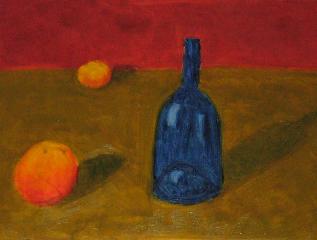
Image: A Painting by Mark Gould.
Wednesday, November 14
Received an e-mail from Mark Gould today:
Mark: Hello Laurie!
pressure of work and my illness has not meant I have been able to spend much time in front of the computer. Today, I have been catching up with all my emails and other messages.
I see I need to answer your questions, so here are my best replies...
LC: Could you further explain this "special scale" and "This scale is derived analogously to the diatonic scale, and it even has a triadic harmonic structure, but the triads here are very different from those of out heptatonic diatonic." Perhaps give us the intervals of this special scale, or the pitches?
Mark: I can do this, but I need to digress briefly into a means of measuring pitch using a kind of graduated ruler. Suppose every one of our semitones is divided into 100 parts. An octave will then contain 1200 such divisions. As there are 100 of these divisions per semitone, they have been named 'cents'.
Written in cents, our semitonal scale runs:
0 100 200 300 400 500 600 700 800 900 1000 1100 (0 = 1200 cents)
suppose however we divide the octave into 19 parts. We can divide 1200 into 19 parts, to give the markings along this graduated ruler:
0 63.158 126.32 189.47 252.63 315.79 378.95 442.11 505.26 568.42 631.58
694.74 757.89 821.05 884.21 947.37 1010.5 1073.7 1136.8
As you can see there are pitches that correspond to the notes of the diatonic scale (I round these pitches to the nearest whole number of cents):
0 = C 189 = D 379 = E 505 = F 695 = G 884 = A 1074 = B
So 19 notes to the octave can be used for ordinary music. But not twelve-note music as we now have two separate notes between each tone:
0 = C 63 = C# 126 = Db 189 = D
So In this tuning we no longer have enharmonic notes, they are separate pitches.
The scale I used in my four pieces is quite different. It is as follows:
0 126 253 316 442 568 695 758 884 1011 1137
Writing this using the numbers from 0 to 18 (like we use 0 to 11 to indicate the twelve notes used in twelve-note music theory) :
0 2 4/5 7 9 11/12 14 16 18
I have put '/' marks in the scale above where the analogue of the semitone occurs in this scale, you will notice that this scale resembles a diatonic scale, but as if the region from F to B is repeated.
This scale can be transposed to all nineteen other degrees of the 19-note system, by the interval of 7 steps. This is the analogue of the cycle of fifths. As a result this scale is also represented by a 'circle of fifths'. We could write out a special stave and write music with up to eleven sharps or flats. In interesting if daunting project.
My four pieces were composed in this eleven note 'diatonic' scale.
I apologise for this digression into microtones, but I have found the idea of using new intervals and pitches a continual fascination throughout my composing career.
As for the twelve-note technique, I will think some more about my proposal to discuss the novel pitch combinations and how composers react to them.
all the best for now and hope your recovery is swift. I may be returning to the piano trio soon, so get my spring sketches into shape. I end with a painting I did earlier this year, simplistic but I hope you won't object.
Mark
LC: Thank you Mark, for this very interesting and clear presentation of microtones. I assume that the scale is broken into 19 parts to accommodate the enharmonics?
I love your painting!
As for 12 tone music: in my view, the true potential of 12 tone music is still largely untapped. As it is now: it would be as though we composers defined, confined all tonal music to the C Major scale and a few chords. In its purest form, 12 tone music, the form itself is so difficult to use - that most composers just gave up on it. They found it too mathematical, too constricting. But in essence, 12 tone music is really no more mathematical or constricting than the rules of Gregorian chant, or modal music - or many of the forms used in the Renaissance, for instance, the many-voiced fugues. Or "My End is My Beginning" sorts of pieces, the mental musical gymnastics of the Renaissance: in this case, where the piece was exactly the same whether played from the beginning to the end - or from the end to the beginning.
What makes 12 tone music so difficult, as a compositional system, is its very premise: that no notes be repeated until the entire 12 note row has been used through. As you and I both have pointed out in our various ways: what does the composer do about the potential resulting chaos, and the potential unruly, unwanted dissonance. This is where the skill and the imagination of the 12 tone composer is tested. And to be truthful: most composers have failed the test.
As I have said in the past, as I grow older, I break more rules - I set up the row in a more tonal way, I allow doublings, I repeat phrases But even when young, and working with 12 tone in its purest form: I still found ways to use the 12 tone system to bring Beauty and Order to the music I was writing. Even when I was setting up the row more melodically, rather than harmonically - and very chromatically. The composer only needs to listen. After all, we composers tell what tones where to go and when - they do not dictate their lives to us ... And if well done, I still cannot think of a more rarified air than 12 tone music, where all tones are honored, where all fragments of the prism are allowed to shine, in order, represented in turn, enlarging the harmonic and melodic horizon into infinity ....
Best wishes to you dear Mark
Laurie
|