View this Article
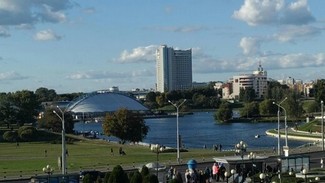
This article falls somewhere between travelogue and historical sketch, focusing on the culturally-rich city of Minsk, where the Lubavitcher Movement of Judaism finds its origin.
In September and October of 2018, Minsk, the city where Lubavitcher Judaism first emerged, played host to the “Belarus and the Bible” exhibition. As part of Dr. Scott Carroll’s Inspired Exhibit staff which runs the exhibit, I was able to be in that city which many Jews consider a pilgrimage site during Belarus’s national Jewish Heritage Celebration. Hearing familiar Jewish music playing throughout square where Soviets had formerly conducted government meetings, I was verklempt. The foods were quite familiar too. The leading rabbi introduced himself extending a plate of challah. The hotel restaurant featured an entrée called "draniki so syemgoi" which was basically latkes with lox.
The Jewish community was very welcoming to this exhibit of nearly 200 Biblical manuscripts, representing both the Tanakh and the Christian Scriptures, with many not only attending the event and its opening ceremony, but also promoting it at the Jewish Heritage Celebration which occurred just a few days ahead of its opening. The exhibit was the most highly-attended in the history of the National Library of Belarus where the exhibit was displayed to nearly 30,000 visitors in the span of a month.
The city, for those who haven’t been there, boasts a population of approximately two million. For such a large city, it is remarkably clean; never once did I see a single bit of litter on the ground. It is also among the friendlier cities I have visited. The word I heard most often in Minsk was “pajaluista” (please). Everyone you cross paths with greets you with a cheerful “zdraftstvuitie” (the Russian word for hello) or “privuitanie” (the Belarusian word), and never once did I board a subway car without having someone stand and offer me a seat. For me, this was very foreign to my usual experience, as I wear a kippa and tzitziyot whenever I am out. At home, this is frequently greeted with hostility and sometimes even violence. This was never the case in Minsk.
Belarus has a violent history of its own. It was part of what was called during the Holocaust “The Pale” – a region where some of the worst atrocities of the Shoah occurred. Some 246,000 Belarusian Jews, about 66% of the pre-war Jewish population, perished in The Pale. There is a monument to the victims at a site called “The Pit.” It depicts a line of emaciated Jewish prisoners being marched down into a pit, presumably a mass grave. How humbling for the Belarusians to present such a memorial to one of the darkest chapters in their history – and its location is a quite prominent one, within walking distance from Minsk’s most exquisite hotel.
Though the nation of Belarus has been independent of Russian/Soviet rule since 1991, the memories of those dark times are still everywhere memorialized. The former KGB headquarters building still towers over what is now called “Independence Square.” The post office in Minsk is on Sovietskaya (Soviet) Street. Downtown, there is still a Lenin Street and a Stalin Square. But one of the old Soviet presidential palaces, though still standing, has been transformed into a ballet school, and behind a statue of Stalin, an avowed atheist, stands a beautiful cathedral. This is a people that has vowed to never forget those events… but also to never again be defined by them.
Visiting Minsk was one of the mountaintop experiences of my life. As I was introduced to the Jewish community by one of the rabbis, I was frequently thought to be from Israel until I explained, “Ya iz SHCHA - v’Amerikania” (I am from the US). Even after making myself known as an American visiting with the Inspired Exhibit, I was warmly welcomed, because a Jew is a Jew, even when affiliated with a Christian organization. In fellowshipping with the Jewish community of Minsk (which is mostly Lubavitcher), my Jewish identity has been forever expanded and heightened. Another piece of the Jewish soul within me has been awakened, and I have a renewed and reinvigorated connection to the global Jewish community.
© 2019 by Brian Tice
|


In this case, cooperation between Christians and Jews is most enlightening and welcome.
Ron