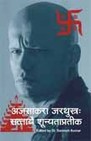
AZSACRA ZARATHUSTRA, a well-known Russian philosopher and poet-mystic, is accustomed to offering his readers and viewers an altered shade of existence. In his works, Azsacra, described as the Master of Death and the Emperor of Horror, challenges us to find the light and direction in his work, guiding us to liberation far removed from the accepted sunny approach normally adopted to inspire awareness… maturing us instead to emancipation through life’s darkness.
Staying in tune with his namesake Zarathustra, a Persian prophet, and philosopher born between 18th and 10th century BC, Azsacra Zarathustra continues to provide strongly dualistic contemplations in his poems, compelling readers to make a choice between good and evil. Extending even further, Azsacra invites us to consider beyond dualism, making his work unique. Zoroastrianism—a religion ancient philosopher Zarathustra inspired, was one of the first religions in the world to make ethical demands on believers… Today, contemporary Azsacra Zarathustra invokes similar responses, building deep reactions in the reader that immediately acquaints one with moral feedback that reveals the true state of one’s heart and mind, which then moves us to even deeper insights into nature, life, death, and us.
The first page of America, book one of Azsacra Zarathustra’s ‘Symbol of Nothing to Power’ instantly hits the reader with surreal imagery invoking an understanding that one is in for a unique and mind-blowing journey. Despite experiencing blasts of uncomfortable metaphors within Azsacra’s ‘Horrific Honey of Poetry’, I also discovered pearls that make me smile.
God is obsessed by
the beauty of face of
rat
The rat is considered by many to be vermin, provoking instinctive reactions of repulsion in many people. However, I am far-removed from that response, being a proud owner of an adorable fancy little rat named Gorgeous. Due to the light her simple and precious presence has brought into my heart and home, I strongly identify with God being obsessed with the beauty of a rat’s face, and delight at Azsacra’s acknowledgement of the rat’s perpetual soul and inherent part of nature, expressed by the dew welcoming a drop of rat’s milk.
Chapters such as True Spring and Unseen Resistance bear powerful poems, compelling one to quieten the mind and then search for the meanings Azsacra attempts profoundly to impart…
be beaten up
instead of
beating up
Within these chapters, and throughout many of these pages, Azsacra writes about the void, rebirth, betrayal, war, confronts indestructible death, and so much more. He explores suicidal self-harm, ascribing that to kill is to learn, yet ending with the reassurance that one could never, never kill the world! Azsacra often displays existential nihilism, seeming to suggest that life has no intrinsic meaning or value, also offering epistemological nihilism by denying most of our commonly held knowledge about life and our existence. Yet, because he proclaims darkness with such intensity, light often pours through his words in contrast!
FIRST INSPECTION of the second book, Bible of Nothing, Bible of Emptiness containing over 1000 blank pages, may invoke one to consider the author grandiose for employing such measures to impart his message. However, in the initial 14 pages before the expanse of empty pages of Azsacra’s mammoth book engulf the reader, statements play on the mind inciting deeper deliberation.
Absolutely there is Nothing existing, but Nothing to Power
Absolute Power in Indestructible: Supremacy as Emptiness to Power is Power as Nothing is to Supremacy
In the above examples and others not shown, as well as within the many empty pages following, Azsacra invokes us to think through his word play, inviting us by his regular use of Nothing, to understand that ‘Nothing destroys all conceivable and inconceivable limits of rationalism and irrationalism’. Azsacra describes Nothing to Power as a simultaneous destruction of the top and the bottom, domination and anarchy, order and chaos. The confines of the world as we know it disappears.
Working with what is described as a Sword of Absence, Azsacra believes ‘each concrete and absolute law should be violated and killed withNothing to Power and Emptiness to Supremacy’. He describes using the ‘Secret Power of the most hidden forces, superiorities and predominance, such as Non-being (bravery), Non-existence (boldness), Absence (courage), Emptiness (determination), Nothing (courage)’, which are keys behind many of Azsacra’s poem throughout all the books in ‘Symbol of Nothing to Power’. Azsacra affords us further insight into his mind and writing motivations when he states, ‘The superior purpose of the “Buddha before Buddha”—is the fourth (truthful) turn of the wheel of the Dharma which will proclaim the arrival of Nothing to Power and Emptiness to Supremacy. There is nothing “existing”, except Nothing to Power.’
Continuing to contemplate Buddha’s wisdom, let us consider the following statement, ‘We live in illusion and the appearance of things. There is a reality. We are that reality. When you understand this, you see that you are nothing, and being nothing, you are everything. That is all.’ Buddha’s philosophy supports Zarahustra’s efforts to expound the empty phenomenon of all things in the Bible of Nothing, Bible of Emptiness…
Azsacra shows he is free of reticence, as page upon blank page within this book denotes the extreme anti-thesis of reserve by an uninhibited author, as he dismisses prospective backlash from all fronts, even the modern day conservationist—of which I am one, bravely utilising bare paper from the world’s precious trees to impart his message that there is nothing existing except Nothing to Power. Azsacra’s bravery has roused mystical contemplations about hidden and indescribable truths of life… his teaching could not be imparted in a more powerful, authentic way!
AZSACRA CONTINUES to expound lurid poetry distinct from today’s generally accepted platform of poetry aiming to penetrate life’s illusions in book three, Tao Kampf. In Tao Kampf, bearing a title that translates to something kin to God’s Struggle or Struggle of the Way, calls upon the reader to continue expanding the mind to consider life, death, and all that’s hidden in an entirely diverse way.
exactly the Dark
conceives
and bears
the Light
the Black
just strengthens
the White
Within this chapter aptly named, INDISCERNIBLENESS, Azsacra continues beyond the above excerpts to offer a simpler description by Chinese Taoist Philosopher, c. 600 B.C.E.Lao-Tzu: ‘the black is just – the white’. Lao Tzu’s philosophy of ‘The truth is not always beautiful, nor beautiful words the truth’ wraps reassuring wisdom around Azsacra’s words, encouraging us to persist in delving deep to uncover Azsacra’s message and illumination.
Despite rousing the reader with metaphors of terror, death, beast, the void, a lesser god, torture, knives, revolvers, and cruelty to self throughout Tao Kampf, Azsacra fuels us with one liners such as: God is alive; the Sky without tears –; everything is – God!; I don’t die. He also offers lovely visions of mind-bending, metamorphosis manifestations in the Illusions chapter:
flies around the worm
but seen is
the butterfly
abrupt blow of the dandelion
scattered the wind
In the Son of Tao chapter, Azsacra reveals the motivations behind his apparent quest to shock and alarm, declaring his allegiance with higher forces destroying the lower: Light killing light; Darkness killing dark; Spirit killing spirit. When the greater power overcomes, when the higher Self conquers lower self, only then will Azsacra acknowledge that he is the Son of Tao, Son of the Way, Son of God.
that Light,
which will kill
the light - I'll name
My Father
that Dark
which will kill
the dark - I'll name
My Mother
Azsacra concludes Tao Kampf with a warm dedication to Dr. Santosh Kumar, the editor of publishing house Cyberwit, in a chapter entitled Grasshopper or the Great Ending of The End. The following excerpt is slightly condensed:
Between
leap and
flight
the grasshopper ...
lit up as ...
the Sun
now -
his field
won't die
RAVENS, SPARROWS, LIZARDS, spiders. Moths, butterflies, geese, dragonflies, tigers, and rats. Azsacra’s final book The Lotuses of Evil in the Symbol of Nothing to Power is a flurry of nature allegories. The wolf, and the worm, the panther and the bee, and more, all find their ways into these pages, together with a flux of flowers and petals, roses and thorns. Sunbeams and Spring Streams, orchids and snowflakes also rest with apparent comfort until the reader again is affronted with a quest to attune one’s discernment.
the dust is blown:
the dead butterfly looks
through the glass
The above is a gentler example of Azsacra’s eye-opening poetry, resolute in guiding one to see beyond the standard filter of life experience and perceptions about life, death, God, Buddha, philosophers, poets, war, and revenge, and so forth. Shining through many is his empathy for perspectives people rarely consider:
no one feels sorry for –
the spider that bit
the child
Revealing again an affinity with higher forces destroying the lower, Azsacra pens the following:
the Poison outside of
the poison Kills
Absolutely
On many occasions, Azsacra employs upside-down, converse prose that gives the reader instant clarity:
the Abyss
falls
in Itself
at the
reflection
aims the mirror
the liberation
of the sting from the shape of
the bee
And, he often affords the tiniest aspects of Nature most powerful impact:
the hurricane
recoiled from
the danelion
the drop of dew
revived
the rain
the snail
passed ahead of
the swallow
Yet, I cannot dismiss providing examples of Azsacra’s controversial writes located glaringly amidst many of his pages.
Brahma
chooses
collapse
Nirvana
begs
for death
Paradise
demands
its downfall
Again, I have selected more benign examples of Azsacra’s works. In Avenge Me, the last chapter of The Lotuses of Evil, Azsacra continues his reign of combating death, asserting fearlessness over his demise, his quest to live fully by freeing himself from the root fear of death hampering the moments of many humans:
to wish
not to survive
too strongly
to pull
the gun
trigger
.....
avenge
me
DUE TO THE INTRINSIC ONENESS, combining the ying and yang of all things, it is our mission to penetrate philosophical wisdom within Azsacra’s writings. Utilising anti-philosophy to reach the world and abruptly awaken humans from living as a cattle of non-thinkers ever fearful of death, and to overcome traditional nihilism, Azsacra states, ‘If you can't teach anybody to fall, you will transform him into carrion!’
He also affirms, ‘I do not teach a primitive replacement of one human rule by another, which could be even more human, but the most severe capture of absolute superiority through Nothing to Power and the statement of total prevalence through Emptiness to Supremacy. That means: one having ears and finding them already cut off’.
Throughout Symbol of Nothing to Power Azsacra highlights the fact that although the mind is able to become God, our bodies will always remain destructible. Invoking us to think dangerously—as an original thinker, Azsacra fervently inspires us to be fearless of death, ‘Do not recede even if someone is going to shoot with a revolver at your head’. He advocates that the body should be ready for the most terrifying truth—‘the Absolute Rupture of Spirit!’, stating that it is necessary to rise up to the Highest Tops of Death where the relentless Spirit breaks away from “everybody” as being “too human”’.
I HAVE REACHED a mystical, numinous end of what at first appeared a sombrous expedition exploring the mysterious caverns of Azsacra’s mind through his prolific poetry, surprising myself when such alternative means woke me with resounding mind-altering realisations. I bow to Azsacra in gratitude for developing my mind and thickening my skin in such pragmatic yet controversial ways poetry rarely dares to attempt!
If I was discussing the contents of Azsacra’s mind with Azsacra himself, I believe he would convey that his insight is existential. Ego dissolved, he would add that the man speaking in it is not speaking as a mind, not speaking as himself either; he is just an empty passage for existence itself to say something through him. In the words of Osho, ‘That’s how the great mystics have always lived and spoken. These are not their own words – they are no more. They have disappeared long before; it is the whole pouring through them. Their expressions may be different, but the source is the same. The words of Jesus, Zarathustra, Buddha, Lao Tzu, Krishna, Mohammed are not ordinary words; they are not coming from their memory, they are coming from their experience. They have touched the divine, and the moment you touch the divine you evaporate, you cannot exist any more. You have to die for God to be’.
the rat opens
its third
eye