"We have two ears and one mouth so that we can listen twice as much as we speak." ~Epictetus
What Is the 70/30 Rule?
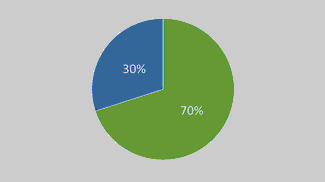
The 70/30 rule is simply a ratio applied as a rule of thumb in some areas of our lives where it has proven useful.
70/30 Rule Applications
Sales is probably the most popular area the 70/30 rule is known and applied. But there are many applications where it has proven helpful. Here are just a few:
Personal Finance: Live on no more than 70%; Give back, invest and save at least 30%
Losing weight: Based on 70% diet; 30% exercise
Marketing on social media: Provide value to potential customers and support others at least 70% of the time; Promote yourself no more than 30%
Fundraising: At least 70% of funds raised is used for charitable programs; Cost to raise funds and administration is no more than 30%
Sales/Communication: Listen at least 70% of the time; Talk and ask questions no more than 30%
70/30 Rule Applications for Small Group Leaders
I like the application of the 70/30 rule for communication. Small group leaders can use it to quickly assess if they give group members adequate time to talk.
The 70/30 rule for communication is supported by The Ken Blanchard Companies. Also, they have developed two more 70/30 rules based on their extensive research on learning and team dynamics. I believe these rules should be considered for small groups.
Below are the three 70/30 rules from The Ken Blanchard Companies. I have revised them to apply specifically to small groups and the small group leader. If you want to learn more about these three 70/30 rules, go to http://www.kenblanchard.com/Leading-Research/Research/Innovations-in-Learning-Design-Learning-Experience.
Listening
Small group leaders do 70% of the listening and 30% of the talking.
Ultimately, the purpose of the small group is about the transformation of members to be more like Jesus and fully live as God intended. It is not about the leader. This transformation is more likely to occur when members actively participate in their learning. That can't happen when it is a one-way "conversation" from the leader.
Read From Distracted to Active Listening about the importance of properly listening to your group members.
Preparation
Small group leaders use 70% of their preparation time on HOW they are going to share information and 30% on WHAT information they are going to share with their group members.
Small group leaders need to spend time and energy creating one or more interactive activities for each meeting which allows the members to practice what is being discussed.
Read Shake Things Up with Experiential Learning Activities about the importance of using learning activities.
Activity
30% of the Bible study time is spent learning and 70% is spent practicing what was learned.
Don't short change the time members can spend doing interactive activities with the other members. It won't matter what information is shared, if it is not remembered or applied once they leave the meeting. These activities reinforce the lessons learned so they are carried out and applied in real life.
Question: Which of these 70/30 rules will you start implementing in your small group leadership? What benefits do you believe will come from it?






But, I did take some graduate courses in sociology and psychology where I learned that studies prove that in small groups the leader was usually the one who talked the most. And, unfortunately that is what happened in many small ad hoc groups that were formed to solve problems during my career. These loudmouths would take the pulpit and convince everyone they knew the right way to go. I would sit back and quite often contradict their dictatorial approach with leading questions. Many of these loudmouths were bad leaders but were allowed to lead anyway.
I don't think our president elect ever listened 70% of the time and talk only 30%. And he is about to lead a very large group of United States citizens.
Ron