That didn't exactly happen in my case. I have to give credit to the surgeon who saved my life. For without the surgery, I wouldn't be writing this. I had a flu. The first night I had a strange fever but slept. I sweat all the time from dysreflexia when I urinate, so that's normal. But on the second night, I woke up in a sweat that completely wet the bed, something that never happened to me before. During the daytime I was better, but Friday came and went and I didn't call the doctor, treating myself with lots of liquids, rest and keeping warm––my usual routine. By Saturday morning I had a sharp pain in my chest when I coughed––something I've never experienced before––and I became worried that I had something serious but no way to get a hold of a doctor on the weekend.
I also had the concern that I didn't want to go to a hospital bed where the staff did not understand my spinal cord injury and quadriplegia. I had three choices: go to a renowned spinal cord rehabilitation center near downtown (or its owner hospital), the hospital within my insurance network, also near downtown, or a hospital nearby close to where Beh has her shop. I called these locations on Monday for half a day, but could not make any real contact with doctors or nurses that could give me good advice. Finally, after much thinking about it and discussion with Beh who didn't know how to go to the other hospitals, I elected the local hospital where I had been a few years before and had minor surgery lasting two days.
The next morning, I drove myself and my helper to the emergency room. I didn't want to leave my wheelchair behind. Unlike many hospitals, they took me in immediately and begin diagnostic tests. I was in a hospital gown and Beh had taken my clothes and billfold when the insurance man came around. That became an annoying problem later. By noon, I was in a room, being hooked up to monitors and given oxygen. I wasn't feeling very well, so food came and food went without me eating it. The nurses seemed too busy anyway. One male nurse said that he would have to get me a replacement for the all-in-oneTV control, phone, and call button speakerphone because I couldn't push the buttons. I never saw him again. This often happens with nurses on rotating schedules.
There were many doctors. First, there was a primary doctor in charge of my care who seemed mostly interested in smiling and telling me that everything was being taken care of. And then I had doctors for my lungs, vascular system, heart, anesthetics, and who knows what else. I was carted in and out of the room for two days until a diagnosis was reached: a blood clot in my left lung, and E. coli urinary tract infection, and pneumonia in my right lung. These were being treated with antibiotics and a blood thinner. All this was fine and dandy, but I got worse and they increased my oxygen each day.
The oxygen mask was difficult because it often moved to where it was ineffective, made it hard for me to talk, and sometimes became quite annoying––an itch I couldn't scratch. I got very cold, so nurses and helpers piled on the sheets and blankets, tying down my arms and making it impossible for me to move. Periodically, I would call out for some small thing for a very long time until someone in the hall heard me. Having the door open to the hall often let the December cold into the room.
I started to eat, and my nurses, nurses aides, and helpers were most willing to feed me since I was tied down with IVs, monitors, etc., making it impossible to use my hands. If they didn't do it right away, my food got cold. The hospital food was quite good, actually, so I ordered and ate too much in an effort to stay strong until I was told to quit, prior to surgery. I had my night time helpers come in because I knew the nurses wouldn't come to my call. I scheduled my bath and my bowel movements during this time because during the day it was virtually impossible.
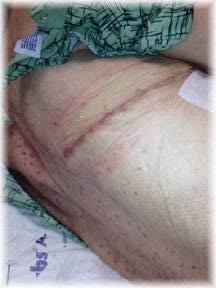
Two days after my diagnosis, they stuck a needle in my back to drain my right lung. It wouldn't drain. The infection, described by the surgeon as “chunky junk,” would have to be removed some other way. I discussed surgery at length with the sympathetic lung doctor. He was quite concerned because my original spinal cord injury was caused by my reaction to anesthesia during exploratory surgery. I told him to go ahead with surgery if that was the only way that the infection could be removed. I developed a rash that can only be described as looking like smallpox on my back.
I got a call from the business office (the nurse had to answer and hold the phone). They wanted my insurance card. I told them that Beh had it. They told me to put it in the bottom drawer of the dresser to be picked up the next morning, and we did. The lung doctor came in every day and began to worry along with me as I gradually got worse and had more difficulty breathing. Why had the surgeon not scheduled me for surgery? Finally, one week after I entered the hospital, I entered surgery late in the day, willingly because I knew I didn't have many more days left without it.
Fortunately, the surgery went well and I woke up in ICU breathing on my own except for oxygen and feeling quite good. Except for the first night when Beh stayed with me all night, I had no helpers at night in ICU and found myself calling out for a very long time… one time for two hours because I watched the clock, before I got help from a male nurse. ICU was more confining and the second night, after a sleeping pill made me, “loopy,” I was not allowed another sleeping pill and spent the entire night awake looking at the clock. By the third day in ICU, my nurse took away my oxygen and I was very happy. She also offered a bed that turned into a chair. After two days of torture on that device, I requested that I use my wheelchair to sit out during the day and it was allowed. One day the nurse came with my insurance card, found in my old room. Beh½ finally took it down to the business office so that I wouldn't have to pay the bill myself.
The only way that I could transfer to and from my chair was with the help of Beh. If she wasn't there, it took at least two people, sometimes three, to jerk me all around and pull out my connections as they forced me in and out of the wheelchair. While I could sit up and watch endless reruns on TV, I couldn't answer the phone, talk on the phone, or exercise like they force most patients to do. The confinement got to me. It was like being in a straitjacket all the time. All I could do was elevate my feet and lower my back on my wheelchair to keep from having pain from pressure that often occurred until I moved. Finally, fifteen days after I entered the hospital, they brought me a big gray button that I could push with my elbow to call the nurse. That was a big improvement except I felt bad about having to call the nurse for water, to adjust my covers, scratch itches, and change the TV channels.
It took fifteen days for my lung to completely drain after the surgery. The blood clot was gone and so was the urinary tract infection. Filters placed in my veins to my heart would eliminate any future blood clots from reaching the heart, lungs or brain. My rash continued, but it was held back by cortisone creams. I seemed to lose strength every day although I ate so much I got constipated and had to use a laxative for the first time in my life.
Finally, after twenty-two days in the hospital I got home and discovered that I had lost considerable muscle and some weight. Now, a month after I got out, I'm just starting to get back where I was before I got sick. I get a lot more exercise here at home and it's helping me recover. My lungs seem to be operating quite well and I'm sleeping without pain pills and sleeping pills, although I sometimes have violent spasms and pain in my left knee that fortunately don't keep me awake for long.
Dr. Nosek was right, hospitals can kill us. The best way to recover is to leave them behind as soon as we possibly can.
Copyright 2013 © Ronald W. Hull
1/24/13












powerful read, glad it culminated in your return home
m
Regis
Anna
Love ya!
Jane