A true story…
The year was 1997. The Internet was just beginning to come into public use after being part of academic and government use for a few years before. The idea of a hacker stealing one's identity on the Internet had not even surfaced yet. But there was concern if someone found out your bank account, your Social Security number and tax records, your medical health records and others. Those could be used for extortion or ransom in the case of kidnapping or other crimes.
All I lost was my billfold with all my basic papers in it. My credit cards, my Social Security card, my health insurance card, a small amount of cash that I carried in those days, and other information that might have been useful, like my driver’s license. All that thieves generally wanted from a lost or stolen billfold was the cash and then, would dispose of the billfold where it might be found or not, like a trash bin.
For 40 years, I carried my billfold in my back pocket, sitting on it and giving it a kind of crushed curved appearance that was rather pleasant. My papers inside also accommodated that curve. In all those years, I never lost it, misplaced it, or got it wet. Except one time, when on a trip, I left it on a dresser at a friend's house in Louisville, Kentucky. I stayed overnight there after a long and difficult drive in deep snow at times from Nashville. I got there late and exhausted. I slept deeply, and, as a result, overslept my normal natural wake up time, 6 am. My host and his wife had both gone on off to work, so I hurriedly got dressed and left the house about 8 am.
I drove north about four hours until I was getting low on gas near Indianapolis. I stopped, got a cup of coffee, and ask the lone attendant to fill my tank with gas so that I could make it past Chicago. When I discovered that I didn’t have my billfold and no credit card or money, the kindly attendant trusted me to go back and get my billfold. It took me about eight hours of additional driving, but I returned to my friend’s house, retrieved my billfold, drove all the way back to Indianapolis, paid the same attendant for my gasoline and had him fill my tank again. All I lost that time was time and the money for an extra tank of gas.
But this time it was different. In December 1994, as I was driving home on my usual 20-mile commute on the freeway to my home to begin the Christmas holidays, I arbitrarily decided to stop driving. My gradual paralysis creeping into my four limbs was making it harder for me to lift my right foot from the gas pedal and put it on the brake. I couldn't substitute my left foot because for some time, I wasn't able to lift my left foot to the brake pedal at all.
Two years before, I had stopped trying to walk the hallways at work reaching for the wall to keep from falling. And had been given a scooter to use that I parked in the utility breezeway overnight and then brought my car right up to it every morning. Opened my car door carefully and transferred from my car seat to the seat of the scooter. And then reached for my briefcase in the backseat and placed it on my lap on my scooter to enter the building by pulling on the heavy door on a short concrete ramp that the school had built for me from the breezeway to the hallway.
Each evening, I would park the scooter next to my car door, open it, swing my briefcase behind the backseat, and climb into the driver’s seat. That system worked well for me for two years, but I knew that I had to do something more drastic. About three months before I started to take Metrolift, a service using large vans that carried up to 10 people but rarely did. They picked up disabled people at their homes, taking them wherever they needed to go: work, shopping, medical appointment, recreation, or other. Riders had to have a prescription from a doctor and a review by the service to make sure that the rider could ride safely. Each trip required to be requested by telephone before noon on the day before and a single ticket, even with a caregiver accompanying, costly only $1.15 for each individual trip, regardless of how long.
When I signed up in the summer of 1994, to try it out, Metrolift had finally reached where I lived, 20 miles from downtown, lucky for me. About once a week, I would order a trip to get used to riding to work that way. Unfortunately, the driver was often scheduled to pick up others and drop them off along the way. The 40-minute drive into work in rush-hour traffic with my car, when the driver repeatedly picked up and dropped off others on the way, sometimes had me arriving at work up to two and half hours late. That was quite unacceptable but tolerated if it was the only way to get to work and back.
So, on that evening going home for Christmas vacation, finding it very difficult to make left turns even with my power steering, very slow to brake the car having to leave a distance between me and the car in front of me that was often hijacked by other drivers in a hurry and having been unable to even turn on the signal lights for about five years, as well as unable to turn on the wipers or run the windows up and down unless I pulled off the road to do it, all made it imperative, for my safety and others, to stop driving.
In January 1995, I turned the driving and care of my 1975 Monte Carlo to my caregiver and partner of three years who I had taught to drive the beast so she could get her driver’s license and drive me, if need be. I started using Metrolift every day to go to work. I stopped using the scooter at work and began using my first power wheelchair.
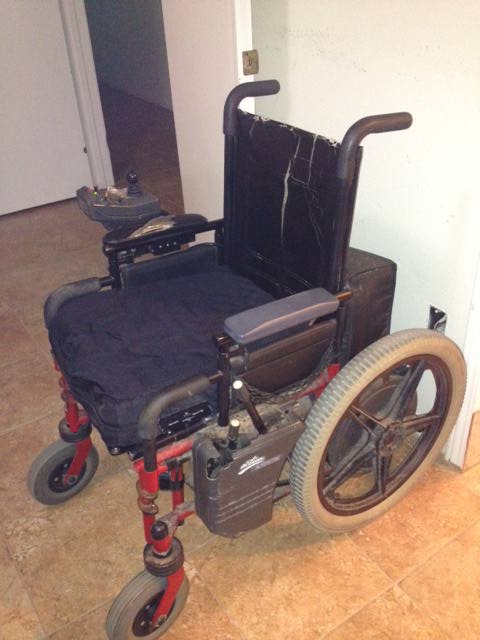
An Invacare model that was especially built for me. Enabling me to swing both footrests to the side so that I could put my feet on the floor to relax and to transfer more easily in and out of the wheelchair. Built low enough so that I could reach down and pick things up off the floor. It had 20-inch bicycle wheels in the back and smaller, 6-inch wheels in the front. It maneuvered very easily and fast. I had already put in the necessary ramps at home. The office was easier the way I had already configured it.
Within in a month after I began using the chair to go to work, I got on a Metrolift van one evening and the chair stopped working. I had the driver put the chair in manual and he had to push me into position to tie me down. When I arrived home, he had to push me onto the lift, and then off the lift, to where my partner/caregiver pushed me in for the evening. I called the provider of the chair. He came that evening with a loaner computer and ordered one costing over $500, at no cost to me. That kind of service is unavailable today.
Within a couple of months, I received a subscription so that I didn't have to call the day before to get my normal weekly ride every day to work and back. I also, on most days, was able to go directly to work without picking up or dropping off anyone. But in the evening, there were usually three of us. I was picked up first, then another, and then another. Both were dropped off before I arrived home. But it was only a bit longer…a bit over an hour to get home. Both of my fellow wheelchair riders became close friends.
The afternoon of my loss, I wasn't with my subscription riders. I probably left for home early after a doctor appointment. I remember going to the Airport Apartments on Airport Drive. A place we often went to because it was specifically designed for people with disabilities and were low income. Many who had been in nursing homes but were able to move into their own apartments with their own caregivers. A great program for those, like me.
That day an affable black gentleman in a cowboy hat and a push chair got on. I was tied down in the middle of the van on the right side. He pulled up alongside me and was tied down there. I always enjoyed talking to other riders. I hadn't seen him before, and we talked freely about something I don't even remember. When we got to his apartment a short time later, he got off and I went home.
When I got home, I discovered that I didn't have my billfold! I immediately called Metrolift dispatch. They told me that the van was already in the yard for the night, but they would check with the cleaners. When they contacted me later, they told me that nothing was found.
I always waited for the van to arrive in the large lobby of my building where there was a pay telephone that I could call dispatch collect if the driver was late or missed me because I wasn't out front in the weather at the curb.
The campus police were upstairs on the west side of the building from my office on the east side. On the west side of the lobby was the police dispatch station where there was a lost and found. If I lost my billfold in the vicinity of the building either inside or out in the parking lot where I sometimes went during the day for a break from my work, any student or employee who found the billfold would turn it in at the police lost and found. The money in it was immaterial. My papers were more important.
The next morning, my partner/attendant just put my two tickets in my shirt pocket where I always had them and anything else I needed, like a credit card that I had to re-order, even money, if needed, for the day, that would fit.
Anything else was put in the backpack that I carried behind me on the chair. I always carried extra Metrolift tickets in my billfold. I put some in the plastic grocery bag with my lunch in little baggies, my hand splint and other items I needed hung on the push handle on my right side. I could easily pull that grocery bag out from behind me and put it on my desk to begin work during the day.
We just made the adjustment after finding nothing at the lost and found and I couldn't identify who the gentleman was that sat in so close to me that he could've picked my pocket. Another adjustment in my life like several before.
After a week or two, not needing my driver’s license anymore or any of the other replaceable cards not used very often, like my health insurance card, I just made do with what I had.
I didn't even have to buy a new billfold. When she looked in my bathroom drawer, my partner found a new trifold billfold that I had been given as a gift. I couldn't remember how I got it many years before and just had put it away in the box.
It was slim and trim but had no way to carry change. It carried cards and cash very well. I decided to carry it in my shirt pocket, so that I wouldn't ever lose it from my back pocket again.
I always carried change in the little change pocket in my billfold until handling change had become too difficult for me. It had become a habit for me to tell them to “keep the change.”
On my trip around the world over 1977-78, in early January, I stayed four days with the family of one of my student friends in Karachi. One day, we went to view the miles-long parade of mourning by a Shea sect of Muslims to commemorate the10th of Muharram. My hosts were Sunni and did not observe the highly emotional parade, except to watch and sometimes taunt those in the parade. Those in the parade got so emotional that they would beat their chests bloody in grief.
My host told me to put my billfold in my front pocket and watch it carefully when we were in the crowd watching the parade because he said the crowd was generally full of pick pockets. We watched the parade for about two hours as it passed in front of us on low bleachers. Mourners with bright red chests or bloody ones passing by with a lot of chest beating, chanting, cymbals and drums. There were no riots or outbursts.
Later, when I was in Thailand, I took a tour to the Ancient City from Bangkok. When our bus neared the site, our guide warned us that there would be many trying to sell fake artifacts who were thieves and pick pockets.
I took that information to heart and moved my billfold from my back pocket to the front pocket of my shirt. As we toured the ruins of what appeared to be more like monuments than buildings, considerably eroded by time, I was surprised that they were dated around the time of the American Revolution, not ancient at all.
As we were told, we were surrounded by many young men offering small boxes with images of gods and the like selling to the uninitiated. As they circled around behind me, I made sure that my billfold was firmly in my front pocket. Relieved that no hand tried to reach it, we all returned to the bus.
There was a large contingent of Australian tourists. One woman cried out as we were leaving, “My sapphire that I bought in India! It's gone. Driver, we must return so I can get it back! Several others started shouting that we should go back. Our guide told her that they couldn't. He had warned us. She wore the sapphire proudly on a necklace for her tour. She was an easy target.
Over a month passed at home. The loss of my billfold forgotten. One Saturday, I wheeled into the bathroom to empty the bucket that I urinated in so that I didn't have to wear a catheter and bag. When I turned my wheelchair around to come out, my billfold was lying there on the tile floor!
Apparently, my billfold had worked its way out of my pant's pocket, slid under the director chair sling backrest and landed on the battery pack behind the backpack unseen where it rode all that time.
Throughout my life, I've had lucky incidents like this. For it to have decided on a Saturday afternoon to fall out of where it had been hiding for over a month, instead of when I was out on the street bouncing over cracks in the concrete or somewhere where I wouldn't have seen it fall out, is one of those little miracles in life that happened to us all by serendipity.
So, I didn't lose my identity to anyone else, and I'm happy to have learned to carry my billfold in a place where it's more easily accessed. That's all that people with disabilities want – easy access.
Copyright 2026 © Ronald W. Hull
8/1/26