Conservative society hates welfare. They believe that everyone should work hard to "make it" and that there should not be any government dole that gives people any money for being lazy and doing nothing. For those who, for whatever reason can't work, families and private charities should take care of.
But the truth is, through pork barrel subsidies, insider deals and taxes favoring the rich, the wealthy get far more "free" money than any other strata of the American, and probably, the world, society. It's been that way for so long, that much of the middle of working society doesn't really notice or understand where the money is going, only that their taxes are too high and politicians are getting too rich. The harder they work, the more they lose, when it comes to wealth.
For purposes of this article, I will include all forms of money I've acquired without having to work or pay into, like insurance policies granted without existing conditions (like life insurance acquired when there is already a dead body) and scholarships/grants often based on need rather than qualifications.
I grew up with a Midwestern, hard-working ethic of helping others when they needed it, mostly physically, to get things done without asking for anything in return. However, I got paid for prearranged work starting at seven to pay for my 25¢ a week allowance. Having a twin brother, we learned to share early so we didn't have to buy two of everything except clothes and food. For example, we earned a Daisy BB rifle by selling greeting cards. Except it was so difficult to sell those expensive cards our mother ended up buying half of them. Like other things, we had only one BB gun for the two of us to use. We shared, but I used it the most.
Our mother set up savings accounts for us when we were born with our birth money. I don't recall ever spending my weekly allowance on candy or toys because mom provided us with all kinds of homemade snacks and candies, Kool-Aid instead of soda pop and great food saving lots of money. We only spent money, and then, only small amounts, going to theaters, fairs and circuses where there were things we needed to spend money on like tickets for rides and cotton candy.
From 7 to 20 my brother Roger and I worked doing the following things: shoveling coal in the basement, mowing the lawn with a push powered lawnmower and shoveling snow for our allowance. During the summer at 8, we worked at our grandparents' truck farm all summer picking wild berries, tending crops and harvesting/picking for about five dollars’ worth of two softball mitts, one bat and one softball. From 9 to 11, picking beans in July and August for three dollars a day, average, and one winter shoveling snow multiple times for a family vacationing in Florida, paid once in spring when they returned. Our mother kept track of the depth of the snow falls, dates we worked and the amount of time it took.
At 14 and 15, working for a guy with a large raspberry patch, picking raspberries and preparing the roots for winter in the fall. At 16, for the same man, a couple blocks from our high school at the start of our sophomore year, we removed all the nails from an old schoolhouse that he bought for lumber. That year, during the winter for the next three years, we set pins in a local Catholic Church four-lane bowling alley. Through hard work and all these jobs, we were saving money for college by that time.
Our big break came at 17. The first Monday out of school, we lined up with others at the local mobile home factory that we could walk to from home. We were passed over for being too small. Our dad, a big strong truck driver who delivered supplies in his truck to the company, talked to the owner. The next day we were hired. We started on the assembly line at the minimum wage of $1.25 per hour. But we worked 12 hour shifts for much of the summer, bringing home a weekly paycheck of $120. By the end of that first summer, we were asked by the superintendent to continue working and not go back to school. We declined, wanting to go to college.
When I graduated 11th in my high school class of 121, I received a Kiwanis scholarship of $1500. I received $750 for my freshman year in college, the rest for my sophomore year. It was one of the larger of the few scholarships given. Before I received the scholarship, it was turned down by the second in class's family who thought of it as charity and had their son enter college through ROTC, a military tradition for them. I took the welfare check, got great grades, and accounted for all of my expenses, totaling something like $835 that freshman year by eating in restaurants for a dollar a day and going home on weekends with rides that cost one dollar for 100 miles between college and home--a penny a mile--the going rate when gasoline was 25 ¢ a gallon. At home, we got caught up on our food deficit and free laundry that we could do at the dorm, and sometimes, did.
We rented our books for $6/semester. And received full coverage with a $6/year health insurance policy. I used mine for eight stitches under my lower lip when a football player came up from underwater in the pool and his head gave me an uppercut blow to the chin that freshman fall. To clean my ears in the spring of my sophomore year. To stitch three of the four of us up after I rolled Roger and my 1935 Ford hot rod at a loss of about $400. I received eight stitches in my left knee. My girlfriend and one passenger received three stitches for small cuts. Finally, I received some eight stitches and in the back of my head in the spring of my junior year. I slipped on a small patch of ice, my feet flew up in front of me and the back of my head hit the concrete, but it didn't knock me out. The loud "crack" was heard by my brother's roommate a block away.
Two months after rolling my classic hot rod with only an injury to my knee, on December 11, 1963, I had exploratory surgery in my neck C4-C6 to correct a nerve caused weakness in my left hand and arm. During the surgery my blood pressure dropped too low and my neurosurgeon had to save my life without finishing the operation. I came out of the surgery paralyzed from the neck down, but recovered most of the use of my legs five weeks later when I left the hospital. My arms and hands were atrophied and appeared to be useless for most physical work. The kind of work I prided myself in doing easily before. My fate seemed to be hopeless and it was very depressing.
My neurosurgeon put me on welfare to pay for the surgery, gave me three months of physical therapy and later, sent me to the University of Wisconsin Hospital for evaluation and treatment in a 14-bed welfare ward in May and June 1964. They taught me how to make yarn potholders with my hands--extremely difficult. They took photographs of my hands. And I waited. Finally, a neurosurgeon came by and asked me why I was there. I answered, "My neurosurgeon sent me. I'd rather go back to college."
As I recovered, I found that even with fingers that didn't move, I could do many ordinary things. My permanently partially closed fingers on my left hand had about a 35 pound grip left to be able to carry something like a light suitcase. I switched to eating with my left hand because I could grasp spoons and forks quite well to eat and pick up things with that cramped left hand.
I got a job in April from the farmer who my parents bought our farmhouse from. Driving a powerful new Oliver six-cylinder tractor only using the clutch and power steering with the throttle set at about 15 mph, I was able to drag a couple of fields that he had plowed for some cash. It was a wild ride when I'd let the clutch out and the front end rose 3 or 4 feet in the air as I took off down the field with only my neck brace for protection.
I still had considerable savings and wanted to go back to college but didn't know how. In July, driving my grandmother's 1956 Buick Super with automatic transmission, power steering and power brakes, I retested and passed my driving test with restrictions, including eyeglasses. My neurosurgeon had told me that he wanted to take my driver's license for my own safety. I proved that I could drive unmodified vehicles and could have had a career driving cab or other driving jobs like my dad.
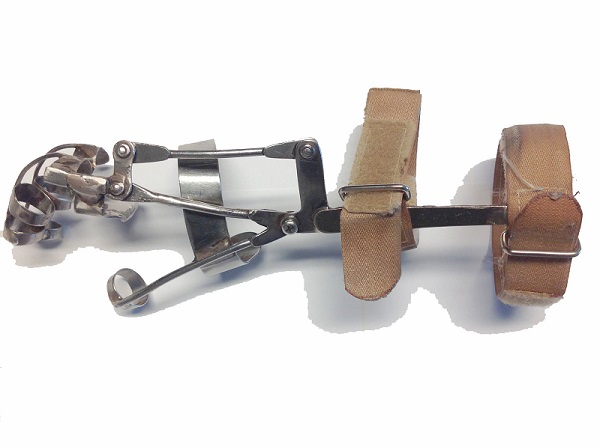
Instead, I got a break from my hospital stay. I was sent back to Madison in August for two days while a prosthetics technician who mostly made leg braces for polio clients, made his very first right-handed, stainless steel hand splint from a left-handed example that he had. While it fit very well, I put it aside after learning that I could pick up things with it and could grasp a pen with the barrel shoved on a piece of surgical tubing for a better grip.
The finger rings that held my fingers rigid was made separate from the wrist and forearm frame with straps of Velcro that held it tightly in place. Supposedly, making it easy to put on. I soon found that I could wiggle into the splint without using the little catch to separate/reattach the two pieces. After struggling with it coming apart while using, I had the catch ground off and the two pieces welded together.
During my working life I had to take the hand splint off many times a day and then put it back on quickly to write or type with one finger, just like my glasses for my myopia--on and off all day long. In the last few years, I haven't been able to put the hand splint on anymore, but I can still remove it at the end of the day of editing and typing. I have it on right now while dictating this, making corrections easier.
Also in August, I got another big break. Our county had a pilot federal rehabilitation program in three city centers: one in my hometown. I made an appointment and got an evaluation that qualified me to go back to college with a free ride. My monthly stipend covered room, board, school supplies and fees, as well as a rented electric typewriter.
I saved so much money from that program, I bought a $100 car with a $90 annual insurance payment to go back and forth the 100 miles between home and college. And I could charge others, like Roger, to ride. I didn't, he already had a sports car as he worked his way through school washing eggs, driving cab and as a Fuller Brush Man using my 1957 Ford the summer of 1964. I could no longer drive that car I bought in the spring of 1962 for $250 because when my dad bought the car originally, he hadn't ordered power steering. I sold it later.
As we stood in long lines and filled out paperwork signing up for school in the fall of 1964, Roger did all my applications. I still hadn't written anything that I remember, except perhaps, attempting my signature in cursive. But when I got to class, and Roger wasn't there, I started writing with ballpoint pens and my hand splint. Quickly wearing out the pens because of the angle I had to write at, causing them to leak ink.
When I returned to my college counselor, a man from industry who would soon become the university placement officer to go to for jobs and interviews, he threw up his hands, and said, "I can't advise you anymore, Mr. Hull. What can you do?"
I went to the industrial technology department head and he took me under his wing. He gave me independent studies to do rather than shop classes where I had excelled before. I got straight As, even one from a specification class with the same professor, former advisor, who threw up his hands. In other classes, I had a partner who did the mechanical handwork and I did the paperwork, like hydraulics and physics classes.
Seeing no prospects for a job like my brother got in the spring of 1965 with six offers from major companies to do time studies with a stopwatch and clipboard, something that I couldn't do, I decided to go to graduate school. Hand typed 60 letters with my one finger hand splint but received nothing but rejections.
Fortunately, my department head came to the rescue again. He got me an assistantship in industrial engineering at the University of Wisconsin. Assistantships allow graduate students to work closely (most of the time) with professors in research projects. It is a form of welfare because you don't have to do very much work in most cases. And, because of your close affiliation with your professor, you tend to get better grades and career network connections.
Then, in April 1966, one of those letters that I thought failed, hadn't. I received a fellowship at Stanford in the industrial engineering department. I believe now based on need and my college grades--basically, welfare. Sunny California called, so I left my doctoral program for a course only master’s degree program at Stanford.
I loved California too much. The Olympic-sized swimming pool, and all the other excitement during the summer of love, had me neglecting my studies and I failed at academic 1966-67 year's end. Fortunately, my advisor gave me an opportunity to do a research study where I worked and write a thesis on the results. With the thesis done, I passed and received my master's degree in the spring of 1968.
But all of my job interviews had failed. Fortunately, the charitable head of the industrial engineering department who got me the fellowship, literally gave me a job. One in quality engineering at a local company started by two Stanford graduates who had sold to General Telephone, GTE LenKurt. Unfortunately, many jobs out of the better schools are done that way, through connections that the average man or woman doesn't have. You can call it welfare for the well-connected.
After two years as a quality assurance engineer, Stout called me back. I returned and started a career in higher education as an instructor. I could have made more money in industry, but I liked the freedom and status that working in higher education afforded me. In two years, I saw the handwriting on the wall and accepted an offer to go to West Virginia University for my doctorate.
With two assistantships and two and a half years of concentrated study, I completed my dissertation:
A test for determining the educational philosophy of teachers using a computer-based database system that was self-learning to improve itself. Something they call, artificial intelligence (AI), today.
After that, I taught in four universities and reached the level of associate professor without tenure. My teaching and research career was, largely because of the way people perceived my ability, headed in the wrong direction. Both my paralysis and my seeming lack of focus in my career began to end it. I accepted an offer from a friend of mine to help him in administration, "To turn TSU around."
I settled in Houston and worked my remaining career at Texas Southern University, for 30 years until I was 69. While I started as the administrative assistant to a vice president, politics worked in my disfavor and I ended up with an average increase in pay of 3% per year. Some others got increases much higher when consultants doing salary studies matched the top university positions with industry. Eventually, my title of director was demoted to assistant director and my salary from exempt to hourly.
I met a beautiful, energetic divorced woman from my high school class at my 1981 20th high school reunion, just before accepting the job at TSU. We were married before the end of the year in Wisconsin. She joined me with her daughter in the spring of 1982 and got a job in sales management. We bought a new home in August 1982 and settled in to married life. It took both of our salaries just to buy the house and the interest rate was high and going higher each year for five years from 11.7% the first year to 15.7% the fifth year and beyond.
I paid the house payment and utilities and maintained the yard. My wife kept what she earned separate, although we had a joint account. We both were frugal so there was no problem with that. Our social life was great except she missed her regular social friends and family from Wisconsin. After three years, disillusioned with her work as a district manager for furniture stores in malls in Houston, Austin and San Antonio, asked me to sell the house and for a divorce. When OPEC began selling oil at a very low price in 1983, almost everyone on our street abandoned their houses because they couldn't pay the higher interest payments or lost their jobs connected to the oil industry. In three years, the house was valued at one half of what I had the mortgage for.
My wife left to go back to Wisconsin and took all of her furniture with her. I was in a house with no furniture that I was struggling to pay for and to take care of as my paralysis gradually increased with each year. I started to borrow from my credit cards just to meet expenses. Finally, I called the mortgage company and told them that I would have to leave the house. For a small fee, they reduced my interest rate to 10% and I struggled on.
I began thinking that I might be able to return to Atlanta where I had built a house during my three years at Atlanta University. I had rented that place out and stored my furniture in the basement. The rent was steady and the depreciation helped with my taxes every year.
Depreciation is a tax benefit for landlords and businesspersons that most people don't know about. Most people think that depreciation is what happens to their car's value over time, it's really welfare for the wealthy that enables them to turn over their equipment more easily.
The combination of my walking becoming more difficult each year and making 500 applications for work in and around Atlanta without any interviews, gradually left me thinking that I couldn't go back there. Also, living in a house with five levels unless I built out the basement for me and rented the upper house to someone else. Even that option faded with time.
In 1989 over the Labor Day holiday, I was able to drive to Atlanta, pick up a U-Haul trailer and bring my furniture and papers to Houston. I bit my tongue when it came to the abuse I received from superiors and soldiered on in my job as I was demoted for fear that was real on the part of some people at the school who wanted me gone. The fear that I knew too much. But I never used it on them. I was mostly ignored and tolerated as I made sure that key university data for the campus was up to date when used for the budget from the state every two years.
Trying to join a study of post-polio syndrome, the rehab doctor running it told me that she could not include me even though I had similar symptoms of decline, but took me under her wing and had me go through a trial with steroids that didn't work and then, a complete workup of my spine to see if the decline could be stopped.
After a myelogram and study by a noted neurosurgeon in 1990, he looked at the results and told me, "Your spinal cord is floating free in the site of your injury, but it is only 2 mm thick! I don't know how you can walk." Fortunately, my insurance paid for those very expensive hospital and treatment programs. And state employees at TSU did not have to pay insurance premiums--even in retirement.
I was having trouble, falling constantly from tripping and getting numerous stitches in my forehead and around my eyes from my broken plastic eyeglass lens. I was also getting concussions and broke my eye orbit and smashed my sinus in one fall. My rehab doctor told me to, "Get in a wheelchair for your own protection and hire help at home. She gave me the phone number of the Texas Rehabilitation Commission (TRC) for assistance.
I acquired two scooters at work but still struggled alone at home. Scooting around the house in my rolling office chair until I was getting out of bed at 5 AM to get ready to go to work and then only arriving about 9 AM and started receiving reprimands for being late. In early 1992, I called TRC. They gave me an electric wheelchair, a Hoyer lift and three months of money to pay for caregivers.
My first two caregivers were very resourceful and helpful. The first, an Ecuadorian plastic surgeon studying to take the test to be an MD here, helped me with getting off to work in the morning, and then, in the evening, my meal and getting ready to go to bed. The second, a premed student at Rice University, moved my office downstairs and built ramps for entrances to my house. Both helped me go through my papers and keep only the essential ones. In the fall when the TRC money ran out. I signed up with the city's social services to get assistance but I was told there was a two-year waiting list. I got on the list and waited.
I hired two more helpers in the fall of 1992. One didn't work out because she had to walk from 3 miles away and was bothered by dogs, no sidewalks and the weather. The other lived a half block away that worked out very well. I was paying them with my credit cards and very worried how long I could do that. The second person I hired turned out to be very lucky. It was Beh who became my partner after a few years of growing assistance without complaint. I had to pay her more and give her benefits like health insurance and Social Security very early in our arrangement.
Desperate, because my house payments and other expenses left no money for paying people to care for me, I found out that one of my two retirement funds could be annuitized, paying me a monthly stipend for 20 years. But not all of the fund, some of the money was retained to continue to grow. The fund had suffered from the downturn in the market of 1989 and not yet fully recovered. It wasn't much at first, but grew with each year, and became a much-needed part of my income.
When I drove home for the Christmas holidays in 1994, I realized it was too dangerous for me to drive anymore. I had already started taking Metrolift to work as a trial to learn how it worked. I rode the 20 miles to and from work for two tickets, each one costing $1.15. But the route, picking up and dropping off others, varied daily and I was very late for work or late getting home--over two hours often. While the service was welfare and saved a lot over owning and maintaining a car, time is money. Once again, my attendance at work was questioned when I arrived late because of the service.
When my two years waiting for assistance was up, I went back to the city's social services and started to apply for assistance. Immediately, the interviewer stopped me and told me that I, "Earned too much to qualify." Fortunately, while riding on Metrolift, a young woman with muscular dystrophy told me of a new state program for working people who needed caregivers. The logic was, having caregivers would allow us to continue to work and pay taxes. Strangely, Texas does not have an income tax. All of Texas taxes come from sales. And I, being both frugal and without funds, bought very little and no big-ticket items like cars, boats or other taxed luxuries like jewelry.
I started renting a room upstairs and thinking of other ways to earn money. All of those still left me with huge credit card debt and equity loans on my larger retirement fund. I always paid back those loans rather than letting the funds absorb the payments.
After I was evaluated and approved for the Consumer Directed Service (CDS) state plan for 44.5 hours a week for caregivers, I was able to hire another caregiver for work at night. My declining condition made it difficult for me at night. No longer able to get up and leave the bed to urinate frequently. Eventually, not even able to turn myself in bed, risking pressure sores. By 1997, someone had to be at my bedside every night with me paying for those hours, seven days a week, totaling 70 hours. While that CDS assistance helped, it didn't pay for all the help I needed, more every year.
First, in 1993, I was tested to see if I could drive a car with hand controls. It was a disaster. My hands and arms were too paralyzed and weak to do the job. I was glad to drive away in my unmodified 1973 Chevy Monte Carlo. But in 1997, I was tested again on a very high tech van with zero pressure steering and brake. It was very tricky driving but I could handle it. While I hadn't bought a car in 22 years and always bought used cars before, I was required to buy a new van.
I bit the bullet and used my credit card to buy the van. There was a fund created by fines of drunk drivers that was used to support disabled drivers with vehicle modification needs like mine. It took $75,000 of that money to transform my van into a high tech vehicle that I could completely operate and drive alone safely on all the highways. There was also four months of training on that older, and more difficult to drive, test van.
My first hi tech van was a frequent visitor to the rehab shop that built her. I rarely got out of that shop with less than $1000 repair bill. When I lobbied for assistance with those bills, I was given a one-time overall repair of the 1998 Windstar that allowed me to keep it a little longer. Finally, at 95,000 miles, I asked if I could do it again, and was granted funds to modify a 2006 Freestar van. This time the modifications cost $90,000 while I had to pay for the van, unmodified for $30,000, using my credit card again.
About the same time, I stopped driving in 1995, my frequent urination and inability to get to the toilet on time, collided. Fortunately, I didn't have to go to an indwelling catheter like so many with spinal cord injury had to do. Instead, I was able to start using a condom catheter with the leg bag on my lower right leg. Emptying the leg bag was not supported by my superiors, and I was even asked by one to drive off-campus to a medical center to have the bag emptied. Fortunately, I always found volunteers who would do it, even though the practice was frowned upon when done on campus.
The electric wheelchair, catheter and the van enabled me to continue working. When my work began acquiring personal computers and I got one in 1987, it revolutionized my work and made it much easier. The state subsidy also worked. Otherwise, I would've had to retire early. By 2005, I had refinanced my house at 7% and had finally paid it off. That was a welcome burden off my back. But I had to hire another helper that more than consumed that improvement and my cash flow.
I heard about an insurance program that came from Texas A&M the year before. The insurance was available to all state institutions. It was long term care (LTC) insurance that generally is very expensive and only purchased by the rich. I signed up right away in 2004 and began paying premiums every quarter. Fortunately, it was one of those offers where there were no pre-existing condition restraints. I already qualified for a claim the day I started paying premiums.
In 2006, I filed a claim and started receiving payments. The original amount was $280,000 spread over 10 years. Fortunately, built into the contract were three cost of care adjustments. Each adjustment increased the daily amount reimbursed to me for care. As a result, since I did not die, I eventually collected $480,000 over 13 years until 2019.
Of course, like with the state funds I already received, I was very careful to pay it all to my caregivers. After I retired in 2011 I no longer had to make loans or drawdown money from my retirement until I reached the age of 70.5 in 2013 where I was required to withdraw from my retirement because all of it was in IRAs.
As a state employee for 30 years, my health insurance was always paid for with typical co-pays of 20%. Upon reaching 65, I moved into a state-supported Medicare advantage program that eliminated co-pays for the most part except prescription drugs. My medical care has been excellent since I retired at 69 and I don't have to worry about medical bills or Medicare payments.
That wraps up my receipt of welfare over the years legitimately. Without adding the tax advantages of being a landlord and charitable giving. I estimate that welfare has covered close to a million dollars of my expenses. Without welfare, I would have been destitute in my 20s with an underpaid caregiver, living in one room without windows instead of my house. I wouldn't have been a long time taxpayer giving generously to charity and planning for the remainder of my retirement money to go to a very good cause rather than my siblings who are all doing quite well without welfare.
Welfare is one of the reasons why I have so much this Thanksgiving holiday time, to be thankful for.
Copyright 2022 © Ronald W. Hull
11/26/22











Wealth inequality is the worst of humanity. It is a waste akin to vandalism and starvation.
"To whom much is given, much will be required."
The potential of humanity was beyond amazing.
I feel as if I am on a sinking ship. I chip away here and there with some real help, but I don't see how the ship can last much longer.
John
Rebecca
Long time since contact.
I feel exhausted after reading your "welfare" offering! You are a super strong guy who manages life's ups and downs like a super hero! I think to myself "can't this man catch a break?"
The effort you put into this overwhelming!
Thanks for this sharing!
God Bless.
Jon