I have written about Ayers Rock in another article. This one tells about other interesting places to walk in Australia.
Tasmania is the large island off the south coast of Australia. Home to platypuses and other exotic fauna and flora, it also has a couple of nice walks.
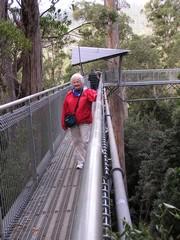
One is the Tahune Forest Air Walk. It is on a metal walkway that averages 20 meters above the forest floor and is 600 meters long. Many of the eucalyptus trees in the area are much taller. My wife, Bonny, and I also see a eucalyptus tree in another place that is 87 meters high, with a seven-meter diameter at the base. From the walk we can see where the Huon and Picton Rivers meet. The walk, itself, is flat and easy, and a good way to see the tall trees.
Many British convicts in the 19th century were sentenced to “transportation,”—that is they were transported to Tasmania or other places in Australia. Thousands, including boys as young as eight, were sent to Port Arthur, Tasmania. Some of their crimes were minor, but once they were in the system it was very difficult for them to get out. Breaking the rules of the penal station got them subjected to inhumane punishment.
We walk around the extensive, grassy grounds where it is difficult to imagine the brutality that occurred there, and then a boat takes us past two islands: one where the dead (approximately 1100) are buried; the other where the boys were taken once the authorities realized they should be separated from the men. To add to the negative memories, a madman opened fire on people at the Port Arthur site in 1996, killing 35 and injuring dozens more. He, of course, now resides in prison, courtesy of the state, and will live to write his memoirs, should he care to.
On the Australian mainland, we drive up Mt. Lofty where we get a view of Adelaide. Then we walk through the nearby wild animal park and cuddle with a koala, feed the kangaroos and see a Tasmanian devil, dingo, bandicoots, emu and numerous exotic birds. It is reminiscent of the San Diego Wild Animal Park, in that most of the animals roam free in large enclosures.
The weather is cloudy, with a cool wind when we drive to a hilltop near Tanunda (not far from Adelaide) with a view of rural Australia. We go to a conservation park and walk around on footpaths. We see over two-dozen kangaroos and a bunch of black and white magpies. The echidnas that live there elude us. We hear stories about people being chased by large kangaroos, including our niece, who is going to school in Canberra.
We spend several days in Alice Springs, the famous village in the Australian Outback. With my old roommate, Jim, who meets us there, we walk along one of the dry river beds bordering Alice Springs, and climb Anzac Hill (Anzac stands for Australian and New Zealand Army Corps), honoring veterans of all wars (“lest we forget”). We get a good look at Alice Springs and the red hills surrounding it.
We drive west from Alice Springs and stop at Standley Chasm, a red-rock chasm formed by water over millions of years. The rocks are impressive. The area alongside the road is largely uninhabited. It is two-lane, paved, narrowing to one-lane for a while. The single lane runs through the center of the graded area. We stop at Simpsons Gap, another gap between red rocks. This one has a pool of water, but the stream is dry and the “No Swimming” sign is unnecessary.
We go to the Blue Mountains west of Sydney with their vertical cliffs and beautiful green valleys. We walk to Echo Point from our motel where we can see the “Three Sisters,” vertical rock formations, and other peaks and valleys. We take a couple of cliff-top walks and then walk to the center of town. The route goes up a steep hill. On our walks we see white cockatoos, kookaburra birds and the ubiquitous galahs, famous for crashing into people’s windshields.
We take a tram (called the Scenicender) down the cliff to the rain forest. We spend two hours walking on the boardwalk looking at trees, vines and birds, including the lyrebird, which moves a lot of topsoil while looking for bugs. There are white gum trees, turpentine trees and fern trees, descendants of the ferns that lived millions of years ago.
Coal mining operations were carried on here and remains of items used by the miners are visible. One sign informs us that while the spring water is suitable for drinking we should stay on the boardwalk because there are poisonous plants and animals nearby. We take the tram back up to the top, eschewing the railway alternative (officially the steepest in the world) because there doesn’t appear to be much of a view from it. The whole area looks a lot like the Grand Canyon, but it is millions of years older.
In Sydney, I walk across the Sydney Harbor Bridge, opened in 1932. It is also possible to climb the superstructure and walk over the top with a guide, but that costs mucho dinero. However, many people walk or run across the main span beside the roadway.