The Dutch Village Theme was the main purpose and destination of our trip to Tulip Times. On the way from Muziekparade to the Nelis' Dutch Village through Holland, I noticed numerous different colors of tulips planted along streets by the city or by residents. It was amazing to see thousands of flowers from both sides of streets.
The city and residents compassionately plant 500, 000 tulips every year not only to attract tourists, but also to beautify their area for themselves as well.
I was amazed by a Dutch community successfully preserving their identity not only for the future generations, but also as they promote and share their culture, history, tradition, and crafts so that other interested parties can learn more about the ethnicity of a small city, Holland, Michigan, which only consists of 35,000 people, a large percentage of which are of Dutch descent.
The Nelis' Dutch Village Theme met us with sun and twelve provincial flags from the Netherlands flanking the walk to the people waiting to enter a spectacular Carillon 25-Bell Tower, a lovely entrance to the replica of Dutch Village.
My first impression of the Dutch village was a working water wheel, used to power equipment to grind grain or saw wood, and life-sized statues scattered thought the village. The statues represent ordinary people in ordinary walks of life, from a baker to a fisherman. They were handcrafted in cement by local artist Joyce Sweers, attracting visitors’ attention.
We had enough time to look around before the Dutch Folk Dance Performance began. Our tour began from the reproduction of the Weighhouse in Qudewater, NL. Some people were brave enough to be tested and possibly to be found guilty of practicing witchcraft. We decided to step on the Heksenwaag, a 200-year-old “witches' scale.”
This device was used in inquisition tests during a Middle Ages ritual of judges before making decision on whom they would burn at the stake and whom they would let live. After our “trial,” everybody received a sealed “Certificate of Proof of Innocence of Witchcraft” as testimony of the Act of Weighting in Weigh – House at The Dutch Village.
It was fun to see how some people took this entertainment very seriously. One woman was even disputing the accuracy of her weight. After receiving a Certificate of Innocence, we visited the Klederdracht (costume) Museum, which features authentic costumes and settings, a Dutch country diorama, and an extensive doll exhibit of provincial costumes.
Walking along an imitation of canal and over small bridges, we had an idea of environment of Dutch villages surrounded by water.
We had the opportunity to observe a farmhouse cheese-making operation using old world equipment, from cow's milk to finished cheese wheel, as well as wooden shoe carving and blue delft making with antique, automated machinery. Watching and admiring these ancient crafts kept us busy, and the demonstrations of old techniques was capturing. It truly felt as if we had somehow returned to everyday life in old Dutch times.
The Nelis' Dutch Village offered attractions and activities to the families with kids too. First, we visited a Frisian Farmhouse and Barn where there was a demonstration of typical Dutch family life. Most animals were outside, thanks to the nice weather. At the Petting Zoo, kids could take goats for a walk. We enjoyed watching small kids having a good time with their parents.
We spent several minutes at the Zweefmolen, a Dutch Chair Swing ride, and restored Draimolen, a 1924 Herschell-Spillman Carousel, to gaze at families having a great time. It’s a nice touch to the park. These activities are very important part of the DutchVillage to keep attracting numerous families for visit year after year.
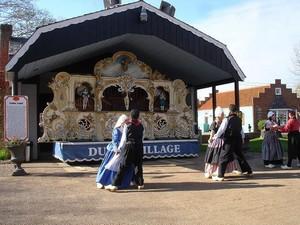
A story about genuine “De Tiet,” Amsterdam Street Organ, with demonstration of some perforates changing by service man to play a different sound was quite capturing our attention. The man was enthusiastic in describing the working process of the organ. In the adjoined building, we observed dozens of accurately stored perforates.
Authentic Dutch architecture, picturesque walks, canals, and flowering gardens reminded me of my European trips. Smaller patches of tulips that spread throughout the ground of this doll village offered some kind of charm to the village. Different colors, sizes, and types of tulips were amazing. Here, I learn the name of black tulips because each plot of tulips is identified by numbered stakes. The “Queen Night” is a perfect name for this beauty. I took lot pictures of these beautiful flowers.
Before leaving to see the Klompen (wooden shoe) Dancer performance, we decided to buy souvenirs. The small souvenir mall was like a museum, with an incredible variety of gifts from around the world, and it even has a large collection of Russian nesting dolls. We had bought candles on our last visit here and wanted to purchase more this time, so we entered the Holland House Candles shop.
The gift shop was full of buyers and viewers of the candle-making process performed by three or four employees. Some tourists requested candles made with a special design and a customized color. The colorful process of hand-carving candles was startling. We bought different kind of candles and delft souvenirs for our friends and family members.
We concluded our trip by attending the Dutch Folk Dance Performance. The dancing arena was surrounded with seats for spectators from one side to watch a performance by Klompen dancers in authentic Dutch costumes. Opposite seats was a playing street organ.
In the beginning of this show, the dancers’ costumes were delft blue with white organdy caps and aprons, costumes patterned after the traditional dress of the Dutch provinces. I was completely relaxed watching six enthusiastic young dancers dressed in costumes of the Netherlands and performing four folk dances to the tunes of the Golden Angel Street Organ.
This spectacular Amsterdam street organ is one of the largest street organs ever built and has been in use since 1880. The great size was one of the reasons the Dutch government allowed it to be sold to DutchVillage.
We left Holland, Michigan with a sense of appreciation for the small Dutch community for the preservation of their European old culture and traditions – not only for descendants, but also for the enjoyment of all of us living in the multicultural society. It was not easy to maintain these traditions, but they made it happen, and now many other ethnic groups have opportunity to learn a way of keeping and teaching their own history and culture to their children.