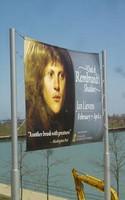
Jan Lievens (1607-1674) was a courageous and inventive painter, draftsman, and printmaker. As time went on, he adjusted to cultural changes and adapted his style to satisfy his patrons and fans. He created numerous of unforgettable characters, scenes, landscapes, formal portraits, religious, and allegorical images.
Two decades after the impoverished Jan Lievens’s death, the popularity of his work decreased, and most of his paintings were kept in a church courts, royal families, and private collections. However, for some unknown reason, many of his works were claimed to be painted by Rembrandt (1606 –1669) or other painters.
It is believed that this may have been due to his family’s need to pay off his own debts, or perhaps that of Rembrandt’s heirs (who were in possession several of his paintings) trying to recover some of Rembrandt’s financial loss by pawning the paintings off as his.
Jan Lievens’s artwork continued to be in Rembrandt’s mighty shadow for several centuries, up until the middle of nineteenth century when his work rediscovered for the benefit of art lovers.
Lievens used his friend and colleague as a model many times in the beginning of his career. Lievens painted himself as proficient and graceful. Rembrandt was more self-centered, painting numerous self portraits throughout his lifetime as further of the dark, brooding individual.
In the artwork displayed in Milwaukee, several of Jan Lievens’s lovely paintings clearly showed images of Rembrandt himself. It was a joy to see Rembrandt’s face in the center of beautiful works like “The Cardplayers” and the “Youth Embracing a Young Woman” and to compare the expressions of love and life in both the artist’s works hanging side by side. It is difficult to describe, but it is clear that the artists’ love for their craft can clearly be seen in their paintings.
Rembrandt also appeared in other paintings, such as well as “Lute Player” and “Pilate Washing His Hands.” “The Feast of Esther” even looked as if it, too, held the smiling face cameo behind the images of a couple. In “The Feast of Esther,” a pastel young Queen Esther points a finger at Haman, the royal councilor who is plotting to kill her people. Her husband, the Persian King Ahasuerus, shares her frustration. A young face in good spirits at the back of the Queen and King is probably Rembrandt too.
“Allegory of the Five Senses” is an indisputable great painting as well. Lievens amazingly painted it as a teenager, openly celebrating all five senses by emphasizing the physicality and sensuality of human existence.
Copyright © Rachel Madorsky