Our Presidents
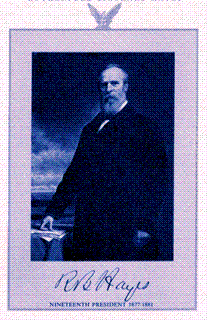
Rutherford Birchard Hayes
Nineteenth
1877 - 1881
"President Rutherford Birchard Hayes" our nineteenth President was born in Delaware, Ohio, the son of a farmer who died before President Rutherford Birchard Hayes was born. President Rutherford Birchard Hayes was raised by his uncle, who sent him to "Harvard Law School".
After being admitted to the bar, President Rutherford Birchard Hayes practiced in Sandusky, Ohio, but was not successful until he moved to Cincinnati, Ohio. There President Rutherford Birchard Hayes was a success, became interested in politics, and married "Lucy Ware Webb". President Rutherford Birchard Hayes and Lucy Ware Webb Hayes and eight children.
When the "Civil War" began, President Rutherford Birchard Hayes enlisted as a Major in the Union Army, and by the time the "Civil War" was over in 1865, President Rutherford Birchard Hayes had been promoted to Major General for bravery.
In 1864, while President Rutherford Birchard Hayes was still in the Union Army, he was nominated for Congress. After a term in the "House of Representatives", he became "Governor of Ohio", serving two terms, then after skipping a term, President Rutherford Birchard Hayes was re-elected in a campaign that attracted national attention.
After the scandals and the corruption of "President Ulysses S. Grant's" administration, both the Republican Party and the Democrat Party were anxious to nominate presidential candidates who were beyond reproach. President Rutherford Birchard Hayes was the choice of the Republicans, and the Democrats nominated an equally capable and honest man, "Samuel J. Tilden".
The "Election of 1876" was the only disputed election in United States history, until "George Bush vs. Albert Gore" (November 2000). Samuel J. Tilden at first seemed to have won, but the Republicans charged that "Southern Democrats" had thrown out thousands of Negro Republican votes in three Southern states. The question was finally put up to an "Electoral Commission" chosen by Congress.
The commission of fifteen men (eight Republicans and seven Democrats) gave the contested votes to President Rutherford Birchard Hayes, and he won by one electoral vote. Before the election was settled, President Rutherford Birchard Hayes supporters had made a bargain with the Southern states that all Union troops would be withdrawn if the states accepted the decision of the commission.
President Rutherford Birchard Hayes immediately withdrew the Union troops after his inauguration. It was the end of military re-construction in the South", and the return to rule by whites.
President Rutherford Birchard Hayes administration was a relatively peaceful one. President Rutherford Birchard Hayes set out to reform the government and angered some members of his own party by insisting on appointed government employees because of ability rather than because they were Republicans.
The "first great labor strike" occurred in 1877, but in spite of his sympathy with labor, President Rutherford Birchard Hayes sent troops and ended the strike. President Rutherford Birchard Hayes vetoed a bill limiting the number of Chinese who could enter the United States because it violated a treaty that placed no limit on Chinese immigration.
Financial confidence that the country had lost during President Ulysses S. Grant's administration gradually returned. President Rutherford Birchard Hayes refused to serve a second term and retired to his home in Fremont, Ohio. President Rutherford Birchard Hayes died in his home in 1893 after thirteen peaceful years.
Written by:
Karen Palumbo
Photography "NOT" by:
Robert Palumbo
3/1/2010 (c)




What they said about repeating errors again and again?
Georg