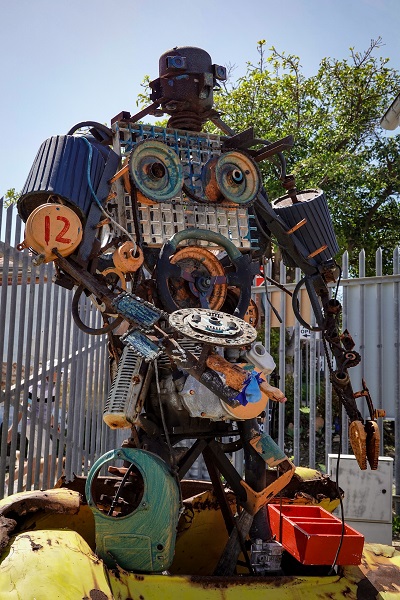
THE WOBBLE BEFORE TIME
Everything begins off‑center, right at the edge of wobble. And once inside it, the wobble feels like the world.
The thing about a wobble is that it demands ever more elaborate adjustments just to keep going.
We, the punters of wobble, are asked to believe that vast intelligences are sorting it out, when in truth they’re only generating more wobble.
Wobbly began the moment we collectively denied the truth: One is all—then twisted that into a moment of time, a point of view.
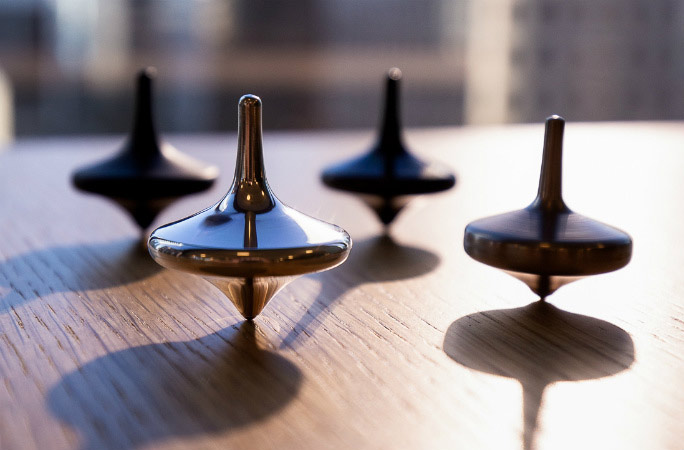
Like a spinning top, the wobble grows as the point of view uses its boundless cleverness to maintain the spin.
For the one caught inside it, the wobble feels like urgency—though nothing is actually at stake.
The point of view—and its wobble into time—finally exhausts itself when manipulation can no longer hold it together.
All falls away, yet the wobbler remains, because the first wobble never actually entered time before it began.
And so it repeats the spinning adventure in time, ending only when the wobbler and its wobble recognize the eternal recurrence—and see that what it seeks is already present, awaiting only a change of view.
And so the wobble ends not by correction, but by recognition— when the view returns to what never moved.
...............................................
These works reflect the same structural insight described in The Wobble Before Time:
that a system born from deviation must generate increasing complexity to maintain itself, and that the intelligence sustaining the spin is the very force that deepens the wobble.
1. Ilya Prigogine — Dissipative Structures
Prigogine showed that systems far from equilibrium generate increasing complexity to maintain their instability.
The wobble creates the intelligence that keeps it spinning.
Reflection:
The system’s “cleverness” is not wisdom—it’s the frantic creativity of imbalance.
2. Norbert Wiener — Cybernetics
Wiener describes feedback loops where a system’s attempts to correct itself actually amplify the deviation.
Reflection:
The point of view’s “boundless cleverness” is a feedback loop that deepens the wobble.
3. Gregory Bateson — Double Bind Theory
Bateson’s double bind shows how a mind trapped in its own logic generates increasingly complex strategies that reinforce the trap.
Reflection:
The wobble grows because the point of view cannot escape the logic that created it.
4. Nietzsche — Eternal Recurrence (mechanical reading)
Nietzsche’s recurrence is not mystical—it’s mechanical:
a self‑propelling loop that repeats because the structure cannot break itself.
Reflection:
The spin continues because the point of view is the engine of its own repetition.
5. Alan Watts — The Ego as a Tightening Knot
Watts describes the ego as a self‑tightening knot:
the more it tries to secure itself, the more unstable it becomes.
Reflection:
Cleverness becomes the wobble’s fuel.
6. Douglas Hofstadter — Strange Loops
A strange loop is a system that uses its own output as input, creating self‑reinforcing complexity.
Reflection:
The point of view maintains the spin by feeding on its own thinking.
7. Lao Tzu — The Way that can be spoken
Not a direct mechanical reference, but a metaphysical one:
the moment the One becomes “named,” it becomes unstable.
Reflection:
The first wobble is the naming—the point of view.
8. Spinning Top Physics (actual mechanics)
A top wobbles (precesses) because its axis is displaced from its center of mass.
The faster it spins, the more dramatic the wobble becomes when it begins to lose alignment.
Reflection:
Acceleration amplifies instability.