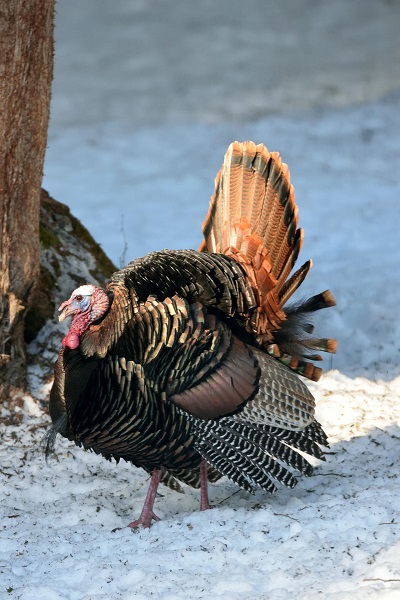
"The turkey’s eyes are such that he can see a bumblebee turn a somersault on the verge of the horizon." Archibald Rutledge
There's some debate as to whether Ben Franklin was serious when, in a 1784 letter to his daughter, Sarah, he described the wild turkey as being “a much more respectable bird (than the bald eagle) and withal a true original native bird of America.” Franklin described the eagle as having a bad moral character (lazy) and not living honestly (stealing other birds' fish). For this reason, he declared that he wished the eagle had not been chosen to represent our country. Obviously he saw the wild turkey in a light different from most.
Today, when we call each other turkeys, we're calling ourselves anything but admirable. We are most likely thinking of those symbols of Thanksgiving that have been bred and rebred to achieve a disproportionately large breast and who can do little on their own but eat and gobble. The birds live in crowded poultry houses, most never having seen the sun, or felt the grass beneath their feet, or eaten a single bug, or been able to have sex on their own. They are remarkably stupid birds.
The wild turkey, on the other hand, is far from stupid (as birds go). They're wily, nearly impossible to sneak up on, and as such, famously difficult to hunt. I have heard devout hunters talk about how much easier it is to bag a decent whitetail buck than it is a wild turkey. They bring the most arrogant of hunters to humble acceptance. They are, I am told, a worthy adversary.
Personally, I think the wild turkey would have made a much more honest symbol of Washington. Imagine the presidential seal with a wild turkey at its center. Or gracing the crests and seals of both houses of Congress and every American embassy in the world. In the right hands, its countenance would be most handsome and regal. In the right light, he might even be considered majestic.
But, no, we have as our national symbol that distasteful, opportunistic, amoral bald eagle. Whether Mr. Franklin would agree or not, it is much more dashing and awe inspiring than any wild turkey would ever be. And not nearly as tasty.
c. 2022
|








When I first hunted, about 1957 in a central Wisconsin scrub oak woods, deer were plentiful, but bucks evaded my eyes. We were told that turkeys from the East were being reintroduced. Anyone who shot a turkey during that deer season, was arrested. Likewise, anyone shooting a coyote, the only predator, also being reintroduced, in those woods with the bear and wolf gone.
I know the bald eagle is more of a scavenger in Alaska dumps then a noble bird of prey. But seeing them sentinel on the tops of tall trees, swooping down onto a lake and grasping a large fish in their talents or just soaring majestically, seemingly a half mile high in the summer thermals, gives them a majestic presence that casual observers like me, see. Turkeys, often in flocks, with no apparent leader, do not represent the lone American frontier ideal like the eagle.
My cousin raised turkeys for a while. A simple disease can kill the whole flock. In the buildings where they are raised, a disturbance can cause them to pile up on each other and suffocate many. They spread disease. Turkey farming is a very risky, but sometimes profitable, business. This year, turkeys are in very short supply because of a number of factors related to the pandemic. They will add to the inflation on Thanksgiving tables.
Ron