I’m ancient as never before this afternoon,
charged with karstic urge, fully born.
(from ‘Eternity at Domme’, June 9, 2007)
This piece belongs to Vol. 3 of The Collected Works of Ian Irvine (Hobson). (Nonfiction)
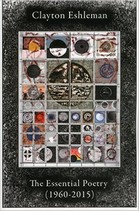
Eshleman is in his 80s now but he is still writing significant poetry and prose—as evidenced by a plethora of high quality publications over the past decade or so. Clayton Eshleman: The Essential Poetrycontains a comprehensive selection of poems spanning some 55 years of the poet’s literary life. Readers should note that I read the collection in conjunction with a The Whole Art; perhaps the seminal non-fiction commentary so far on his life and work. Having read his poetry and prose since the 1980s, I suspect that this collection, published by Black Widow books, will become a close to definitive collection of his life work as a poet.
There are some poets for whom reading their poetry is all that is needed—little is gained by reading the poet’s prose or even by reading a biography on the poet. There are others, however, for whom knowing something about their lives as well as their prose writings enriches the reading experience. Because Eshleman is such a multifaceted literary figure – he has practiced simultaneous careers as a poet, journal editor, translator of poetry, prose writer (usually on poetics and the experience of being a poet), poetry teacher, etc. – it is well worth reading his poetry in parallel with his major prose writings. To approach him from the perspective of his ‘Whole Art’ is to prepare ourselves for a multifaceted encounter with someone for whom prose writing, journal editing, translation, archaeological speculation and even, perhaps, teaching, are precursors to poetry—poetry by other means or poetry in process. Unfortunately, however, his achievements in these other areas have sometimes obscured his achievements as a poet.
Ours is a culture of specialization. This imperative is useful in economic and scientific spheres, but is less useful in the cultural sphere. Those who love poetry may never read a poet’s prose writings on poetics, readers of a poetry journal may never take the time to read the editor’s poetry, and so on. Such an approach works against those wishing to understand Eshleman’s full achievement as a literary figure.
This collection features over 220 poems from some two dozen books (plus miscellaneous pieces) published since 1960. The poems are largely presented in chronological order - giving readers some sense of an unfolding narrative. Through Eshleman's sustained 'inner dialogue' (sometimes across decades) with a range of figures - both real and imaginary - the reader is slowly exposed to the key elements (obsessions even) of his 'inner dreaming'.
The figures tasked with overseeing the poet's inner transformations are numerous. Many poems dialogue with real people: César Vallejo, Wilhelm Reich, Bud Powell, Aimé Césaire,Antonin Artaud, Eshleman's second wife Caryl, his parents and so on. Others engage with mythic, legendary or purely imaginary beings: Yorunomado, Coatlicue, Ariadne (and spiders generally), Persephone and so on. When we add the poems dedicated to creative peers and friends e.g. Paul Blackburn, Vladimir Holan, Leon Golub, Jerome Rothenberg, Diane Wakowski, Gary Snyder, Adrienne Rich, Robert Kelly, James Hillman, etcetera., the sense of Eshleman's poetic narrative unfolding as a sustained and intimate dialogue with significant others intensifies.
Once admitted to the poet's inner world, these figures are put to work imaginatively - become, in a sense, a means for Eshleman to dialogue with unexplored (or only partly explored) regions of his own unconscious - which, from the early 1970s on, turns out to the unconscious of the species itself, all the way back, layer upon layer, to the origins of the imagination as depicted in Paleolithic cave art.
Although we note occasional abrupt shifts of thematic focus - notably in the early 1970s and, I would argue, post 9/11 - there is also a continuity of purpose on display that reminds this reviewer of the elemental symbolism of rivers. Rivers feature stretches of long, slow-moving deliberateness that suddenly gives way to tumultuous rapids and waterfalls that force direction changes. The major recalibrations of the poet's creative life are all tracked in this collection - sometimes they are dealt with in a single poem, more often in a poetic sequence.
The full visionary breadth of Eshleman's 'inner dreaming' is more evident in this collection, I think, than in any of his individual books (except, perhaps, Juniper Fuse). As we progress through the collection we witness the gradual emergence and development of complex, self-created, mythopoetic narratives spanning the length of both human history and the poet's own life. Blake's epic myth making endeavors later in his life, as well as Robert Graves' re-evaluation of human imaginative/mythic history (as outlined in The White Goddess and The Black Goddess and Mammon) are comparable projects, but neither of these poets pushed the 'Origins' theme as far back as Eshleman has attempted in both his poetry and prose works.
Readers can track for themselves the key narratives embedded in (and developed throughout) this collection e.g. sustained meditations on the nature of creativity (particularly as expressed through poetry, art and music); on sexuality and love; on the pathologies of political and economic elites, to name but a few. Like the Paleolithic caves the poet and his wife Caryl explored for decades, readers will encounter many-layers to his poetry.
I’d suggest that whichever entrance to the visionary labyrinth of his life work one enters first, e.g. this poetry collection; back copies of Sulfur; his poetry-prose opus Juniper Fuse; his award winning translations of other poets, or key prose works like Companion Spider, we should, from the outset, understood that it will give us at best only a partial picture. At the back of each ‘discipline gallery’ we will always find a gateway to a central chamber featuring swirling fragments of insight gathered from the multiple vocations he has practiced throughout his life. In this kaleidoscopic—and profoundly creative—‘apparent’ chaos we nevertheless glimpse, if we are patient and attentive, an essential wholeness or unity of purpose to his work that is fierce and serious and direct.
The Essential Poetry counts as one of the best gateways to Eshleman’s oeuvre—largely because pieces from so many of his most important poetry collections feature here. The book’s introduction (by Stuart Kendall) and the poet's ‘Gratitude and Annotations’ section at the end, together do a fine job framing the poetry selected in terms of some of the major turning points in the poet’s adult life—i.e. the encounter with Vallejo’s work, the period in Japan, the encounter with Paleolithic cave art, meeting Caryl (his second wife), and so on. It becomes clear that particular personal challenges have motivated many of his creative and intellectual pursuits. This grounding of Eshleman’s work and poetics in the personal allows us to glimpse the unflinching courage underlying both his poetry and prose.
I suspect that the true species value of Eshleman’s poetry and prose has yet to be fully processed by our contemporary global culture/s. In part, this is because his vision is so vast—demanding as it does genuine and sustained engagement across multiple disciplines. However, I also suspect that there is something in the American (perhaps even the Western) psyche that resists acknowledging the more difficult insights/ critiques proffered by its major writers and poets. Eshleman is a truly international literary figure – dare I say one of the few poets useful to all ages and all cultures. Perhaps a full appraisal of his achievements will only come once he is better known internationally. When a true and measured international assessment of his worth begins, I suspect that this collection will be fundamental to the process - it is already one of his major works.
Dr Ian Irvine (Hobson) is the author of two novels, a book of poetry and an acclaimed nonfiction book on chronic forms of alienation and ennui. His works have featured in various Australian national writing anthologies as well as in over 100 journals and magazines. He has co-edited over 20 writing anthologies and has taught as a creative arts educator and some times course coordinator since 1994. He is the founder and chief songwriter of the alt. rock band Interstitium, and was also the lead singer and co-songwriter of Australian alt rock band "Goya's Child (Original)" before his departure in late 1993..
|





I have particularly noted what you wrote about specialization. Higher education has become the realm of extreme specialization. From my perspective, writers in many fields are our only understood by others in their fields. There is a great need for those who would interpret the extreme language of the specialists into a more general language for the masses to understand. I have noted some authors that are very good at this. I believe you are one of those and I want you to have credit for doing us all a service.
Ron