The above 2 min. has Psycho stars at Hitchock's awards show.
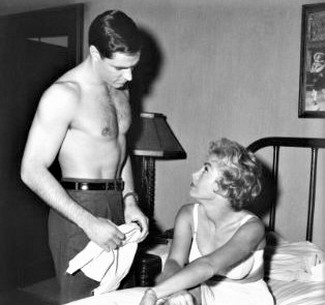
In the first scene of Psycho, Janet Leigh (Marian) talks with John Gavin (Sam) about their relationship. They've just made love. Janet is in a bra. John is shirtless.
Marion: "Oh, Sam. Let’s get married."
Sam: "Yeah. And live in a storeroom behind a hardware store? I’ll tell you what; when I send my ex-wife her alimony checks, you can lick the stamps."
Marion: "I’ll lick the stamps."
Censor: "Whoa! Wait. She can’t say that."
Writer: "Can’t say what?"
Censor: "She can’t say 'LICK the stamps’."
Writer: "What’s wrong with that?"
Censor: "It’s got a bad meaning."
Writer: "She’s saying that she will help him do anything, so that they can get married. What do YOU think it means?"
Censor: "Well .... ah … hmmm.... Okay, let’s go on to the next scene."
This story about the Hayes Office movie censor meeting about the Psycho script, was told by the screenplay writer Joseph Stefano. Director Alfred Hitchcock sent Stefano there to argue with the censors about the script before filming the movie.
The novel of Psycho was written by Robert Block. Hitchcock got the film rights, with no percentage to Block, for $9,000 by buying it anonymously. A dirty trick? Perhaps. But every book Block wrote after the movie was released, had 'From the writer of Psycho' on its cover. So, he cashed in that way.
Joseph Stefano also said:
"Another word that the censors had objected to was transvestite. They thought it was somehow dirty. So, we got out a dictionary and looked it up. And it said;
'A person, typically a man, wo derives pleasure from dressing up in clothes primarily associated with the opposite sex.'
The other problem we had was showing a toilet and flushing it. In the past, bathrooms in movies never had a toilet. We finally convinced the censors that we needed to show the toilet because of the story point where the heroine flushes down some evidence, but some of it remains to be found later."
One sexy line that the censors did not let stay in the movie is in the real estate office scene.
Janet Leigh (Marion) tells her boss that she's not feeling well. The obnoxious, rich man sitting with her boss says:
Rich Man: "What you need is a weekend in Las Vegas; the playground of the world."
Marion: "I'm going to spend this weekend in bed."
Rich Man: "That's the only playground that's better than Las Vegas."
That last line was cut. But was used in the 1998 version of Psycho.
After Psycho, Joseph Stefano went on to be the head producer for the original The Outer Limits TV series. He wrote12 scripts during the year he was there. After that, he went on to produce movies.
In the 2012 movie Hitchcock, the Making of Psycho, Stefano's character was played briefly by Karate Kid star Ralph Macchio. He comes to Hitchock's office to interview for the writing job.
Stefano: I see my psychiatrist every day.
Hitchock: What do you talk about with your psychiatrist every day?
Stefano: Oh ... the usual ... sex ... rage ... my mother.
Cut to Stefano typing the script.
Article Writer's Note: At a Hollywood luncheon, I submitted my request to sit at George Pal's table. But he was very popular because of The Time Machine, so I was seated at Joseph Stefano's table instead.
I remember Stefano saying,
"The only director that I ever heard mention the audience was Hitchcock."
I remember Stefano's words everytime I write a screenplay or direct a scene in one of my movies.
Please check out my movie Forbidden Power on Amazon: https://amzn.to/2nszuEJ




I enjoyed the entire Joseph Stephano interview. He's the kind of guy I admire and would have loved to have had a conversation with like you did at the dinner table. So down-to-earth and direct. Willing to listen as well as to tell his story.
I never saw The Outer Limits. Perhaps because I was in college I didn't have a television set. I recall watching The Twilight Zone and Star Trek, but not TOL. Perhaps because it was, dark and scary, mostly just fantasy. I wasn't scared by Frankenstein. In fact, during that era Edgar Allan Poe became rather camp and even Vincent Price turned to comedy rather than horror. I was scared a bit by Psycho and later, with The Blob, but my childhood was not filled with monster dreams even though measles haunted me three times one year and romantic fever and polio hovered over most of us. I felt that Norman Bates, while he existed in society, was more fantasy than science fiction. Hence, any show with lots of monsters wasn't worth my time because I liked more science in my science fiction and less fantasy.
I still don't write, "to the audience." And kind of don't like those who do, often writing episodes to successful movie or television dynasties of one genre or another. But I guess it's a way to make money, like writing nonfiction, like you do.
Ron