The above Cinemascope trailer has most of the cool stuff in the movie.
Six years after the dinosaurs of the low-budget Lost Continent (1951) and two years before the dinosaurs of the great Journey to the Center of the Earth (1959) came Universal Studio’s biggest budgeted movie to date; The Land Unknown (1957) to satisfy pre-teenage boy’s dinosaur-hunger.
Cary Grant was considered for the lead, but when the Tyrannosaurs Rex ‘costume’ and the water dinosaur cost more than expected, the large extravaganza project with Cary Grant was diminished.
The idea of having Grant in a dinosaur movie was not far-fetched. James Mason had appeared with a giant squid in 20,000 Leagues Under the Sea three years earlier. And Mason would also appear with dinosaurs in Journey to the Center of the Earth two years later.
Also gone from The Land Unknown was director Jack Arnold who adroitly directed Creature from the Black Lagoon and the deep-meaning The Incredible Shrinking Man.
Also gone was the color. However, the Cinemascope remained making The Land Unknown a rare black and white ‘scope’ movie giving the now obvious painted jungle a dream-like effect.
Even with these reductions, at $617,000, it was the most expensive science fiction film of its time. Even Universal’s color space-drama This Island Earth, two years before, was less expensive.
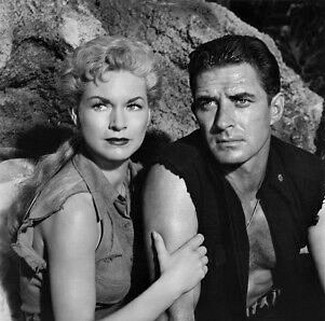
The Range Rider and future Tarzan, Jock Mahoney, replaced Cary Grant. Jock’s helicopter is brought down by a flying Pterodactyl, landing him, two men and a woman (naturally) in a humid jungle in an Antarctic canyon.
Sure, by today’s Jurassic Park standards the live-lizards, man-in-a-suit and hydraulically-operated dinosaurs don’t hold up. But amazingly they look like they’re in the same scene with the actors. In fact, most critics of the day praised the special effects as being top-notched.
The movie has some fun adventures, stunts and a run-in with a man that’s survived there for ten years, played by the intense Henry Brandon (‘Scar’ in The Searchers).
Years later, its star, Jock Mahoney, talked fondly of the movie saying;
"I enjoyed all the running around and the stunts in that film. I got to swim and dive out of helicopters. All the good junk I love to do. When you’re diving out of a helicopter that’s 30 feet in the air and landing in six feet of water, well, it wasn’t really a problem for me, but you get a new meaning for air-brakes. (He chuckles.)
“I remember one scene where there were chalk marks on the floor that said ‘log’. I had to imagine a log lying there. So, I took a dive over it and then rolled back against it. Hell, it didn’t seem like much when I did it, but looked just great on the screen.
“It was really impressive to see all the effects worked integrated with us. I think I could have acted more concerned or horrified with the monsters, but I never worked under those conditions before.”
At any rate, there’s enough of a fan base for the movie to warrant a Blu-ray with an in-depth historical commentary which went to the trouble of having voice actors re-create quotes from the cast and crew.
The t-rex roar heard in this film was used in Spielberg’s movie Duel when the truck crashes over the cliff.
He also used the t-rex roar in Jaws when the shark is sinking after being blown up. I heard him say it about both movies in a video. And you can hear the roar clearly in both movies.
So, maybe Steven liked The Land Unknown. I know I still do.




I believe that King Kong was the first movie of this type. I read somewhere that the special-effects at the time that movie was made was very creative and way ahead of their time. What gets me with those wonderful trailers you provide us with, is the background music that always reaches a crescendo just before it happens… Whatever it is… Getting our emotions in the right place. I guess I'm too jaded to find that music useful any more.
Ron
I enjoyed reading this interesting article
Never Stop Writing
m