Historical Sketch of my Home Town Beja
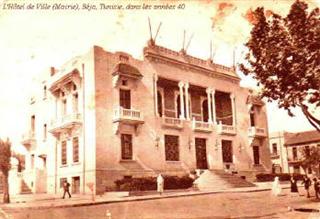
Sixty-two miles from Tunis, between the Medjerdah river and the Mediterranean, against the foothills of the Khroumire, the city of Beja spreads softly on the sides of Ajibel Acheb, facing the greening meadows, its white terraces and red roofs dominated by the imposing ruins of the old Roman fortress.
Whether you approach the city from above by way of Souk‑el‑Khemis or from below by way of Tunis or Tabarka, you cannot miss the spectacular view that enchants every stranger.
The origin of Beja is lost in the beginnings of time. Famous for its fertile soil, it drew all the masters of the Mediterranean. The Phoenicians set up important trading posts. Their presence is felt through numerous Punic necropoles which have recently been unearthed. The Carthaginians, recognizing the importance of maintaining their authority in this area, built a garrison and fortified the city.
Beja was extremely desirable, not only because of its fertile soil but because of its geographic location. It was at the doorway of the mountains and it was the crossroad for Carthage and Tunis going toward Cirta and Hippone. On several occasions it was assaulted, brutally destroyed either by the Carthaginians, the Numidians, the Romans, or, later on, by the Vandals. The Numidian king Jugurtha made the city his governing headquarters.
Originally the city was named WAGA, which became VACCA and then VAGA under the Romans and eventually BADJA under the Arabs.
The Romans destroyed the old Carthaginian citadel and replaced it with a new one; they built fortifications that are still standing today. Under the Roman domination, Beja became prosperous and was the center of a diocese. According to Salluste, who relates the details of the famous war between Jugurtha and Metellus to possess Beja, Beja was the wealthiest warehouse of the kingdom and the center of intense commerce.
Taken and destroyed by the Vandals, the citadel and ramparts were demolished, the abandoned city remained in that state for a century until the arrival of the Byzantines.They renovated the fortress and took real pleasure in beautifying the city.
Beginning with the seventh century, Beja was under Arab and Turk domination.
In 1880 France occupied Tunisia. On April 24, 1881 Beja in its turn was occupied by the column led by General Logerot who had arrived from Algeria through the Kef.
Beja remains a picturesque city with wide horizons, a healthy climate and rich and fertile soil. Another distinctive feature is its family life, its traditional friendliness and hospitality towards foreigners.
In 1942 after a long period of tranquility, Beja was furiously bombed by German airplanes and artillery (75mm Krupp cannons), because of its key position leading to the roads of Tabarka, Bizerte and Algeria. The city became the stage for ferocious battles between the Germans and the Allies (Americam British, French and various forces) who fiercely defended it, at the expense of severe military and civil losses. The Allies succeeded in stopping the Germans three miles away from the entrance to Beja. The town had one of the best schools and boarding schools in the country.





By the History that I remember, Carthago was one of the most rich gang of civilized people around, and as man will, destroyed because they were so good.
Don't be too good and you wouldn't get the seat of your pants kicked.
Georg