Tackling political, racial and class divisions in Trump Era America
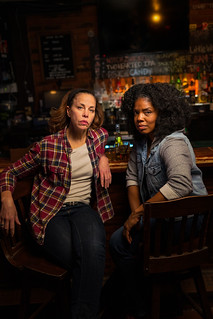
"We will not continue to bear our backs for them to strike us down!" Exclaims one of the characters in Lynn Nottage's excoriating and unmistakably timely Pulitzer Prize winning play "Sweat" directed by Kimberly Senior at the Huntington Avenue Theatre in Boston and extended by popular demand from Jan. 31 through Mar. 1, 2020.
Lynn Nottage--a two-time Pulitzer Prize winning African American playwright-- is a Brown and Yale University graduate and Columbia University professor whose literary compendium frequently tackles the plights and triumphs of the marginalized and forgotten members of society. Notably, she is the only woman who has hitherto won the Pulitzer Prize for drama two times; the first being in 2009 for "Ruined" and subsequently in 2017 for "Sweat."
"Sweat" is a searing and revealing character study about a group of working class friends and co-workers in Reading, Pennsylvania navigating their relationships amidst the pitfalls of corporate downsizing as factories either shut down or initiate the harrowing process of trimming their employees due to robots replacing humans consequential to, mostly and pejoratively, greedy white American patriarchal caviar sucking corporate fat cat's hungry aspirations for profit proliferation. The multiracial cast speaks to imminent racial and sociopolitical divisions in America and even beyond as matters of religion, immigration and economic inequity galvanizing friends to turn against one another as focal points of blame resulting from disenfranchising and disadvantageous institutional policies affecting the bottom feeders of our society, coming from uppermost political hierarchies in the echelons of those bearing the lambasted breadth of institutional power.
"Sweat" speaks to the issues that divides us in Trump Era America with ruthless and unrepentant honesty, a vivid sociopolitical theatrical avatar of the frail facade of the human condition fundamentally—although clumsily, transcending our inexorable foibles to emerge victorious even in spite of ourselves. The production creates a realistic atmosphere with believable staging and true to life characters that one can immediately recognize and relate to. As in our current societal backdrop, racial and class tensions tethered with the imminent threat of violence were palpable; thus effectively propelling forth the essentially taut trajectory and subject matter. The story is told using a flash back and flash forward effect, that I found to be at times somewhat confounding, but one can still manage to follow the plot with relative ease and clarity. Expect your attention to be held captive by the rapid fire dialogue and action sequences, blink and you might miss something. Controversial issues like Black History Month is brought to light when a white character bellows mockingly "...make white people feel guilty month..." and adding "Why don't we have a white history month?" and one liners like "They don't even see you…you think they give a damn about your black *ss?" In this instance, "black" is a representation of all who has been marginalized and left behind across all racial and class boundaries.
The play raises questions about race, class, friendships, family and rightfully without providing immediate answers, as is the responsibility of effective art to raise questions and allows the audience to come to their own conclusions. Essentially and despite our differences, "Sweat" sends one clear message: that our collective "...humanity is at the core of everything..." and I couldn't agree more... See it and you be the judge.
I give this production a five out of five stars!
|











I have to laugh when I hear politicians claiming that they are going to "create jobs," during their campaigns to great cheers. From their viewpoints, especially Donald Trump, they keep looking backward into what was supposedly the United States's great industrial age, fueled largely by two terribly destructive and deadly wars. Automation and outsourcing are rapidly removing jobs from peoples' hands regardless of their background. High-paying jobs are disappearing at a more rapid rate, especially skilled factory work. What is left are boring or stressful jobs in call centers or sales jobs in a local marketplace that is rapidly disappearing as more more people buy on the Internet. The need for government work increases, with good jobs that are more stable and have good benefits, but politicians want to remove those like the Post Office and public schools in favor of cutthroat privatization.
It seems that art always helps us understand why we are the way we are. And why we can't seem to progress favoring our differences our similarities.
Ron