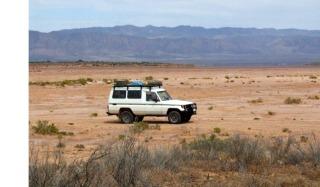
A slightly different approach to survival training, based on the author's military background, plus his many years of staying alive in wild and remote areas of Australia.
SURVIVAL:
A D.I.Y. Exercise
by Bill Revill
True life-or-death situations are rarely given much thought by the average city dweller. Understandably, their safe and comfy lifestyles tend to keep such disturbing notions well beyond the boundaries of their urban goings-on. Besides, our taxes provide for police and paramedics and other trained emergency people ready and willing to undertake that sort of worrying on our behalf, leaving the rest of us blissfully free to get on with the more humdrum aspects of human activity.
On the other hand, if you’re one of the many thousands of people who -- along with family or friends -- frequently venture beyond the protective reach of established emergency support, perhaps it’s time to consider just what it would mean to be confronted by a genuine life-threatening scenario. At that critical moment when death suddenly stares us straight in the eye we may, at worst, have just seconds to respond, or at best be left with little or nothing with which to save ourselves and family over the hours or days that lie ahead.
Adventurers, yatchies and boaters, four-wheel drivers, remote travellers, backpackers: these are just a few of the growing legions of died-in-the-wool outdoor types who really should take time to consider the range of survival circumstances that could arise within their chosen sphere of activity. And perhaps more importantly, examine the actions they might take in order to keep themselves and their group alive should the unthinkable occur.
Sure, there are countless potential survival scenarios, across numerous outdoor activities, which can (and often do) present varying levels of risk. Nevertheless, there is a generic suite of survival skills and techniques that can be considered as the basis for your own more in-depth examination of the dangerous situations you might, conceivably, confront.
We’ll look at some of those techniques shortly, but first up we need to consider the fundamentals of being prepared to stay alive. In fact, apart from a huge chunk of luck, surviving a life-threatening situation invariably gets down to three essentials: What you have in your heart, in your head, and in your hand.
Let me explain:
¡ What you have in your heart
Without doubt, the most important factor by far is your will to live. Although this may sound obvious, if you fail to recognise it as the most critical survival tool, you might be dead within a very, very short time. In other words, you must be able to call on higher-than-normal levels of determination, courage, and optimism to get you through, no matter what you come up against.
However, to help maintain this sort of positive attitude and high degree of mental toughness, you need to develop certain resources that you can carry, permanently…
¡ In your head
By this I mean the sum total of your survival knowledge, and skills, perhaps even training. But it also goes beyond that to your ability to think through a situation logically, and to then set priorities.
For example, once thrust into a survival situation, you must be intuitively aware of the ‘Rule of Threes’:
- Without immediate protection from further danger you could be dead in three seconds (or less);
- Without air you are likely to die in less than three minutes;
- Without shelter from extremes of weather you may last only three hours;
- Without water you may not live beyond three days; and
- Without food you would usually have at least three weeks to live.
Agreed, such survival ‘deadlines’ can be somewhat theoretical; they vary widely with circumstance. However, as a guide to establishing your immediate and daily survival priorities ‘on the ground’, they are invaluable.
Of course, having done that, it then comes down to what -- if anything -- you are lucky enough to have…
¡ In your hand
This includes virtually anything and everything that you -- and members of your group -- are carrying:
- on your person, or
- in your portable gear, such as a backpack, or
- in your car, aircraft, boat, whatever, plus…
- whatever you are able to salvage, find, scrounge or improvise from the situation and surroundings.
Obviously, this might range from elaborate, off-the-shelf commercial survival kits, to fresh water, trees, vines, etc., that can be located and utilised within the area of your predicament.
In many situations, for instance, your most valuable item of kit is likely to be a box of matches. Other simple items that may ultimately save a life include a full water bottle, map and compass, nylon twine, and so on.
Of course, published lists of ‘essentials’ go on and on, but if you are a frequent visitor to out-of-the-way regions, and your activities present any level of inherent risk, you should consider putting together a survival kit of your own. Better still, assemble several ‘stand-alone’ kits of increasing size and complexity, such as:
- A pocket kit
- A backpack kit
- A vehicle kit (or boat, plane, etc.)
That way, in the event that one kit becomes lost or unusable for any reason, you should -- hopefully -- have other critical gear to fall back on.
So, having thought through (1) all your likely ‘what if’ scenarios, and (2) the most appropriate hardware to suit, it’s now time to consider (3) what action you will take once the crunch ‘comes’ for you or your group. And its here where survival schools tend to differ. Not necessarily argue, just differ in their emphasis. Nevertheless, much of this difference arises from the varying circumstances and environmental factors at the time: things like terrain, climate, type of situation, injuries, or location of the nearest source of assistance.
To my mind, though, there are ten key elements to mounting a determined effort to get on top of the situation, make the ‘best’ of it, then give it your absolute best shot to stay alive until help finds you, or you find help. Moreover, these ten steps can be split into two distinct stages, as follows:
Stage 1: Preserving Life
1. Protection: Remember, you may have only seconds to get out of harm’s way. You must rapidly calm down, assess the immediate dangers, then act decisively to remove any threat. Immediate treatment of wounds is your very next protective priority.
2. Shelter: When suddenly exposed to weather extremes, time is not on your side. You need to get yourself and your group as sheltered as possible without delay -- which includes clothing, and natural or improvised shade and windbreaks. In very cold conditions, for example, pay attention to potential loss of body heat through hands, feet, ears, nose, head and neck. Get as organised as possible, as soon as possible, including workable arrangements for sanitary needs.
3. Water: As we saw earlier, water is likely to become critical -- in three days or less! This may include such tasks as finding, collecting, carrying, rationing, etc. Share it in small amounts often, rather than the occasional chug-a-lug. However, the key factor is trying to prevent dehydration. And here’s where knowledge of where to look for it and how to treat it should be stored away in every outdoor person’s ‘head’. (And having a few Puritabs in your ‘hand’ won’t hurt either!)
4. Fire: A fire has the utility to provide warmth, purify water, cook food, dry clothing, throw light (or signal beacons), and build morale -- any of which may save a life. Not bad, considering that tiny pack of matches cost you less than 50 cents!
5. Food: Here’s where we need to maintain perspective: those three weeks mentioned earlier can be a ‘long time’ -- most survival situations are resolved in half that period. Nevertheless, you may eventually need to consider finding and rationing whatever is edible. But unless you are trained and experienced -- or life is definitely in the balance -- wild bush food is rarely an option. On the other hand, warm fluids, sweets and chocolates are often enough. In any case, if you don’t have water, it’s generally unwise to eat since digestion/metabolism processes will dehydrate you even further.
Stage 2: Making it Home
6. Assess: Eventually, an opportunity should arise where you can take a step back from the life preservation stage to think and to observe. What’s our situation? Where are we? Who and what skills and resources do we have here? Our surroundings? What are our limitations and our capabilities? What possible options do we have? What are the real priorities?
7. Plan: Any plan should evolve from an accurate assessment of your situational priorities. Should you move? Stay put? In which direction is help likely to be found? Are there vantage points to make use of? Features such as rivers or coastline that might be followed? What is your last known reference point? Keep in mind that, without a direction or destination, it’s usually best not to move at all (unless, of course, there is no option). After all, failed attempts to extricate from the situation may serve only to consume limited resources. Indeed, it might make things tougher, particularly for search and rescue teams.
8. Communication: Consider any and all forms of outward communication as potential life saving resources. Examples include two-way radios, mobile phone, flags on high ground, high visibility ground markings, smoky daytime fires (or a nighttime blaze), etc. Your plan needs to include whatever means of communication you can utilise, and just how and when to activate them.
9. Action: No matter what action you choose to take -- whether in the immediate area or while hiking out -- you must be decisive. Having come up with a plan, then made a decision, get on with it. At the same time, though, avoid energy and/or resource wasteful activities that are leading nowhere. Rest often; take things gently, but stay aware of your situation and surroundings. Above all, you must avoid taking risks since serious injury could thrust you right back to step one -- with three seconds to live! The other problem with fruitless running around is the higher likelihood of thirst, excessive perspiration (even heat stroke), plus the possibility of becoming lost, none of which is going to help your situation one little bit! Keep in mind, too, that on-going lack of sleep dulls decision making ability to the point where errors of judgment can become a real threat to safety.
10. Review & Adjust: Whatever your plan, don’t become so wedded to it that you lose all flexibility. Circumstances will change -- perhaps rapidly -- so your plan and your actions may have to change accordingly. Decisiveness may be necessary, in fact, on an hour-by-hour basis. Even so, your determination and will to get through must remain constant throughout.
Having said all of the above, it’s still an unfortunate fact of life (and death!) that the quickest killer of all in the sorts of situations we’ve been talking about is, most often, blind panic: lack of heart, plus simply not knowing what to do next. When that occurs, within minutes the number two killer is almost certain to step in: giving up.
To counter this, there is very definitely a Number One survival tool: Your brain, or more specifically, the unique combination of what’s ‘in’ it and how you ‘use’ it. Throw in the second most important tool -- a positive attitude -- and with luck, you will come through OK.
What that’s really saying is this: The heart and the head are going to dominate in virtually all survival situations. If you’re also lucky enough to have a bit of hardware on hand as well, you have a better-than-good chance that, pretty soon, you’ll be telling your friends in the bar about how you took charge and survived against the odds.
All without help from the rescue squad!
This article may be copied, transmitted, shared or used in other media, but only on condition that his byline and the following information is included:
ã 2007 by W.V. Revill
__________________________________________________________________________________________
|


