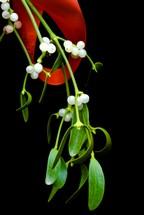
From superstitious to sacred, from ancient pagans to prairie pioneers, the strange mistletoe plant carries a mysterious history of both aversion and curiosity. Mistletoe has piqued the curiosity and imagination of both saints and sinners for centuries. Much of its scandalous history has been ignored or forgotten, and mistletoe, the kissing plant, has become one of our most popular Christmas plants and traditions.
Our ancient ancestors believed mistletoe could heal many illnesses, predict the future, and protect against witchcraft, nightmares, and even death in battle. They also hung it in stables to protect livestock from trolls. Actually, it does have some healing properties and has been used in creating modern medicines.
The mistletoe’s association with the Druid and Roman cultures caused its banishment by the church. Each year the Druids celebrated the winter solstice with sacred ceremonies involving the strange looking plant. They all gathered in the forest, led by the Arch Druid and his high priests. There they selected the tree with the most mistletoe on it. Mistletoe on an oak was considered extremely rare, and therefore especially potent and lucky. The Druids treated this mistletoe with special reverence and chose the oak tree with the most mistletoe for the ceremony. The Arch Druid climbed the branches to the mistletoe and severed it from the tree using a golden sickle.
Some legends claim the Arch Druid caught the plant in his flowing white robe; others by virgins holding a white cloth. The Druids then shared the mistletoe among themselves as a symbol of peace and prosperity. They hung it over their doors to ward off evil spirits, to ensure fertility and to encourage settling old arguments. They expected guests to embrace under the mistletoe.
Our popular tradition of kissing under the mistletoe comes from the Romans who like the Druids required enemies to reconcile under the mistletoe. Much like the olive branch, the mistletoe has been used throughout history as a symbol of peace. Another tradition includes leaving mistletoe hanging in the house throughout the year and not disposing of the old, dried out bits until fresh mistletoe can be hung at the beginning of the new holiday season. Nowadays, we use it only during the holiday season.
Mistletoe is most commonly associated with the kissing tradition. Proper etiquette about kissing under the mistletoe dates back to ancient times; the gentleman should pluck one white berry while kissing the lady on the cheek. One kiss is allowed for each berry. When the last berry is gone, there should be no further kissing. A successful kiss under the mistletoe will result in marriage or so legends claim. Unmarried ladies were encouraged to place a sprig of mistletoe under their pillows to dream about their future husband.
Along with other greens of the season, mistletoe is often burned on the Twelfth Night or January 6. Unmarried girls are encouraged to be especially attentive at the burning of the greens. A steady flame from the mistletoe indicates a steady, even-tempered spouse, while a sputtering flame predicts a cross, irritable, and bad-tempered mate.
Mistletoe endured many years of banishment from the church because of its association with the Druids and Romans. A medieval legend claims its wood was used to make the crucifixion cross, which, according to this legend, was once a tree. As punishment for its role in Christ’s death, it was cursed and no longer welcome on earth. The only way it could return was as a parasite that depended on other trees for its survival.
Early pioneers helped redeem the mistletoe’s reputation. In 1889, after the opening of Indian Territory in what is now Oklahoma, the settlers endured several hash winters in the new land. On their first Christmas, they observed mistletoe growing “thick as Spanish moss” in the trees along river and creek bottoms. Weary from the hard work to settle the land, the hardy survival of the mistletoe became their inspiration for endurance against the elements and unpredictability of the future. Often it was the only greenery available in the winter to decorate graves of loved ones or to use in weddings. The settlers were unaffected by its disreputable past and probably didn’t even know of its unsavory history.
Mistletoe became the state floral emblem of Indian Territory in 1893, and the state flower of Oklahoma in 1910, a title it claimed until it was replaced by the Oklahoma rose in 2004. Its current title is state floral symbol, a tribute to the hardy spirit of early settlers and their endurance in settling a new land.
In the language of flowers, mistletoe means, “I surmount all difficulties” ~ an appropriate claim for both its history and that of the pioneers.
Adapted from Decking the Halls - The Folklore and Traditions of Christmas Plants - http://www.authorsden.com/visit/viewwork.asp?id=50119