Let it be known that when a countryman starts talking or writing about his life, he, sooner or later, will get around to his homeland, native village, his home, and finally the yard, the kitchen, and the two-windowed room where he learned his mother tongue. I too, in writing about my whereabouts, work back through my unwritten history and recall the times past. I return to the country of my birth, my native village, my home, the yard, the kitchen, and the two-windowed rooms where I was born.
However, because in Hungary, my native country, the village of my birth Sívó,* did not have a church, not even my birth certificate notes its existence. There are no registered historical records of my birthplace, but as I recall it, it was a beautiful little hamlet. My native land was the region around my village, but as I grew up, it gradually expanded to include ever wider circles like the ripples from a stone thrown into still waters.
The ripples of the widening circles, like my feelings, may overcome the whole world and it may even reach the stars when I think that my home Sívó forever disappeared without a trace. My native village disappeared only in the physical sense, because my memory of it is still alive. When I think of it, I recall not only my birthplace, the hamlet of Sívó, but also a little house with two small rooms, the earthen-floor kitchen and the circumstances under which I grew up as a segregated and discriminated against minority.
(Pronounced Sheevo)
My recollection of my whereabouts awakens not only my child hood feelings but also my notion that, Ahome is only there where one has rights.. In Hungary, because of my ethnic background, (Bcásh)*; I had no rights. It was the lack of such that prevented me not only from developing a sense of patriotism toward the country of my birth but also from gaining a sense of belonging.
When I think about the country of my birth, sadly but with conviction, I have to acknowledge that it was only my notion of duty that connected me to my homeland. It was my sense of weak belonging that permitted me to grow up as a citizen of the World. In spite of that and perhaps because of that, in writing my memoir, it is not my intention to bite the hand that fed me. My intention is to shed some light on the times of my growing up within the lowest social stratum in Hungary.
My growing up in the lowest social stratum and the discrimination I was subject to however, did not prevent me from believing in my self. It strengthened both, my understanding of the situation I was in and, my readiness to leave my home land without holding anything against the people of my native country. Having no regrets, no ill feelings and no better way to express that, I take the liberty of quoting Shakespeare and address his poem not to a friend as he did, but to the country of my birth, to the people of Hungary, to the Hungarians.
*An unwritten Indo-European language
When to the sessions of sweet silent thought
I summon up remembrance of things past,
I sigh the lack of many a thing I sought,
And with old woes new wail my dear time's waste.
Then can I drown an eye, unus'd to flow
For precious friends hid in death's dateless night,
And weep afresh love's long since canceled woe,
And moan th' expense of many a vanish'd sight.
Then can I grieve at grievances foregone,
And heavily from woe to woe tell o'er
The sad account of fore-bemoaned moan,
Which I new pay as if not paid before.
But if the while I think on thee, dear friend,
All losses are restor'd, and sorrows end.


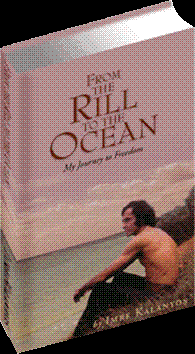



The only correction I would make is to the wensitewhich should be: fromtherilltotheocean.com
Imre Kalanyos author of From the Rill to the Ocean - My Journey to Freedom