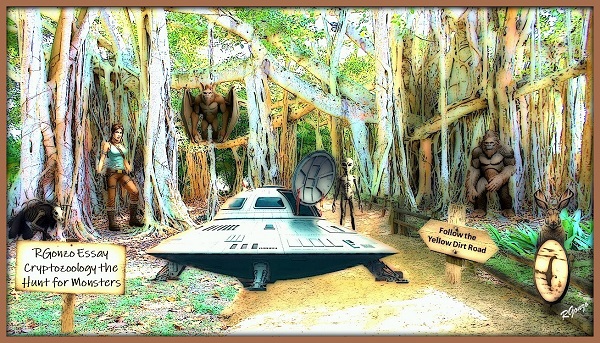
Randy Gonzalez's new essay, Cryptozoology: The Hunt for Monsters — A Classical Criminological Perspective, examines the relationship between pseudoscience, media exploitation, and human belief systems. He defines cryptozoology as the study of unverified creatures like Bigfoot and the Chupacabra, emphasizing its pseudoscientific status due to a lack of empirical evidence. Gonzalez critiques how media, particularly reality TV, profits from cryptid legends, contributing to "truth decay"—the growing societal difficulty in distinguishing fact from fiction. He connects this phenomenon to cognitive biases, misinformation, and the human inclination toward mystical beliefs. Comparing cryptozoology to criminology, Gonzalez highlights the risks both fields face from subjective interpretations and weak evidence, stressing the importance of critical thinking and scientific skepticism.
In the allegations of pseudoscience advocacy, cryptozoology refers to the study of animals that have not been scientifically validated. That is the basic definition. A search of the internet for a meaningful explanation requires more in-depth analysis. For a more questionable realm, an encounter might incur a reference point in a particularly common 'pedia' format. At the outset of attempting a defining orientation, cryptozoology is immediately designated a pseudoscience. At that point, such as the study of mystical, legendary, and mythic creatures is disputed through scientific authentication and evidentiary substantiation. Regarding the notion of pseudoscience, the viewpoint here is that such application pertains to what is unknown at this point. As investigations continue, evidence may unfold in the future. For the time being, proof remains elusive, skepticism continues, and discovery persists.
Nothing inferred here condescends to pseudoscience and its many-faceted fields of study. Likewise, many forms of pseudoscience espouse diverse schools of thought. Unless an undertaking is scientific, mechanical, or technical, it generally falls within the scheme of theoretical speculation. For instance, the domain of criminology is one of those. Additionally, some refer to the social studies arena as inclusive of the pseudosciences of criminology, psychology, sociology, and theology. These collectively represent part of a spectrum of inquiry that transcends many philosophical adventures in the world of metaphysics. Historically, prominent researchers have suggested that the various philosophies transcend fields of study, which include law, ethics, aesthetics, politics, and metaphysics. As to the latter, that is where the adventures in criminology are placed. And now, the quests for monstrous lifeform variations are arriving on the scene. Wonderfully fun adventures in hunting mythical beasts of one sort or another. So, if investigators for a well-known federal agency announce they hunt monsters, what does that mean?
Actually, in the forgoing, they are referring to so-called serial killers, which is, of course, quite deceptive. The subterfuge helps market and capitalize upon historical mythology in a sense. Questions frequently arise regarding why so much research goes into less than 1% of the crime problems. At any rate, mass marketing and gross commercialization have promoted the exploitation of cryptozoology creatures. Sometimes called cryptids, entities like Bigfoot, especially in reality TV shows, receive wide audience appeal. By the way, there is no reality in reality TV shows. The only reality one encounters is profit continuity.
The greed, the trickery, and the psychobabble are everywhere. Mass media perpetrates a daily barrage of con artistry that reaches sophisticated levels. Nearly every aspect of social engagement is seemingly rife with what one think tank termed as 'truth decay '. This concept refers to the increasing divisiveness on what objective fact versus fiction is, which denigrates to the primordial irrelevance of emotional reactivity. It claims a loss of authenticity throughout society regarding honest discourse. Does one think for himself or herself and conduct original self-motivated investigations? On the contrary, most rely on others for their information without examining the evidence. Personal agendas heavily laced with bias promulgate unsubstantiated guesswork throughout social media, mainstream news media, and political processes. Cognitive bias permeates most human activities, from corporate boardrooms to so-called higher education and politics. Opinion no matter how often repeated is not evidence.
As the arguments over evidentiary artifacts increase, so does the need for authentic validation in scientific investigations. The deliberate blurring of lines between opinion and factual authenticity is a challenge, but in the domains of hard-core science, intense scrutiny delves into the organic mysteries of the real world. Data-driven and proof-oriented scientific investigations strive for authentic validation to the extent possible. Attempting to disprove the materiality of a theory becomes a rigorous effort to avoid bias, design flaw interference, observer conflict, and other issues related to avoiding subjective validation. It is well-established that opinion and eyewitness testimony are the lowest forms of evidence. For instance, “opinion evidence” must undergo strenuous assessment in a court of law. This emphasis on scientific validation is essential and should reassure the pursuit of truth and applies especially in the hunt for monsters.
Regarding all that, what does the evidence say? A trap was set, but Bigfoot did not show up. People seem to want to believe in strange creatures roaming the earth. Cryptids include sea monsters, yeti, swamp apes, skin-walkers, chupacabras, and so on. From a basic dictionary definition, a cryptid is any creature claimed to exist but has yet to be proven to exist. That suggests any number of entities outside the normal frame of reference. Some researchers have included the supernatural, paranormal, and extraterrestrial. As to that, perhaps a broader definition is required to facilitate a more proactive investigation. Maybe vampires, werewolves, and others fall under the same designation. In furtherance of such ideas, promoting alleged reality shows tends to demonstrate a wide audience appeal.
These reality TV shows, which often lack actual reality, contribute to the popularization of pseudosciences by presenting them as entertainment. Anything scam is possible for a culture filled with celebrity worship and stardom fixation. It must be true if it's on the magical tube of plenty or the big screen of crowded spaces, right? Likewise, throughout social media, wannabe movie stars do their best to spread all manner of illicit psychobabble. As truth fades, fabrications become believable. Most likely, the scam is so good that temptation is challenged against the willfulness of caution. Regardless, every day is an encounter with the multitudes of snake oil salesmen. So many schemes confront the quest, and it seems overwhelming. Of such deadly sins, avarice and larceny span the cultural spectrum in countless formats. Girth around the middle circumference of human physicality might indicate potential fraud. Fat and gluttonous ought to be a clue. Yet, such is not foolproof. That is because demonic personalities come in a variety of forms.
Where evil is concerned, everyone is a suspect. And here, evil refers to the criminality of human intentions. By association, demonic forms are the diverse personalities within each person. Beliefs stem from thinking processes, and the variations of psychic manifestations inside each individual have many voices. From an interview in a podcast with a skeptical inquirer, the search for scientifically validated evidence remains elusive. A veteran scientist from paleontology sets forth some basic concerns about various realms of cryptozoology. One aspect is to prove it. Another is where are all the artifacts? Still, another point suggests that nothing solid has been found after many decades of research. Mysteries continue to abound and confound the lack of any provability to the claims of all the gurus, adherents, and promoters of one monster after another. A critical caveat is that the savvy investigator ought to be aware of the pervasive demagoguery. From one alleged 'expert' to another, credentials require scrutiny.
For the many supposed reality TV shows, there is a scripted formula to fool the viewer. Entertainment provides how revenue is produced. Showmanship is cleverly devised as the circus acts unfold. Who are the pretentious investigators, and what expertise do they possess? In some social media, tick-tocking portrayals are easily invented to promote a shallow sense of self-validation. Mainstream news media is no different. Opinions often get in the way of real news reporting. Exploitation takes advantage of every opportunity to maximize the gain for the profiteers. Myth, magic, and poorly constructed metaphors labor to fool the populace. To entice the fantasy into reality, most people willfully surrender their common sense for the satiation of their libidinous proclivities. Cognitive bias precludes factual authenticity.
As to the podcast involving a scientific perspective, the issue of pseudoscience versus science surfaces. Regardless of the philosophical point of view, the necessity of evidentiary requirements still holds. As to that point, the whole realm of the social studies arena in academia reflects the notions pertaining to cryptozoology beliefs. What evidentiary components are uniquely measurable in terms of organically material scientific sufficiency? No matter the length and breadth of facts to the contrary, most people will believe whatever they want. Factual validity all too often is irrelevant. In an attempt at scientific relevance, one online science-oriented journal sought to explain the fixation on cryptids. Seemingly, a paradox arises. According to the viewpoint presented, alleging studies supporting religious people are admonished not to believe in the paranormal. By contrast, those not so religious tend to accept speculations about cryptids. As to the former, that seems contrary to believing in religious mystical notions.
The word paranormal infers the mystical, the supernatural, and the ghostly. For the non-believers, one form of mythic belief is traded for another. All of these relate to metaphysics in general. From the domains of the collegiate enclaves, researchers might argue that both constituencies share a commonality. For some in the pseudoscience endeavors of sociology, for instance, that connection concerns a kind of spirituality toward the world in general. Back in 2008, exploring the believability of monsters and gods, a couple of investigators dallied with the spiritual nature of such thinking. By way of all manner of investment, interest revolves around the notion that so many people spend a lot of money pursuing myths, legends, and folklore. Many shady practices, scams, and related deceptions within this realm capitalize on public intentional gullibility. Others speculate (keyword) without any scientific basis that people want to believe because that is how the human brain works. And that in itself is an illusion.
No one knows with any high degree of certainty how the human brain thinks. As such, guesswork abounds in the social studies arena. Simplistically, researchers say people just want to believe. In today’s techno world, with everyone an 'expert' seeking fame and fortune, the blogospheres are abundant with non-scientific conjecture. Many assume such fallacies of inference translate into definitive evidence. However, stupidity is constantly in flux. When one person claims a truth, another fails to test its validity. From there, the tall tales spin from one pundit to the next, and soon, politicians are on stage espousing all nonsense. In the showmanship of the circus, the clowns are sometimes the most entertaining of the acts. Aside from the intricate issues relative to thinking processes, the cash flow is good.
Marketing is non-stop, and Bigfoot is very good for business. Not to forget, aliens and UFOs are right up there, too. From psychics to witches and warlocks, the storytelling is pervasive. The lethargic, uninspiring motivational impetus to critically analyze purported phenomena also creeps a sluggish pace toward emotional reactivity. As hope springs eternal, every effort becomes a subterfuge to obfuscate the reality of objectively seeking the truth. While many relish in the techno gadgetry of the latest electronic gimmick, little is committed to a self-evolving transition to a well-differentiated psycho-physical transformation. Elevating superstition beyond common-sense possibilities, multitudes seek godly reflections of themselves. Let the app do it; some proclaim as gizmo goddesses satiate the amative proclivities. And yet, the more a machine is asked to do, the less efficient it all becomes. Critical thinking is more relevant than ever.
Likewise, with all the technology that so many worships, no evidentiary confirmation has been proved. Speculation abounds in alleged eyewitness testimony and opinions based on circumstantial conjecture. Someone else is blamed, as scapegoating defaults to the usual suspects like the government. Of course, everything must be a coverup, right? Regardless, stroking the cell-phone for the latest 'phone-gasm' stokes the egoistic inclination of a culture not particularly interested in facts. On the contrary, the preference is for immediate gratification in whatever fantasy of self-validation quenches the salacious need for emotional reassurance. Constantly re-creating godliness in personal image is an old story. Computer technology offers examples of such desire for narcissistic reflection. Nonetheless, gods come in many forms. Similarly, adoration follows a multitude of celebrities. Regarding the previously cited reference, allusion is suggested in the direction of human inclinations to deify the unknown.
To want to believe something is out there manifests in a belief system that infers an anthropomorphic nature to some mystical entity. From gods to ghosts, people ascribe reality to explain the invisible. In a recent documentary reflecting actions by the U.S. Congress to investigate UFOs, a series of interviews of alleged witnesses ensues. Unfortunately, betraying the very essence of what a documentary is supposed to be, the slant shows favor to UFO adherents. All manner of unsubstantiated viewpoints present a theme where opinion inclines toward evidentiary validation. Actual organic, material, and solid scientific confirmation is not produced beyond the realms of personal perspective. Over and over again, the viewer is subjected to the viewpoints of believers, absent any cross-examination or substantial corroboration once and while it would be reassuring to have a documentary present alternative views and explanations.
What would be wrong with that? Are believers so afraid their beliefs will be challenged that any opposition is too frightening? That is not much of a belief system when opposing views cannot be exchanged. As though a samurai, transported to a post-modern context, entered the hunt for ancient discovery, a well-armed individual relishes in a thinking person's game. Such unfolds with many diversions into the specious notion of unproved replication. The battle is engaged in the sufficiency of what might prove the outcome. The conflict is within the nature of the investigator. To believe or not to believe in the ghosts, goblins, and gremlins of primal illusions, the adventurer leaves the cave of safe mediocrity and comfortable consensus. His or her framework, the warrior mindset, castigates the urge to presuppose initial conjecture and inject cognitive bias for amative proclivities. In the warrior's duty, devotion, and discipline, embracing the reality of the situation is essentially based on experience, skillset, strategy, and tactics.
Forsaking immediate gratification of self, the savvy investigator, with a warrior's heart, discerns the relevancy of any preliminary conjecture. Revelation remains critical. For all who are negligent of appreciating the facts, the self-centeredness of easy speculation leaves the necessity of a definitive conclusion vacant. An ancient analogy applies to the investigative process and the personal commitment to searching for scientific validation. Similarly, a contemporary sci-fi series plays off this conceptional imagination, where the actor often recites, 'this is the way'. It is the way of the warrior to be of unquestioned ethical responsibility. His or her resilience resonates from the desire to be resolutely credible in all actions. Actions stem from thinking processes, generating willfully from intricate ideations. Belief systems dare reside within those internal building processes. Cutting through the illusions with the certainty of a sure and swift mental sword, the skilled inquisitor exposes the trickery of the con artistry.
While people choose to be mesmerized, they easily fool themselves. Insightful, well-differentiated, and self-evolving warriors will skillfully reveal the facts versus the fiction. Pointed out by numerous skeptical inquirers, one magician who labored to expose the fraud in pseudoscience commented that magic tricks are everywhere. People will believe what they want to believe, and tricksters will take advantage of that. About the former phrase, fraud in pseudoscience, some might be quick to assert a play on words. The utterance has multiple intentions. Suffice it to say that the preference is to suggest that further use of pseudoscience is to infer a philosophical viewpoint in the investigative process. A school of thought, for instance, reflects that which interacts with metaphysical propositions.
For that, the social studies arena is filled with exciting theoretical adventures. It is a faulty argument to argue that using scientific methodology makes something a science. To that assertion, it is a further error in thinking to presuppose knowledge of science when scientific expertise has never been part of personal rigorous exploration. By neither education nor field experience, the philosopher promotes misadventure by arrogantly assuming an easy understanding of the real world's mysteries. For an assumed background for which a person cannot boast truthfully, egregious miscalculations have plagued humankind for centuries. Academia is rife with illusions and every other venue of human interactivity. In the theatrical expressions of social life, humans are deceptive in many ways. Some have more profound skills than others and are among the most illicitly successful con artists. No doubt, there is a scam a minute everywhere.
Well, to a point, of course, as once they are exposed, success is short-lived. In a critical analysis of human behavior, one researcher expresses the literary symbolic reference that the world is a stage. Everyone plays a part; for most people, there are many roles. Prosocial or antisocial motivation is in the notion of free will. From entrance to exit, the gambit is afoot. In showmanship, everyone wears a mask of one sort or another, given the context of the situation. At least two spectrums come to mind: public and private. As to the civic domain, the deception can be quite elaborate. With significant skill levels, the trickster effectively applies his or her fraud. No sphere is immune from deceptive manifestations for the hoaxer to gain an advantage over another. Ripe for the harvest is the world of infotainment. Sometimes linked to edutainment, the provocations seldom relate to knowledge advancement or social ascendency.
The premeditation is likely part of a larger scam to pull off some extortion scheme. Often, the pretext for social justice is the cover story for ideological or material gain in favor of the pretentious social warrior. Beware of the chupacabra in sheepskin. Likewise, when hunting for monsters, caution is warranted regarding monster reality shows. The cash flow is in the audience appeal, the subsequent ratings, and the promotion of consumerism during commercials. The puzzlement remains: where are all the monsters or aliens? Other than the people who might be so characterized, again and again, the evidence remains blatantly absent. And with all the hunters in the U.S., no one has yet to bag a Bigfoot. Regarding estimates by state and federal licensing authorities, roughly 100 million hunters possess some form of hunting license. Hundreds of millions of guns, bows, arrows, related paraphernalia, etc., are utilized every year. And yet, no carcasses were hauled in for scientific examination.
www.deviantart.com/randygonzalez/art/1125407638
|