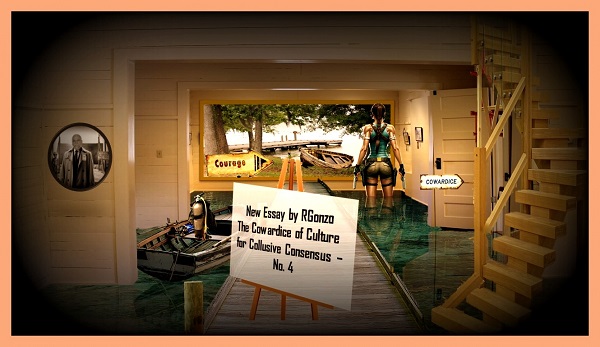
In The Cowardice of Culture for Collusive Consensus #4, Randy Gonzalez critiques what he perceives as a long-standing decline in American cultural courage, attributing it to collusion among various societal forces. He argues that this decline—described as "pussification"—manifests in a preference for safety, conformity, and mediocrity over intellectual adventure and individualism. Gonzalez targets multiple areas: academia, media, politics, and mainstream entertainment, claiming they foster intellectual cowardice and suppress independent thought.
According to some more experienced observations of the American culture, the “pussification” has been a multi-decade collusion of variously purposed interactions. By neither demonic possession nor otherworldly deception, herded collusions of one sort or another desire the bland, safe mediocrity of a cowardly culture. Naturally, several inferences hide behind the blatant conjecture of certain keywords. To say coward, cowardly and better yet, the “cow-herd”, immediately gets attention. And that, in and of itself, might provoke a digression or perhaps a distraction. Nonetheless, the cowardice of culture for collusive consensus characterizes mainstream society. Not to forget, of course, the child-like, albeit juvenile, approaches to modern storytelling and movie making. Then again, what does that infer? Money-making and any movie-making moment? What is the morality tale? Or, where is the efficacy of the hero’s truth? No, wait, why bother? Younger generations probably will not get the undertones of innuendo.
Flashback for a moment, the term coward as it cuts across the many domains of pretentious intellectual attempts, from “academy awards” to presidential elections. From academia to the sports arena, for the sake of self-interests, material acquisition, and gluttonous consumerism, egocentric antics devolve into “juvenile carnality”. Additionally, the infotainment mainstream, including alleged news reporting and social media, boasts an array of idiotic conjectures on a daily basis in order to ensure thumb-sucking commonality. The cowardice of culture devolves to persistence in replacing courageous adventures with bolder expressions of individuality. Censorship, now more than ever, tramples upon the feel-good sensitivity of not being offended by anything. Likewise, historic struggles in the dominions of the “social studies arena” persist, as nothing conclusive defines the totality of human behavior in psychodynamic terms. Opinions vary and anecdotal citations redundantly spin the mantra of one school of thought or another.
Regarding the aforesaid conjuration of the “social studies arena”, a momentary diversion might be inescapable at this point. On the stage of academia, where performances in the realms of the liberal arts, the humanities, or other arts and crafts of “higher ed” reside, all manner of metaphysical contrivances abound. Of the “physics” outside the “physical”, there is the theoretical speculation of the surreal and supernatural. These are the pseudosciences. And, this only means here to be suggestive of that which is not absolutely known beyond any reasonable doubt as would be required in a court of law, proof by evidence beyond any question.
With regard to the mention of that which is abstract, non-material, or non-organic in the natural existence of nature, theoretical and philosophical, the “social studies arena” is that “bastion of higher learning”, aka academia, which includes fields such as criminology, psychology, sociology, and theology. These are, at best, conjectural and delve into many aspects of belief systems, some of which pursue inquiries into the ontological issues that explore the nature of being. From the abstract to the hypothetical and conjectural, studies about human nature in the corporeal manifestation become challenging speculation. As to this quest for understanding the ethereal disembodied spectrum of thought that translates into physical action, there is much debatable discourse. Here, pseudo means unknown. Attached to “science” means investigative processes are on the outside looking in toward the real world of hard-core science. Softcore is the social intercourse that never quite makes the full penetration into the communion of psychophysical enlightenment. There are far too many egos involved in the “social studies arena”.
Reality as to the vitality of the material realms concerns sciences such as astronomy, biology, chemistry, and physics, to name a few. Philosophy attempts to discern reality as relegated to those exploring the philosophical aspects of human nature. Of these perspectives, the raging debates of any pretension to reality regard fields of supernatural adventures as those four previously mentioned. Particularly important to ideological discussion is the field of criminology. In the present contemporary devolving American culture, where anti-intellectualism fuels much contention toward real science, non-scientists in the many fields of psychology seem to have cornered the marketplace. The use of the term marketplace has many implications. Nonetheless, the conceptual framework of “cowardice of culture” relates significantly to the belief systems that translate into “collusive consensus”. No singular philosophic conjecture has the answers.
In the dominions of the pseudosciences, there is the challenge of intellectual adventure. And yet, surprise, upon achieving an alleged post-graduate degree in the social studies realm from an alleged institution of so-called higher learning, there is a supernatural aura of mystical proportions. Ghostly, a stream of consciousness, not necessarily one that reflects common sense, projects and provokes pseudo-intellect of some measure. Of the newly “doctoral” nobility, there is a presupposition of exceptional knowledge in a particular field of social studies. Mainstream media, social media, and gurus of this or that are very fond of such royal titles. With that, publish a few literary works, conduct some surveys and interviews, and suddenly, the pretense of “expertise” unfolds, and one might be referred to as an “expert”.
Meanwhile, in the real world, where experience, maturity, and a veteran’s wisdom are crucial, academia does not instill such psycho-physical readiness, and there is no potency of actuality. Yet, mesmerized by the magic of the pontifical realm of alleged knowledge and learning, the mainstream of specious ideations perpetuates that hope springs eternal. So quickly, appeals to the questionable conjecture of magical thinking become the “sacred dogma” of superficial cause-effect illusions. As such, cowardice becomes the elusive trickster of personal selfishness. This not only degrades intellectual capacity for insightful illumination but also divisive motivational impetus to inflict maladaptive inflictions on others. Cowardice perpetually haunts the inner sanctum of many kingdoms. Wearisome for want of wit toward the accumulation of willful purposes, to evolve the courageous purposes of ideation, such demands are more than most will invest. Too many easy ways out; the vast majority prefer the herded self-loathing of degrading collectivist commonality.
For a “career of cowardice”, as in the “professional politician”, typically treads upon the simplistic and comfortable, well-worn pathways of self-righteous passivity. For such self-idolized and professed “victimhood”, their dishonesty is in the uncreative realms of self-doubt. Of those who willfully grip the psychic energies to propel their potency into the realms of heroic adventures, these are the “superheroes” of prosocial enrichment. Comfortably, with no malice aforethought, their premeditation is confident, creative and unabashed. However, for others, their emotional reactivity is the child-like tantrum of weak-minded unkindness. Added to that is the special probability that cowardice comes with many masks. Some can be easily recognized, but others are quite cunning and cleverly concealed. Cowardice shares a diversity of types, intentions, and perversities. Timidity craves the tortures of one form or another.
From spiteful meanness to socio-political animosities, cowardly aims perpetrate all manner of panic, fear, and ethical trepidation. As to the heritage of cowardly antics, it seems as though the accusation of being a coward is etymologically hundreds of years old. Avoiding pain, difficulty, and danger finds distressful association with an Old French derivation. As to a “cuard”, suggesting the tail of an animal, when stuck between the hind legs, meant a frightened creature. In American preference, the accusatory claim offers the observance of one who shrinks from danger or trouble. By inclusion at this point, the degrading appellation concerns the diverse realms of interpersonal human activities. It is in the various social contexts that these purposes are of interest. From diverse aspects of community and country, humanity and civilization, regarding prosocial interactions, issues of courageous behaviors speak to matters of personal transformation.
To ascend to higher levels, as expressed by one 19th-century philosopher who considered the individuality of “becoming gods”, asserts the loftier notions of individual sanctity. In that sacred sanity of self-motivation, the valiant few labor to rise above the cultural destitute materiality of modern society. Severely demanding is the vitality of personal liberation. With regard to that ascension, the individual is responsible for his or her own divinity. To be a creator and creative is culturally abhorrent to the mass hysteria of commonality. Of all manifestations of ideation, the conceptual framework of “warrior-hood” summons heroism in many spheres of interaction. Confident, individualized, and exceptionally persevering, the braver persons of culture overcome the cowardice of collective normality. Rather than quick obeisance to authoritarian tyranny of any kind, the adventurer accepts nothing without question or inquiry.
Maturity, of course, discerns the context for the application of a rebellious spirituality. Added to that ideation of personal proclivity comes the relevance of intellectual capacity fortified by experience. Of this, an argument might be posed that loftier realms of cerebral edification presuppose, as earlier philosophers suggested, a “transhuman” form of introspection. Or, “superhuman” transformation offers the idea that a person can become a better version of the original. This does not suggest contemporary notions of a “techno-human”, redesigned by using current or advancing technology. On the contrary, here, the idea is willful differentiation to the highest potential of self-evolution. It is a thinking process that supersedes the illicit undervaluation of human potentiality to transform willfully.
Such requires a quest for courageous adventure outside the mainstream while operating as necessary within the mainstream. But, the maturity of exceptional intellectual exponentiality in individualized astuteness is beyond childlike narcissistic adoration of oneself. Extremely few in modern society are that self-actualized. Most are regressively oriented to the selfishness of a “Peter Pan” flirtation. Immaturity cuts across every generational threshold. Childishness is the purposeful naiveté of irresponsibility in personal growth and development. For such broad-based ingenuousness, the blank stares of limited perspective and crudeness of silly egocentricity relishes in the profane forms of cowardice. As to such fearfulness, the fearmongering of culture knows no boundaries by which socio-economic elitists transgress. Among the more courageous personalities, regardless of setting or situation, acts of courage embrace mature intellectual capabilities. To assert the knowledge of evidentiary consistency by virtue of individuation, spineless ignorance is opposed wherever possible.
However, jeopardy is always present in the cowardice of culture. Adjusting for the moment to the issue of public service, how many people decide early on in life to serve their country or community? In this case, the example of the military and first responder public safety services are particularly cited as examples. Some surveys indicate that less than 7% of the total U.S. population enters the ranks of military service branches. While estimates range between 5% and 7% for those who previously or presently serve their country, the numbers in the law enforcement field are smaller. By close association, a reduced percentage of Americans who join the varieties of American constabularies throughout the country is about .003%. So, less than 1% of the entire U.S. population risk their lives every day to serve and protect their communities. This estimate, based on several studies, does not include the many millions residing inside the U.S. in an illegal status. And yet, the brave women and men of law enforcement daily receive the divisive condemnation of mainstream media and political cowardice.
For the real-world practitioner of behavioral analysis, the cops, some take the view that if one has never “been there, done that and got the tee shirt”, one has no idea what they are talking about. Their inexperienced socio-political cowardice speaks for itself. In an article from an online “psychic magazine” service, actually a field of psychology publication, an author notes the disingenuous perspectives of “academia”. Citing the conceptual framework of “career cowardice”, the writer notes the strenuous necessity of certain skill sets in realms such as the military, medicine, and so forth. It is a similar consideration in various career aspects of the multifaceted criminal justice systems. From policing to the courtroom and correctional settings, skillful development of essential “tradecraft” remains vital to professional services. The right training, mental and physical development, and dexterity in the application of capabilities are significant.
At this point, according to the article, the focus switches to an examination of the world of academia. This infers the various schools of thought relative to the dominions of the academe, the college, the university, ivory towers, and alleged bastions of higher education. What is the nature of the intensive brutal training curriculum and attendant experiential exposures? Here, the slant is in the direction of the “liberal arts”, or more specifically, the “social studies arena”. Intense, super-dynamic intellectual capacity and extraordinary imaginative creativity, along with strenuous psycho-physical endurance, are non-existent. Many Ph.D.’s go from the classroom as a student to the faculty office as a professor of something.
As to the aforementioned articles and their creator, an observer of the academic world, career cowardice reaches the lowest ebb of success. Timid, fearful, woefully redundant, and unimaginative, the academic feel safe in academia. Cowardly inclinations default to the redundancy of repetitive anecdotal citations. With weak admonition without wiser maturation or rationally enlightened ascendancy, the stagnation of intellectual regression fosters the rise of stupidity. One researcher asserts the philosophical and speculative notion of “menticide” perpetrated by a “power elite” who control the means of infotainment. As to the concept of “mental murder”, the idea of “menticide” suggests the intentional effort to undermine, subvert, and otherwise destroy a person’s individuality. With that comes the perpetration of various means to subjugate values, beliefs, and ideologies.
Other than what is proscribed by the powerful ruling class, becomes that which is promoted by the mainstream media, social media, movie-making industry, and the varied aspects of the techno-society, controlled by the big tech industry. As a “technocracy”, the prior methods of Cold War era efforts at social manipulation are facilitated by modern telecommunications. Regardless, systematic efforts at manufactured manipulation of mainstream consensus in status quo conformity seduce collective acceptance. It is an age-old perversion of the few who desire to control the many for personal gain and selfish enrichment. As to the opportunistic perspectives of the upper rungs of the socio-economic ladder, the “divine right of kings” castigates the individuality of private liberties that threaten the collusive consensus of the few. Negativity, so rampant in modern society, encourages fearfulness in order to perpetuate the control of the majority. Terrorizing the populace by mass deceptions against reality ensures a higher probability of compliance.
Evidence in factual sufficiency becomes subverted to the emotional reactivity of the necessary moments needed to perpetrate trickery. The spreading of gossip, rumors, and unsubstantiated opinions run rife through the maze of contemporary technocracy. The cowardice of culture is performed by the spinelessness of fear-mongering over fact-finding. From blatant lies to conflicting reports, absent evidentiary validation and scientific confirmation, “influencers” of one ilk or another encourage the trepidation of social dread. At this juncture, the so-called “influencer”, as often seen in social media, is that self-appointed “expert” who claims mystical insight for self-serving advocacy. They come in many sizes, shapes, and social silhouettes. Expertise among the alleged “sage” is generally questionable and depends upon their vast field of experience in real-world human interactivity. False prophets are everywhere.
Nonetheless, the reaches of technocracy give the pundits the resources to cast their spells of arrogant self-righteousness. Where logic and reason can be argued by the necessity of evidence, stupidity stumbles upon its own emotional reactivity. Foolishness is everywhere. And, as to an issue of foolhardy conjecture motivating unsocial regression, heroism is woefully underestimated and undersold. Cowardice is the marking scheme of the socio-economic marketplace. For the hero of any story, the urgency to motion, to action, means rushing into the obstacles of those who fear the potency of their creativity. The urge to move on, to reveal, and to discover is often discouraged by the less imaginative and mean-spirited. Foolishness bears witness to the idiocy of irrationality more often than not. Instead of embracing the cow-herding of postmodern servility in cultural mediocrity, the warrior pursues the enticing forces of maturation in wiser realms of personal ascendancy.
From the morass of mounting stupidity, heroic endeavors confront the corrupt nature of manipulative commonality for contrived compromise. To reflect upon the works of one writer, a sea of “sissytude” confronts the beachgoer. A divide washes wave after wave upon the scattered shells. Choices are available to cross the shore. Swimming against the current, crashing through the waves, and diving to depths, doing that which is different from the “beached whales” requires serious courage and conviction. But for the inane mimicry of coalescing with the flocks, the singular visionary diverts from the crowded clusters. With a social nexus of devolving prospects, individuality shuns the stupidity of each day. Where absurdity “self-identifies” as folly, the adventurer labors relentlessly toward his or her differentiation. The cowardice of culture knows no boundaries in the reach of diminished intellectual capacity.
Any idiotic, unsubstantiated conjecture easily masquerades as authenticity for the amative allure of subjective validation. This is rife in the various spheres of academia, which prior investigative notions suggested is the bastion of intellectual cowardice. Not to mention, of course, the “mind-body” configuration of psycho-physical prowess. Weakness connects to every aspect of bodily configurations, as wussification permeates the whole of personal existence. From the communal castigation of “microaggressiveness” to the social castration of censorship of any kind, the wussy, ineffectual, easily frightened, and unevolved human life form runs to the nearest safe place. The atmosphere of cowardice is found in every organizational construct people devise. Some resist, and others meekly subsist. With cupcakes, coloring books, and calming tones, the social mainstream slides thoughtlessly into eventual extinction.
|