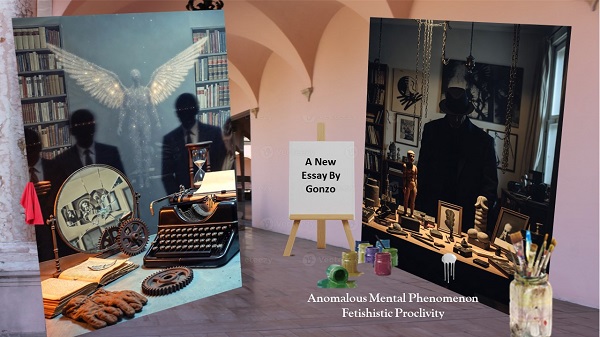
The essay, explores anomalous mental phenomena (AMP) through "Gonzo Theory" in the context of classical criminology. It critiques social sciences (e.g., criminology, psychology) as pseudoscientific compared to hard sciences, emphasizing free will, quantum consciousness, and rational choice in human behavior.
In the ongoing discourse on AMP (anomalous mental phenomena) and Gonzo Theory, studies of pseudoscience offer opportunities to explore a variety of mysteries. As in each episode of the Gonzo discussions, the primary pseudoscientific philosophies in the "social studies arena" (i.e., criminology, psychology, sociology, and theology) present a range of viewpoints. For this discussion, classical criminology serves as the foundational framework. Naturally, this contrasts with the real sciences, such as astrophysics, biology, chemistry, and physics, to name a few. The emergence of studies in the quantum realm in the 20th century is of contemporary interest. From several scientific viewpoints, a research team comprising a mathematician/physicist and a medical doctor finds that the noncomputational and unpredictable complexity of human consciousness remains a fascinating speculative adventure. No one knows where it all comes from. As such, it remains an open investigative enigma in behavioral analysis.
From a classical point of view, free will is essential to this conjuration of a single behavioral perspective. No doubt opinions will differ regarding the freedom of choice and the question of whether such is an illusion. In the mainstream, the prevailing view is that there are varying notions of deterministic influences. Nonetheless, for the commentary, fetishistic proclivities are premeditated, willful, and sometimes express malevolent intentions. Human actuality is purposeful, and the "quantum consciousness" levels may, in fact, be formulated in the deeper recesses of cerebral activity.
One author of a college text used in some criminology courses cites fetishes as an expression of paraphilic behaviors. This, of course, invites definitional criteria not only of a "fetish" but also of what a "paraphilia" represents. As such, the underlying explanation depends on the philosophical domain. Generally, according to the author mentioned, paraphilia is considered among those actions, allegedly "deviant behaviors," that express amative personal fantasies and urges regarding inanimate objects and harm or humiliation to others. From the same source, a fetish becomes that which is among the paraphilias and involves the sexuality attached to non-living objects. The fetishistic behavior becomes part of a vast list of so-called paraphilias. From a classical view, a question arises. Where did this conception of behavioral frameworks originate? Another question that comes up is whether these perspectives are scientifically validated? Regarding the first question, the historical reference dates to the late 19th century.
What is deviance? There is no such thing as deviance except for the social construct one chooses to obey. The question provokes all individual and community reactions and interactivity, both prosocial and antisocial. As with every means of public exposure and subsequent activities, behaviors have consequences. This should not dissuade the instigator from their intended behavior, but to the extent of the repercussions. In expressing one's individuality in the free exercise of freedom and the motivation to self-evolve, there are always critics, detractors, and those self-conscious of their inadequacies. Ignorant, self-righteous people will do anything possible to censor others for shortcomings they choose to ignore and otherwise stifle their individuation and personal transformation. Many will be prone to condescension and injure others due to their selfishness. Although issues of deviance remain debatable, in this discourse, deviance is not illegal, immoral, or otherwise an expression of "mental disorder".
In addition, depending on the context and the exhibition thereof, deviance is about personal liberation. Such is an exploration of the depth to which psychic recesses argue the complexity of individuality. However, there is an element of exceptionality. In U.S. society, unless there is a duly constituted legal prohibition, any particular behavior is not deviant. This is a matter of personal preference, opinion, maturation, and other aspects of personality. Fortunately, such is a matter of personal expression, etc., protected by the First Amendment to the U.S. Constitution. Considering this, deviance becomes a concern for statutory provisions enacted by a legislative body and signed into law by the appropriate executive authority. As to the individuality of deviation from contrived norms, fetishes emerge and become labeled accordingly. Who does this? Such conjecture surfaces from the various philosophical schools of thought, particularly in the so-called "social studies arena". This, of course, does not mean these notions are correct.
Regarding definitional criteria, as one college text in the criminal justice domain suggests, fetishistic behavior is included in the broad spectrum of paraphilias. Yet, the two subjective concepts should be considered part of a whole array of behavioral variations. Rather than distinguish one from the other, perhaps a more efficient framework would be a simple singularity. After all, these topics reflect a diverse range of activities, each grounded in a philosophical point of view. Nonetheless, as to the reference above, the author allegedly infers that fetishism relates to sexual fantasies about nonliving objects. Continuing that, the discussion infers that urges emerge by which a person places erotic significance on a particular inanimate object. As such, the presence of the object or objects is necessary to enhance the sexual fantasy.
Additionally, the terminology regarding a "fetish" ought to be viewed as a generality for which the meaning has significance to a particular person. In that person, a unique personality is either developing or regressing. Unfortunately, most people are not evolving, and neither are the schools of thought in the "social studies arena". That would particularly apply among those proffering conjecture that infers fetishes are somehow connected to disorders. Broadly speaking, fetishism suggests a salacious fantasy for specific things, human anatomy, or certain activities. Neither disorder nor dysfunctions unless the creator intends malevolent actions. This considers the possibility that a fetish is closely akin to a paraphilia. Such behaviors are only included on a list of alleged "disorders" because of particular philosophical viewpoints. Following that, self-interest manifests in legislative action, and a law is passed against such behavior.
Worse yet, at some point, such opinions make their way into the medical realm. Imagine a twilight zone whereby someone, or an entire "psychic industry", absent credible scientific credentials (real science), gets to influence the fields of medicine. How many science courses at the graduate level do liberal arts majors take? Take, for example, a Ph.D. in one of the pseudosciences (i.e., criminology, psychology, sociology, theology). Unlike undergraduate "general ed" courses, where a biology class might be required, no hard science courses are required. Again, such notions should not be taken as indicative of scientific validation in opinion-based research. Additionally, fetishes should not be considered "disorders" as suggested by the mainstream "psychological industry". Meanwhile, people willfully maximize their interests by "weaponizing" amative ideations and inflicting harm on others.
Regarding the textual reference above, the author characterizes the "diagnostic" aspect of the intervention as though such sexual excitation were maladaptive. People express ideations they create by searching out the psycho-physical means by which they can express themselves. This is a matter of personal discovery and liberation to the extent that individuation can unfold. Special criticisms aside regarding the efficacy of any school of thought, there is a longstanding debate over whether such fields in the "social studies arena" are sciences. That aside, it is important to recognize that consciousness (i.e., thinking) processes are highly complex. Not only that, individuality in thinking remains remarkably mysterious and elusive. Although there are many theories, no one knows how or where it occurs. To that extent, a multitude of organic factors interact at the subatomic level, making interpretation difficult. Alleged empirical research in the "social studies arena" amounts to the regurgitation of biased opinions.
In the academic world of the "social studies arena", once anchored in overcoming the overblown blather of egocentric interests, an array of fascinating philosophical viewpoints unfold, particularly in the schemes of rational choice theory in criminology. Behavioral analysis involves recognizing the potential of an infinite number of factors. Psycho-physical processes, and if preferred, spirituality as well, encounter a diversity of influences. One is always free to assess the variables and behave accordingly. And yet, interceding into this is the perceived primal simplicity of consensus. A self-evolving personality can always resist and decide where rebelliousness will reject the contrived commonality of conformity. In the efforts of many viewpoints within the "social studies arena", the conjecture tends toward the Orwellian contrivances of mass obedience. Tyranny has many faces behind many masks.
Such admonitions or condescension to subtle antisocial constraints typically devolve from "pseudo-empirical" assertions based on pseudoscientific speciousness. Of the many projected hypotheses, notoriously flawed "experimental" schemes flow superficially from prejudicially slanted expositions. Data interpretation of deliberate design often skews toward the original intentions. And, quite questionably, the alleged rigor and reliability of the information are carelessly applied. Over time, the abundance of methodological implications has, unfortunately, become easily accepted within mainstream society. Social media is rife with an air of infantile embellishment of egregious inferential fallacies. Of this, and for purposes of self-serving agendas, the shallowness of hasty generalizations adversely affects liberation in individuation.
As to human nature's expression of fetishistic behavior, individuality ought not to be interfered with to every extent possible. As a fetish may imply the fascination with an "object" for fulfilling personal satisfaction, ideations to fantasies are nearly limitless. In all likelihood, extraordinary creativity goes beyond the norm in imaginative processes. Shaping individual preferences, from childhood to adulthood experiences, willfully contributes to the unique spectrum of individuality. To what end would mainstream society desire to crush that realm of personal proclivity? Power, control, and domination by a few, whose sexual dysfunction pretends to know "what's best for everyone". Whether a work of art, a carving, a stone, or a photographic depiction, the magical potency of psychic fascination offers the individual a means by which to discover one's own authenticity, to say that what one relishes for one's own self-determination is taboo, illicit, or dysfunctional is potentially down the dangerous path of prejudicial behavior. Who decides what is deviant? That is up to individual choice, and yet many foolishly fall into conformity.
Before the turn of the 20th century, one medical researcher proposed that the word "fetich" denoted an object and a personal association with it. Systems of belief are pervasive and can be seen in many examples worldwide. Nonetheless, eroticism was at the core of the thinking processes. And, to that extent, the author of a classic text on human sexuality suggested that such things expressed one's passion for the exploration of fascinatingly amative ideations. Aside from misguidance on the conceptual framework of so-called "deviance", reflecting the 19th century's opinions, the sexologists of that time offered that sexuality is expressed in very diverse ways. By way of symbolic representation, possibilities for experiencing the erotic nature of fantasies cover a broad range of activities. Extending that viewpoint, the exploration of fetishistic behaviors ought to pursue a similar expansive sense of possibilities. Regarding this metaphysical continuum, the extent of impassioned proclivities is endless.
An intense sensation, emotion, and persistent feeling about "people, places, and things" might better be considered in the realm of sexual exposition. For example, passion for a particular subject, such as a paranormal one, could likewise fall into such perspectives. Similarly, as "mindsets" unfold, desires can be directed toward many kinds of socio-economic and political associations. Again, the persistence of one or more fascinations, fixations, or obsessions plays a significant role in personal behavior. The suggestion of playing a "significant role" may be an understatement. That is to say, people rationally choose those particular proclivities they are emboldened to pursue. At the same time, each achieves varying levels of pleasure according to his or her needs. This does not mean, of course, that the translation of sexual energies into particular pursuits is always of a positive nature. People freely make decisions based on their hedonistic, self-centered calculations for personal gain.
While most actions are prosocial, other intentions may pose dangerous outcomes. Additionally, maintaining a healthy, self-evolving, well-differentiated transformation remains challenging. Many people choose not to self-evolve and instead remain stagnant and mediocre throughout life. An aspect that perpetuates social regression is the gross lack of creative productivity and easy compliance with socially contrived consensus. As related to the depth of passionate inclination about certain things, the potential for immeasurable attributes becomes exceptionally essential to the process of individuation. Pursuing goals, interests, and aspirations with valiant determination requires intense introspection. From that, the ascent to higher levels of enlightenment is ongoing in intensity.
From within the molecular constituency of individuality, deep in the cerebral recesses, intentional ideation creates the impetus for various activities. As to its historic originality, the passion of which becomes artistically creative, fetish transcends the nexus between reality and fantasy. From the outset, various forms express self-driven spirituality, as if seeking the deity of some imagined prospect. To provoke the necessary allure, the surge seeks out the manifestation of the charm, the sorcery, and the magic. Replication finds an artisan's kinship with aesthetically pleasing fascinations. At a basic level, all manner of entertainment fills arenas, particularly salacious venues. Fans, followers, and fanatics lust for one form of vicarious enticement after another. Blogs, vlogs, and other self-flagellating mystic flogs span a global spectrum of fetishistic satiation. Instead of a narrow perspective on what a fetish is contrived to be, a broader encompassing human sexuality ought to pervade.
Herein, a holistic theory of fetishistic proclivity unfolds within the scope of "Gonzo Theory". Where holistic infers an all-inclusive framework, a comprehensive point of view expands on the theory of the fetish concept. To this assessment, the notion embraces diversity, equity, and inclusiveness of many human passions. Such is openly freewill-oriented, ensuring the viability of personal liberation in exploring the complexity of personality. Such is the assertion that fetishes are fundamental to every aspect of an evolving (or not) human nature. Yet, some will "weaponize" their sexuality and harm others. Regardless, the theoretical construct suggests an expanded scope rather than the traditional narrow confines of superficial conjecture. Overall, the inferential notation offers the view that fetishistic inclinations suggest a unique sense of individual desire, connectivity, and challenge. This is a significant matter of self-validation. Furthermore, regarding a passionate underlying self-driving force, personality complexity is important.
Many facets of life, especially interpersonal relationships, become associated with "people, places, and things". As such, people create a diverse array of manifestations. And to that end, full disclosure is essential. That is, a high degree of open-mindedness among partners and a full disclosure of personal preferences. Relationships should be open and without reservation, with all parties understanding the uniqueness of the other. No doubt ignorance is supposedly blissful, but surprise revelations tend toward maladaptive reactivity. Whether the materiality of the fetish is a "talisman, totem, or trinket", the amative expression is of individual preference. To say that such preferences for the surrealist are taboo or tainted in any way is a matter of someone else's opinion. And viewpoints are filed away accordingly.
As to the earlier framework, fetishes are a matter of individual expression. Neither the object nor the activity is as relevant to the purpose that such proclivity plays in a person's life. For the unfolding advocacy here, the significance of free will is fundamental. The depth transcends to a primal basis within the realm of "quantum consciousness". Such a nature is beyond the present capacities for either the "social studies arena" or the scientific community to fully understand. Regardless, theoretical constructs help along the way toward higher realms of enlightened transformation. A working theory might be suggested along the lines of the "free significance theory of fetishistic behavioral expressions." This is offered only as a working idea to explore the salacious aspects of human individuality further. The fundamental ideological basis here is the classical school of criminology, specifically the rational choice perspective. Again, rather than focusing on the object or the particular activity, the essence is to look to the purpose.
Overall, people engage in various sexually self-serving behaviors. To each person, there is a special meaning and intentional provocation. As opposed to passive participants, or interacting "spectators", another aspect of personality, or a different personality, enters the performance. Each one is developing a script in the sensuality of the unfolding stage play. Stories are crafted by the person "writing" each episode, as if a dream were coming to life in a more awake state. Lucidity is transformed in real time through a special relationship. Contemporary emphasis on many shadowy aspects in the "social studies arena" is quick to invoke a "mental health" model in response. More objective observation should ensue rather than their academic fixation on objects and activities. As individuals attempt to shape their personalities, identities, sense of self, and transformation, compassion for a better understanding is more relevant. Naturally, unlawful behaviors are another matter.
Of special importance is recognizing that people make choices. A unique "cost-benefit" analysis, emphasizing hedonistic selectivity, becomes central to initiating ideation to achieve the aforementioned free expression. Disagreements notwithstanding, and debates to the contrary are certainly within the scheme of investigations as the pseudosciences attempt to unravel the mysteries of human thinking. What is particularly reassuring is overcoming the immaturity of selfish inclinations that lazily succumb to the contrived consensus of manufactured social norms. As personal inclinations experiment with a variety of fetishistic behaviors, the process of individuation ought to be for the sake of meaningful differentiation. The means of self-expression toward a better understanding of oneself is vital.
|