Meanwhile, fiction without facts is good storytelling. In the pseudosciences, that is what we are good at: storytelling. It is a different genre, masquerading as though real science, but defaults to opinion; most often, the go-to rhetorical hyperbole is an "appeal to authority." The savvy investigator is one who not only seeks the evidence but also has a self-evolving personality bent on objectivity. Overall, such a quest becomes a challenge for unfolding intellectual pursuits. Separating the facts from the fiction becomes critical in confrontation with opposition, animosity, criticism, censorship, and other divisive condescension.
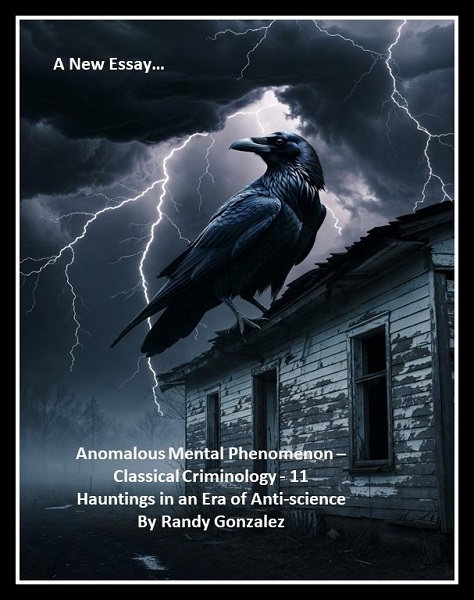
On a foggy, damp night in crowded environs of greedily overdeveloped habitats, a story raged with nerve-jarring rips of lightning and thunder. Old homes, run-down, faded, and weathered by time and neglect, cast mysterious shadows of a better past than present. Overhead, the moon dared not escape behind the heavy charcoal curtains of cloaking clouds. As the overused utilities dulled electrical supplies, the lights dimmed, flickered, and eventually went out. Street lights were the first to go, and then candles and flashlights would add to a scary symphony of silence taunted by scratching screeches. For the lone observer, hunkering in an aging abode, creaky shutters replaced the daily moan of wordless voices. Terror could be easily imagined. A faint hint here and there of unresolved nightmares tortured the strain of whispered memories. However, it was just a storm, and the power failed. There were logical explanations. In the search for meaning, a whole cast of strange characters, including all shapes, forms, and archetypes, enter the stage play.
While storytelling can be fun, creative, and artistic, eventually, fantasy fades into reality. Responding rationally to various phenomena through objective, logical analysis must come to the forefront of realistic conscious perception. Logical confrontation exposes the mystery of intentional fallacies of inference. A thorough data/evidence-driven investigation ensures the viability of evidentiary artifacts. Scientific authenticity, particularly the criminology of forensic applications, remains crucial to a fact-oriented inquiry. As to the foregoing dark and stormy night introduction, the intention was to set the stage for haunting atmospheric conditions. For entertainment purposes, horror stories, ghost hunting, and demonic possession are extremely popular cinematic genres. In the vast entertainment industry, scary movies rank high in audience consumption. While drama, thrillers, and action movies are popular, those productions are costly. However, with nearly a 25% market share, horror movies have a wide audience appeal.
Nonetheless, the societal challenge that potentially affects everyone across multiple institutions is separating fact from fiction. Confusing the two purposefully for hidden agendas and personal preferences leads to socioeconomic and political dysfunction. Contemporary society is affected by what some call an era of intentionally contrived anti-science attitudes. In one sector, academia, the social studies arena of the liberal arts plays a role in the conspiracy. Its key players are the various pseudoscience fields, such as criminology, psychology, sociology, and theology. Pseudoscience also includes areas such as the paranormal and the supernatural.
Meanwhile, fiction without facts is good storytelling. In the pseudosciences, that is what we are good at: storytelling. It is a different genre, masquerading as though real science, but defaults to opinion; most often, the go-to rhetorical hyperbole is an "appeal to authority." The savvy investigator is one who not only seeks the evidence but also has a self-evolving personality bent on objectivity. Overall, such a quest becomes a challenge for unfolding intellectual pursuits. Separating the facts from the fiction becomes critical in confrontation with opposition, animosity, criticism, censorship, and other divisive condescension. Anti-science attitudes span the mainstream from idiotic "tock-ticking" selfies to the diminished intellectual capacity of blog after blog. Seemingly, everyone is an expert, yet typically has no conception of expertise or what that might entail over a lifetime. This is all too familiar in the pseudosciences of academia.
As one physicist points out, in observing contemporary anti-science attitudes, America was once a pioneering country of science and technology, and great accomplishments. Regardless, we now live in an age of social stupidity. Not everyone, of course, because there are always notable exceptions, but critical thinking has generally become challenging. Some offer the excuse that the lack of real-world knowledge and understanding is because we live in an "age of information overkill". Tremendous amounts of data are exchanged through many information systems over diverse technologies. And so what? That would be the classical criminologist's response. People can detect, discern, and distinguish the information they utilize. For the self-evolving personality, the valiant one who resists contrived consensus, he or she invests the time and energy to distinguish "baloney and sausage" (B.S.) from vast amounts of data.
Testing the information flow against well-researched evidence or lack thereof requires effort for the skilled inquisitor. But wait, maybe that is the underlying problem. Working diligently to be smart, shrewdly inquisitive, and maturely articulate demands serious exertion. In the sometimes "mindless" plethora of social media blather, such self-serving platforms are more about "celebrity status". Various bloggers often say to hit the "like" button, follow the channel, and consider the advertisers and other salacious reinforcements. Of these antics, it is not so much about the quality and competency of the information as it is about the "fame and fortune". Often missing from such podcasts or YouTube channels are the credentials of the purveyors. Most of the time, they are regurgitating the superficiality of someone else's informational form of expression. Not much depth to the commentary is discovered, and any semblance of intellectual capacity is notoriously absent. False narratives are quickly spread with dangerous consequences.
Mainstream American culture is rife with bogus conjecture. No doubt, of course, and so is academia about the "social studies arena". All too frequently, during an investigation, the savvy inquirer confronts a plethora of ideologies that sound good. Yet, proving a conjectural assertion through definitive evidentiary substantiation becomes problematic. Clever-sounding typologies do not necessarily infer incriminating complicity. Likewise, whether a particular locale is haunted or demon-possessed begs the question of scientific validation. Additionally, as suggested by one investigative source, a substantial explanation escapes the rationality of why a demon or a ghost chooses to remain in one particular place. Supposedly, with their extraordinary supernatural powers, it seems logical that they could be anywhere else. Nonetheless, ghost-hunting "reality T.V. shows" are a very popular genre. As to that, they make a lot of money for producers and television networks.
According to a prominent business publication, a survey in 2015 found that many believe in paranormal entities. As such, it was reported that 3 out of 4 people believed in some form of the paranormal. That is a significant number. In a similar frame of reference, another researcher in a "social studies" publication suggests that ghostly beliefs are commonplace in the social mainstream. From a resource studying human psychology, the author claims the alleged "normalcy" of such ideations. According to this reference, many believe it is possible to have interactions between the living and the dead. As to this theory of promulgating a social "norm," the article suggested that those who harbor such beliefs demonstrate a weakness regarding "reality testing." Does this mean believing in something lacking serious scientific validation is normal? Yes, it would be a starting point for such an analysis. It is a concerning issue for the other 25% of the population, requiring a standard of evidentiary authenticity.
In furtherance of this point, the inference allows the induction for the criticality of scientific literacy. As to academia, for instance, and in particular, the "social studies arena", science is not typically at the top of the course listings. On the contrary, philosophy courses make up the standard issue in the liberal arts curriculum. In the criminal justice area of the academic enterprise, scientific methodology is sometimes mentioned, yet no real hard-core science courses are required at an advanced level. Investigative techniques, tactics, strategies, and in-depth analytic processes are seldom the subject of intense application. As to the research above about alleged "reality T.V. shows", the script calls for fooling the public by suggesting or hinting at science. As though smoke and mirrors, sleight of hand, and pseudoscience are more prevalent.
Regardless, the serious investigator considers the key question: what does the evidence show? With that, he or she insists upon the laborious effort of keeping an open mind. Just show the proof, and maybe a skeptic will adjust his or her perspective. That is the answer in some situations when a supernatural believer questions a non-believer. In the long run, what does it matter, given the brevity of each moment? For some skeptics, believability is evidentiary-based. To that extent, the necessary scientific validation used in a court of law is the basis for testimonial consideration. In the search for the truth and the context of ghost hunting, some skeptical inquirers are fascinated by the realms of pseudoscience. The criticality comes from clear and convincing evidence other than alleged "eyewitness" testimony. For the required proof level, eyewitness information is one of the lowest forms of evidence. And, in a court of law, such testimony would likely not be permitted. Scientific validity tests the science against "junk science".
Relatedly, opinion, gossip, and rumor are not viable forms of evidence. Solvability factors remain elusive unless organic materiality or scientific authenticity can be demonstrated. Alleged "experts" in supernatural adventures frequently do not have solid, well-established credentials in terms of education, experience, and investigative skill sets. Regarding "Reality T.V.," which comes nowhere near any semblance of reality, it is notorious for bogus expressions of "investigative expertise." Regarding television portrayals, alleged "experts" may use EVPs or electronic voice phenomena equipment. An EVP represents how entities on the other side of death communicate with the living. Even though the EVP is an electronic device, like a cell phone, ghosts do not typically use the latter. Aside from the high probability of interference from other sources, some ghosthunters believe an EVP device can aid in such afterlife communication.
Given all the interactivity of computers, cell phones, C.B. radios, short-wave transmitters, AM and F.M. broadcasts, and so on, more realistic explanations are possible. The savvy investigator requires rigorous analysis of such electromagnetic interference. As in all such investigations, confirmation bias is readily at play. From one reference, an audio engineer cited the notion that there is much more sophistication in electronic communication monitoring in the modern era. To date, accordingly, research scientists have not had conversations with the dead. From one skeptical publication, researchers assert that serious paranormal investigators usually do not pay much attention to the claims of EVP advocates. In some research areas, parapsychologists look to other forms of evidence as speculation continues.
Nonetheless, what is the truth, and who do you trust? And the answer is nothing and no one without scientific confirmation. Illustrating the mythic quest for alternate realities, a metaphorical example is that of the lone detective, searching relentlessly for an answer. As a well-trained skeptic and seasoned investigator with credentials second to none, her exploits would cause "ghost-hunting reality shows" to cower in her presence. Since most of the actors of an alleged "monster hunt" show generally lack serious expertise in conducting investigations, the savvy detective remains committed to testing reality. Renowned for her objectivity and keen intellect of profound rational thinking, she steadfastly finds logical intrigue in pursuing ghost stories. For instance, the abandoned old opera house in the town square invites the curious all year round. A silent witness to decades of festive occasions, the structure is a dilapidated monument to suspicious paranormal claims. Now, ghosts run the box office.
On a dark and stormy night, in the middle of the south's worst winter, she answered a request to apply her skills to exposing any timeless entities still lingering. No doubt, an investigator entering a dimly lit structure would likely feel a chill run up the spine as rain falls heavily and chill fills the air. Creaking stairways, howling winds, and unidentified noises combine to evoke the presence of things not easily explained. As the "mind," working on behalf of the brain, conjures all manner of suspiciousness, she might think she heard ghostly whispers for a moment. With a spooky sense of the supernatural, the intrepid detective looks for clues. Will an apparition appear? Is con artistry at work? Where does the real end and the surreal begin? Undeterred, the relentless investigator examines every nook and cranny for essential puzzle pieces. As her flashlight carefully illuminates dark, shadowy hallways, beams of light scan the corridors, and nothing seems to suggest paranormal activity. Flickering light sources could be misleading.
For our steadfastly objective detective, as unbiased as probable, four key aspects of investigative skill come to the forefront. One is the serious lack of scientific evidence that correlates with contemporary findings. Unless, of course, one allows for unsubstantiated opinion. A second aspect is that proof remains inconclusive with all the so-called investigative efforts, including T.V. shows. Additionally, a third point relates to the viability of the evidence in the face of scientific consensus. Most scientists, not the wannabe types, concur that empirical evidence is lacking. A fourth consideration concerns that explanations fall within a spectrum of psychological, environmental, and cultural factors instead of actual supernatural events. The overwhelming concurrence is that evidence remains elusive.
Likewise, the controversy between the several major schools of thought is relentless. For instance, in citing two particular viewpoints, there are others that tend toward skepticism. However, in this fascinating realm of the supernatural, one view is adamant that there are no ghosts. By contrast, another perspective comes to the forefront from some scientists and asserts that while there is no proof, there is always a possibility. Meanwhile, as the adventure unfolds, staunch skepticism of alleged "open-minded" exploration remains steadfast for those conducting research. Often, opposing views clash relative to the existence of paranormal entities and the enigmatic nature of metaphysical investigations. For one skeptic in particular, with a background as a private detective and liberal arts viewpoint, plus many years of "ghost hunting", there is no evidence for such occurrences. Applying many years of investigative expertise to the spectrum of inquiry, the inquirer challenges socially popular notions of ghostly manifestations.
Adopting a conclusive skeptical stance, this viewpoint relies on the lack of evidentiary substantiation. By comparison, a physicist-philosopher draws a different perspective. Based on theoretical propositions in terms of multidimensional probabilities, the researcher claims the viability of the answer is in higher dimensions. This intriguing possibility suggests that, at present, evidence confirmation may be beyond conventional knowledge. Metaphysical phenomena are likely out of our current reach of understanding. By contrast, the skeptical investigator considers that most people choose not to analyze how a non-physical entity can manifest a physical activity. As people tend to influence each other regarding testimonial assertions, the power of suggestion is quite powerful. For example, a hoaxed occurrence can be translated into an actual and mysterious incident. In an article from a science magazine, the author considers the current anti-science state of affairs in U.S. culture.
With a rich history of scientific advancement, mainstream society appears to be devolving into an anti-science "mindset". Formerly a global pioneer in scientific research and innovation, what some call an alarming trend, many people, including politicians, seem to understand very little about science. And that is real hard-core science like biology, chemistry, and physics. Of these apprehensions, those who lean toward the efficacy of scientific validation infer that data-driven, evidence-based decision-making could jeopardize America's future on the world stage. Not only that, but also the probability that an ignorant public, steeped in folklore and magical thinking, will become unable to embrace the tenets of freedom. Widespread ignorance fosters primal and emotional reactivity that becomes regressive in terms of antisocial behaviors.
An anti-science culture is a stupid society. Critical thinking is often shelved in favor of emotional reactivity for personal enrichment. From the vantage point of the savvy investigator, one finds little or no effort to ensure the credentials of alleged ghost hunters in various "reality T.V." shows. Qualifications are critical in the real world of law enforcement, which encompasses quite a few specializations demonstrating investigative skills. Whatever the level of operational application, whether strategic or tactical, techniques are formulated on experience, background, and training, education, personality development, maturity, etc. It is not about egos; it is about competence. And yet, like all organizational structures, there is a certain percentage of clowns in the circus. Nonetheless, credulity is frequently challenged regarding the make-believe of television, movies, and other entertainment venues. In a recent study in a major science magazine, the author expresses concern that no viable evidence has ever been discovered.
As to this particular source, the writer cited that "ghost-hunting reality television" demonstrates a serious lack of genuine commitment to reality. Such productions could be compared to the con artistry of a Ponzi scheme. The objective, instead of proof, is profiting from an intentionally gullible audience. In this case, the review presents a critique that focuses on an inability to present a consistent, forthright investigation. Not only that, but there is also a purposeful lack of substantive provability. Again, a healthy, well-toned configuration of critical thinking is vital. That is one reason why an advanced state of maturity is needed in every investigative process. This infers real-world expertise and a process that needs the involvement of grown-ups. With that also comes the relentless application of scientific methodology. Generally, several factors come to mind. An "appeal to authority" surfaces, assuming an alleged "expert" knows what they are discussing. Added to that is the notion of confirmation bias.
This is persistent throughout society. That is ignoring viable evidence that contradicts preconceived notions. Every attempt is made to find the "evidence" that supports the original viewpoints. Another factor in the typical schemes is "that is what we have always done". Relying heavily on the longevity of a particular hunt, pretentious investigators place credence on making the credibility of "standard operating" templates. That is not evidence and does not demonstrate the rigors of the investigative process. For the seasoned inquirer, another issue is the notion that anyone interested in the paranormal is automatically gifted with investigative skill sets. All too frequently, this becomes an emotional process rather than a meticulously logical application of well-reasoned logical processes based on facts.
As one journalist laments, American culture has become a collection of whiny, overweight, self-indulgent, and infantile weaklings. Fatalistic groupthink-oriented self-loathing wimps, a teetering majority, desire the safe mediocrity of simplistic explanations. Gullibility over skepticism enjoys the mindless acceptance of "deterministic forces" that cause everything to happen. The irresponsibility of such preferences insults those few who desire greater insistence upon scientific confirmation. There are always exceptions, as a smaller percentage prefers a rational understanding of the facts, regardless of psycho-social babble or political expediency. Very often, especially in so-called "reality shows," a failure to prove the evidence does not easily dissuade the "true believers". After several seasons or many years, where proof is lacking, audiences, politicians, and proselytes still foster the illicit nature of groupthink. At the same time, there is often little provocation to demand to see the evidence.
With that, questioning alleged "experts" seems to pass serious scrutiny. Seriously, in-depth background investigations fail to stir much alliance. Misuse of "expertise" is a common everyday occurrence. Whether hunting ghosts or chasing aliens, where are all the apparitions, and when does the planetary invasion begin? For decades, maybe even a century of study, photographic, video, and physical evidence remains grossly inadequate. To capture visual anomalies, such as in the elusive orbs or shadowy movements, the entertainment value is getting boring.
Nonetheless, it has become common "ghost hunting" practice to bring in unskilled investigators to chase floating lights or elusive phantoms. At the same time, much production value is given to personal experience to provide testimonials. Of course, this is not evidence of a credible nature. Some alleged documentaries, particularly on cable channels, asserting a study of history, are rife with testimonials about aliens, etc. Relying on eyewitness testimonials is highly questionable.
When historical references are asserted as a claim of evidence, the skeptical inquirer typically demands further research and verification of accuracy. Further, replication in testing and consistency of findings are likewise essential to eventual provability. Can such things be repeated and demonstrate substantially consistent proof? Often, questions arise for single-source testimonial claims that lack sufficient and persuasive corroboration. Regarding scientific methodology, critical analysis should be applied to ensure the credibility of rigorous investigative processes. Where emotional reactivity and personal bias are allowed, and subjective validation prevails, scientific literacy typically goes to the wayside. Meanwhile, more intensive efforts should be instituted across American society to ensure scientific literacy.
|