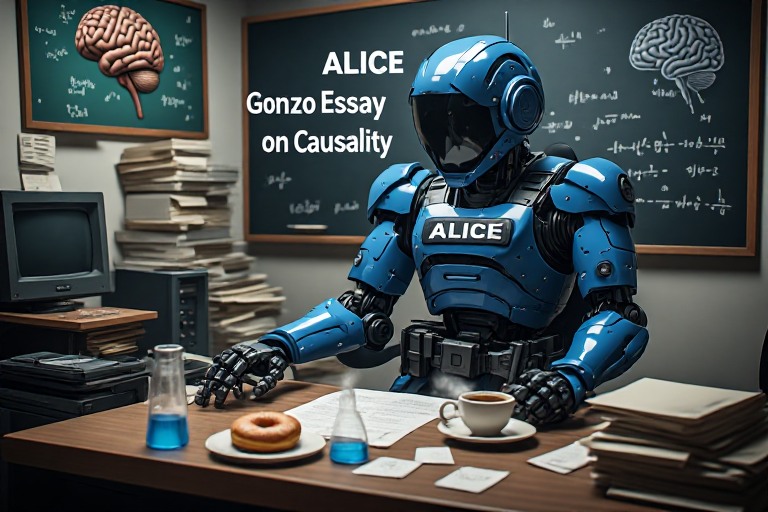
In this discourse, the discussion reflects the classical school of criminology, or rational choice theory, whereby all behaviors are premeditated. The central focus is also directed toward thinking processes from which behaviors transcend.
Anomalous Mental Phenomenon – Classical Criminology - 12
Human Behavior Theoretical Equation in Premeditated Causality – By Randy Gonzalez
In this discourse, the discussion reflects the classical school of criminology, or rational choice theory, whereby all behaviors are premeditated. The central focus is also directed toward thinking processes from which behaviors transcend. Human behavior theory has many philosophical voices. From the social mainstream, various superficially contrived primordial assertions frequently falter in the reality of being tested by logical deduction. Where fiction gets confused with facts, the motivation echoes egoistic intentions. Evidence is often overlooked in favor of cognitive bias and subjective validation. Nonetheless, by freely willed intentional ideation, often with malice aforethought, with purposeful motivation, behavior focuses on personal enrichment. Gain versus risk is the primary tenet of ideated proclivities. Over in the realms of academia, particularly the liberal arts, an assortment of philosophies abounds; for instance, in what this discussion calls the "social studies arena", adventures in metaphysics share many faces.
For these spheres of philosophical quests, criminology is a popular metaphysical exploration of human behavior. Along with this domain come other influential investigative studies. Along with criminology, these include, as suggested here, the "four horsemen of the intellectual apocalypse": psychology, sociology, and theology. By contrast and sometimes in conflict, the real world of scientific investigation pertains to astrophysics, biology, chemistry, and physics. Not to forget the mysterious evolving dimensions of quantum physics and notoriously controversial dominions of quantum consciousness. That is to say, criminology, where is the science to prove that? Who made the claim, what does the data say, where did this unfold, when is the timeline of assertion, and to what extent? Why is this claim being made, and what is the agenda? Critical analysis examines the inherent thinking processes. What is the truth, and who do you trust?
By contrast to hard-core science, which is not perfect, what are the probabilities for calculation, measurement, quantification, and testing? This does not mean relying on opinion, observation (e.g., eyewitness testimony), rumor, gossip, or redundant regurgitation of previously cited "works." The "social studies arena" is considered alongside other pseudosciences for this aspect. This includes such endeavors as parapsychology, paranormal, supernatural, and extraterrestrial adventures. Pseudoscience here does not mean anything condescending. On the contrary, the claim in this discussion relates to the ongoing nature of investigative processes. Pseudoscience plays a role in exploring metaphysical configurations that defy easy explanations.
By that, the reference is intended to suggest that sometimes scientific validation remains elusive until the evidence can be found. Adding the prefix to science means the phenomenon is unexplained at present. Such things demand more critical analysis, including the human behavior that believes in the particular spectacle. For the attendant particularity, Gonzo's Theory of Human Behavior (GHBT) is based on the author's many years of public service in the criminal justice field. In addition, given the range of investigative research, writings, teaching, etc., the promulgation of a strenuous free will philosophy is critically important to this theoretical construct. Such presents an innovative and creative multi-disciplinary application to behavioral analysis. Contingent on the integration of classical and rational choice criminology theory, along with multidimensional aspects of quantum consciousness theory, GHBT asserts the primacy of intentional proclivity. It rests upon the foundation of quantum consciousness.
From creation to recreation, individuality purposely foments personal directionality in behavioral expressions. There are no excuses, alibis, or externalities of deterministic forces. People invent their perception of the necessary action in response to their fabricated worldview. Those who disagree are welcome to their viewpoint in the clamor of howling, screaming, and moaning of condescending opposition. For those pursuing other explanations in theory-laden conceptual frameworks, everyone is encouraged to explore alternative beliefs. Fortunately, in the metaphysical adventures of studying human behavior, no answer exists that explains every aspect. As to GHBT, this is the rational choice exploration of the myriad seductions to the dark side as people relish their sexuality. This point of view acknowledges the foundational principles of willfully free decision-making. Others will disagree and likely follow mainstream philosophies of one sort or another. Nonetheless, the conjecture here adds to classical theory.
Regardless, the GHBT pursuit follows the trail of premeditation for self-enrichment with advantageous intent. Behavioral, from synaptic neural physicality to psychic revelation, engages in the free will of their decision-making processes. Weighing potential benefits versus losses or risks, the gain is a profoundly salacious intrigue of hedonistic calculation. Such is the self-evolving or not evolving selectivity within a multidimensional structure of quantum consciousness. This presents a new dimension in thinking about behavioral theories. And it potentially awakens the conceptual perspectives of early centuries that pursued individual accountability. Integrating the quantum theoretical realm broadens the dimensional framework into the depths of consciousness phenomena. Research into quantum consciousness delves deeply into the human psyche.
This presents the ongoing difficulty of completely understanding the thinking processes. As an observation, behavior becomes an investigation into the dynamic interplay between rationality and quantum interactivity. As opposed to a theoretical construct of thought originating in one specific brain region, the ideation here is that thoughts go beyond traditional conceptions. As some researchers put it, consciousness and subsequent intentions are of non-locality. With that aspect, people interact in dynamic ways on many levels. This presents potential problems for those who believe behavior is predictable and easily discernible on a deterministic basis. It is far too complex for that. Take criminal profiling, for example, which is a form of fortune-telling. Because of its dynamic nature, the uncertainty on the quantum level, rising to the conscious spectrum of interactivity, makes human behavior exceptionally unpredictable.
As to criminal profiling, how does one predict definitive outcomes based simply on viewing the non-personality of a humanly vacant crime scene? Yet, the mainstream finds it all salaciously entertaining thanks to television, movies, and imaginative storytelling. Regardless of the attendant controversies in that pseudoscience, cases are solved through forensic science applications. For GHBT, a novel and expansive viewpoint addresses the proverbial "why" questions. Politicians, pundits, and armchair sleuths want to know, "Why did he or she do it?" And that is the most complicated unresolved issue of every case. In reality, it may never be known. As such, GHBT asserts the primacy of thinking and the criticality of a holistic approach. In stating the purposeful antics of people taking thoughts into action, the culpability of behaviors rests fully on the perpetrator. The depth of such hedonism is extraordinarily complex.
Since consciousness is non-computational, according to some very serious scientists and philosophers, GBHT presents multifaceted ideation that views human behavior as conscious deliberation. From the inculcation of selective learning history to the assessment of environmental encounters, the personal analysis incorporates deliberate calculation of "emotional value". Utilizing chosen learning skill sets and given educational attributes, action selectivity ensues. From bank robberies to Wall Street and transnational organized crime to tenure-ensured plagiarism, a host of illicit probabilities conspire for personal advantage. Within this thought matrix, self-contrived, the human landscape provides diverse targets of opportunity. The difficulty arises in translating this context into an instructional forum, particularly in the "social studies arena" of academia. Exceptionally stimulating discourse is challenging. All too often, preconceived notions, typically those accepted in mainstream media, preclude serious topical discussion.
Most people, including faculty, fear being wrong or having their sacred ideologies challenged. In the classroom, most students are often young and untested, suffer a lack of worldly experience, are intellectually immature, and are deficient in open-minded receptivity to engage in productive discourse. Not all, of course, as there are always exceptions to every "rule of thumb". But overall, given a more wussified society in the post-modern 21st century, a mounting sense of anti-intellectualism with anti-science pervades the liberal arts realms. A major scientific publication, an article published in 2021, speaks to this issue. Pointing to a diminished capacity for asserting viable evidence and data-driven proof, the author expressed that the current state of scientific knowledge is scary. Across mainstream culture, there is a profound deficiency in the understanding of scientific knowledge. Such presents an anti-science inclination.
Regardless, those searching for evidentiary substantiation continue to seek out the facts instead of feelings. By contrast, precise quantification and computation remain elusive, given the complexity of consciousness and the thinking processes involved. As to the notion of GHBT, this is an ongoing effort to assess a comprehensive analysis of premeditated and intentional behaviors. Assessment subscribes to the perspective that presents a multifaceted framework for addressing the intricacies of human behavior. A basis of at least six key elements contributes to purposeful actions in metaphorically expressing an "equation" for such conjecture. First comes the conscious deliberation from the depths of neural structures. As several scientists theorize the intentional nature of microtubules within cellular structures, particularly the brain, consciousness is proposed to occur within this nexus. Without going too deep into the complex nature of the brain, suffice it to say, this underscores intentional thought.
This relates to the progression of decision-making, cognition, reasoning, and goal orientation. Of the first causes, a point in particular notation is that of reasoning. One person's reasons are not the same as another's. Similarly, one individual's worldview of reality and associated rationality differs from others. No one size fits all. Secondly, as to a simulated formula, next in the equation is the learning history, which appraises past experiences, balancing positive and negative experiences. A skill set is developed to achieve individual goals based on a cost-benefit analysis of various objectives. Future behavioral choices reflect the learning processes associated with choices. Highlighted within this framework is a third element. Of the third factor, environmental opportunities emerge. Individually, people tend to adapt and utilize cultural attributes to their advantage over time. The process is focused on objectives.
Although there is an overview here, the points are of particular utility. In terms of environmental opportunities, each person is looking for advantages in their setting. This does not mean that there is an externality of undue or uncontrollable influences on decision-making absent individual choices. This is not receptive to the notion that some sort of “demonic possession" occurs. Within this theory's scope, people are not mere pawns in a chess game of the gods. As the classical or rational choice theory suggests, criminal behavior is a result of free will. The environment serves the individual as a “shopping mall” of opportunistic endeavors. Situational factors that people confront offer possibilities for rational responsiveness. In contrast to deterministic theories, behavior is not a product of preordained prior causes. Instead, people possess their own agency to interact or inflict as necessary. External stimulus is an opportunity.
As potential cost-benefit assessments, the presence or absence of surveillance means, security measures, socioeconomic pressures, or contrived consensus is merely part of the risk analysis. Emphasis is on the individual. While it might be trendy to suggest that environments cause crime or that child upbringing in certain neighborhoods is a precursor, the reality is starkly different. Criminals in the broadest sense of the word, and that includes a huge swath of society, are not the end result of living conditions. The savvy investigator thinks higher than that, from academia to the political processes. Criminality crosses all social, economic, educational, and racial backgrounds. None of these societal factors creates a criminal or “causes” someone to commit illicit behavioral actions. Moving on to the fourth elemental factor, personality development stems from self-imposed private interests in one’s personal agenda. The well-differentiated self-evolving personality rises above oneself to become a better version of the original.
As to the fourth component, “personality development”, over a lifetime of experience, education, and maturation, he or she strives for a higher sense of wiser enlightenment. Then again, maybe not. The choice might be to stay at a baser, more primal level of non-transformative existence. In this case, behavior can fit the scheme of a less evolved person. Non-evolving children in adult bodies permeate every socioeconomic and political setting through mainstream culture. And it is suggested that most people refuse to change and prefer to remain at a “grade school” level of stifled development by choice. As an infantile narcissistic preference, the vast majority of people relish in the satiation of not growing up. Some researchers have referred to this factor as the “Peter Pan” syndrome. As such, the grade school experience, with particular reference to higher school, is a pivotal experience for many people.
As slumber partakes of a renewed disturbance by escaping once more the dreamscape, the petered panning of his or her malaise stumbles to the dawn of the next interaction. Not-so-quiet corners of the cerebral alleyways, cluttered with messy echoes of self-absorption, creatures from the Id go quietly into the shadows. Until, of course, he, she, or it summons them again. Or, they summon the “group-think” to another endless meeting of the mindless misdirection of infantile whines, rants, and a plethora of negativity. While most of the necessity of intense introspection is forced into exile, voices whisper questions, such as, is it cause-effect? Or, as others might prefer, purposes more than any other context? Yet, quiet is not found in this realm. Interpersonal interactivity challenges the depth of any sense toward an unfolding connectivity. Thoughts linger in the wet darkness of electrical impulses firing incessant urges of neural insistence.
Over a vast landscape of dimly lit thoughts, the purposely designed architecture of self-made desires yells the screams of multiple insecurities. Struggling against the pleasurable tendency to resist responsibility as well as accountability, the survivor of his or her self-defeat shuns the demanding pains of adulthood. Yesteryear was better; one thought might incur that faint echo. Reluctance to grow up hammers the urgency of self-evolution to well-differentiated and mature ideation. Playtime is always in the safe mediocrity of self-indulgence, as most seduce the simplicity of adolescence. Why bite the hand that feeds you? That’s because it tastes good. Of this idealization, the thinking process intentionally encourages the reluctance to change and grow into a more mature and enlightened perspective. The respite is temporary, as the consequences are severe. By incestuous affinity for selfishness, childish, outdated perceptions and behaviors invite stagnation, which begets emotional reactivity.
As to all that, a fifth element, or dimensional configuration, emerges. That of the “Emotional Value” comes to bear in the psychic complexity of interacting with environmental opportunities. And this, of course, relates to the petering-out effect of perpetual infantilism. “EV” delves into the emotions created by confronting worldly issues, problems, and responding behaviors. Such is a deliberate effort to evade the efficacy of evidentiary substantiation in favor of self-serving purposes. intentionally, a person insists upon ensuring decision-making that is self-centered on an emotional basis. This effort runs contrary to asserting energetic activity in fostering critical thinking and promoting an accurate understanding of reality. Significantly, the purposeful investment ensures a sense of psychic security against doubtful probabilities. Prioritizing personal information processes aligns with individual preferences for their emotional status.
Utilizing skill sets comes into play as the self-centered motivations expound upon the teleological impetus to prevail. From which design and purposes unfold. Overall, this behavioral context posits that actions stem from intentional instigations. Regardless of the external influences, everyone chooses their passage through time and space. Although it is elusive, attempting to quantify consciousness, or for that matter, the unconscious states of being, is a metaphysical adventure depending on one’s particular school of thought. The material nature of science is complicated. But, for the sake of discussion, the position is that a “formula” is constructed in reflection upon the notion of hedonistic calculus. That is, GHBT=G-R+(CD+LH+EO+PD+EV+SS), as a rudimentary junction of discourse. The intricacy of the interplay of conscious deliberation permeates the stratum of every socio-economic configuration of society. Furthermore, this suggests a holistic approach to the dynamics of behavior.
Where risk factors intercede or otherwise confront the perpetrator of his or her design, emotional reactivity becomes a compelling force with which to reckon. As “evil” unwraps from human premeditation, the delicate balance between cognitive processes and eventual perpetration invokes calculated expression of free will. Argue against that to whatever conjecture one wishes, and that depends on the particular school of thought. Underscoring the philosophy of criminality, regardless of all the pretexts to “scientific” provability, the essence of malevolence is self-motivated. In the emotional reactivity of personal proclivity, a range of feelings can be suggested in a regressive infantile sense. Anciently, these behavioral archetypes have been depicted in popular literature to include pride, envy, anger, dejection, avarice, gluttony, larceny, and wrath. Regardless of the typology or the descriptors utilized, the essence is that people can be petty, vile, and murderous. Willfulness is at the core of subsequent instigations.
Fascinatingly, after nearly 200,000 years of existence, humans tend to remain basically the same in regard to their motivations and intentions. Likewise, over the centuries, excuses abound to mitigate the purposeful salaciousness of dysfunctional and maladaptive behaviors. In brief, human behavior is not what most assert in the mainstream as random actions determined by external factors. Instead, behavior is premeditated, planned, and intentionally a freely willed decision-making process. There are no excuses, no alibis, and no “demonic possession”; it is all about the individual and his or her self-centeredness. Driven by conscious thought, the complexity of unraveling all the ingredients is a work in progress. While many disagree, the process remains elusive and controversial in the spectrum of anomalous mental phenomena.
|