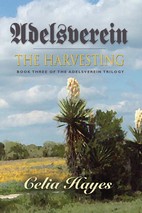
On the eve of release of my latest - "The Adelsverein Trilogy" - some thoughts on where it all comes from
I suppose it does seem a little like magic, this storytelling thing. Explaining it, even to yourself, much less to other people usually results in bafflement. Like the old joke about dissecting humor being like dissecting a frog – by the time you are done, there is nothing but a bit of a mess and confusion and the frog is dead anyway. Mom and Dad are as puzzled by this aptitude in me as anyone else – they can’t for the life of them figure out how I came by the gift of spinning an enthralling story, of creating people on a page and making them so interesting and endearing that they care very deeply about them. Made-up people… and these are my parents, who have known me all my life. They can’t figure out how I do it, especially Dad, the logical and analytical scientist.
“Are you picturing it in your head, as if it was a movie?” he asked me once, and I suppose that comes as close as anything – although it is as much like to a movie as real life is, or maybe a hyper-life. I can see what the characters are seeing from all angles, know what they are feeling, the little things they do which betray that feeling, I can sense what the weather is like, how where they are smells… a couple of readers have pointed out that I do take a lot of notice of smells. Can’t account for that, either; just another aspect of the gift, I expect. The semi-employer who has also volunteered to edit much of Book 3 (which will be available after the first of the month- thank god and what a panic that has been!) also notes that I do pay particular attention to the weather, what the sky looks like, if it is hot or cold, rainy or clear. She noted this in particular as regards “To Truckee’s Trail”, which I didn’t think surprising, because of course, living in a covered wagon, and in tents, walking ten or fifteen miles every day, of course one would have taken note of the weather. The weather would have governed every aspect of their existence for six long months, all along the Platte River trail, to Fort Hall, and into the wilderness of the Great Basin – never mind the Sierra Nevada, where weather would kill half of the Donner Party, not two years after the pioneers of the Stephens-Townsend Party dragged their wagons over the summit.
Don’t know where I got this sensitivity from – unless it was as a teenaged Girl Scout, being dragged along on all sorts of back-packing expeditions into the mountains; miserable experiences which usually resulted in making me sick from exhaustion and sun-exposure for a couple of days after returning from the worst of them… but I still hold in memory, the taste of sweet water, from a rivulet, high in the mountains above Lake Tahoe, and drinking it from my cupped hands. And also the experience of trying to sleep in a wet sleeping bag in March, high in the Angeles National Forest, after melting snow had trickled through our campsite all the day. After that one, I had a whole new appreciation of weather, even though I was never at any hazard for frostbite.
Places – I construct them in my imagination as carefully as I used to build miniature interiors; what is in the room, what are the walls made of, how sound is the roof, what do you see when you look out of the windows. What is growing in the ground outside? People live in these interiors – what would the imprint of their lives have left on that space. I saw a vignette at a miniature show once; an elaborate scene of a WWII fighter plane and a cross-section of the maintenance shed close-by, in 1-12 scale. The craftsman who had built the vignette had made the shed a show-piece of squalid disarray, including a thread of cigarette smoke rising from an ash-tray on the workbench. It was as if someone had just stepped outside for a moment… and that is such art, to make it so real that you can see the cigarette ash crumbling into the tray and a bit of smoke rising from it. In 1-12th scale, it was a real place, as real as any of those places I have built in my imagination.
People – that is one of the other weird aspects of this gift. I can read people, after a time. I have always been able to do this, not instantly – that is supposed to be one of those really, really useful talents, extraordinary valuable for a personnel manager, or someone doing job interviews, reading people as accurately as one of those instant-read cooking thermometers… but it is not mine. I’ve been fooled as well as anyone else, on short acquaintance. There have been people that I thought initially were major-league assholes who turned out to be quite the reverse, and people whom I had a good first impression of, who turned out to be so useless or malevolent that they should have been marked off with day-glo tape and tall plastic cones as a hazard to human navigation… but after six months of work-day association, I would know someone. I would know someone so thoroughly, be able to assess them down to the sub-atomic particle, with a fair degree of accuracy. This used to astound my fellow NCOs. They would not have realized some essential truth about Airman So-and-so, until I pointed it out to them. Then, with a shock, they would realize that I was right, and everything about Airman So-and-So would be understandable, out in the open, and perfectly transparent … and why hadn’t they have seen it?
I think that being able to create convincing characters might be somehow linked to this ability. Always, when I had to do a performance rating on a subordinate, my crutch in constructing this official bit of documentation was “What is the thing about this person which instantly comes to mind when you think about them?” And there would be the fist sentence in their required yearly Airman Performance Report, and all the rest of it would flow after that. What is the key bit of their character, what is the essential bit that you have to know? Everything flows naturally from that… and so it is with creating characters. In my “Adelsverein Trilogy” I had to get a grip on what is their essential core characteristic. Everything flows from that: I couldn’t get a read on Magda and Carl’s children until I was writing a scene of their sons and Magda, digging up potatoes, before Christmas, 1862, during a year when they were living in poverty in Fredericksburg. Everything about the two boys became clear – the older was grieving and traumatized, the younger was taking emotional refuge in books, and would emerge as being elastic and undamaged by the experience. Everything about them was established – they would go in different directions, their reactions to various experiences would be complete as this sudden insight would take me – and everything would be coherent and sympathetic.
But of course, that is the other aspect – kind of an uncomfortable one, as far as I can see; seeing people at the best and worst, to know them down to their core – especially when it comes to people who are not all that admirable. That is actually the most challenging bit of writing a story – that is, writing about characters who are psychopaths. The major villain in Adelsverein is one if those – so cruel, so brutal – I actually don’t want to go there. I don’t like or sympathize with that character and I don’t want to go any farther into the story of him. No farther than it would take to outline the effect that he has upon the other characters, or how my main characters feel about how he meets his eventual doom. Which is as just as it is unexpected – or so I hope has appeared to anyone who reads all three books of the Adelsverein Trilogy.
The creation of characters is another one of those miracle things. That happens in a couple of different ways. The ones who are historical characters are easiest of course; people like Sam Houston, or Jack Hayes, or John O. Meusebach, all of whom make appearances in the various volumes of the trilogy. There are biographies, and historical accounts of these characters, so it is simplicity itself for me to get an idea of what they were about, how they looked and spoke and what background they came from. This does have its distractions; I was waylaid for a whole week reading biographies and letters of Sam Houston, who makes a brief appearance in “The Sowing”, on the eve of the Civil War.
Then there are the ones which I made up: I start with a requirement for a character, a sort of mental casting call for a certain sort of person, usually to do something. It can be, to continue the movie imagery, anything between a starring role, down to just a short walk-on, bearing a message or providing some kind of service to the plot. I usually don’t get caught up in describing everything about them – which is a tiresome tendency I will leave to romance writers and authors who have fallen in love with their own characters. Just basic age, general coloring, tall or short; a quick sketch rather than a full-length oul painting. I also don’t bother with describing in great detail what they are wearing – that’s another waste of time. Just the basics please – work clothes, or dirty, or ragged, or in the latest fashion, whatever is relevant. And it’s really more artistic to have other characters describe them, or mention key information in casual conversation. That way allows readers to pull up their own visualizations of my characters, which seems to work pretty well and keeps the story moving briskly along.
On certain occasions, that character has instantly popped up in my imagination, fully formed. One moment, I have only a vague sort of notion, and the next second, there they are, appearing out of nowhere, fully fleshed, named and every characteristic vivid and… well, real. “Vati”, the patriarch of the Steinmetz-Richter clan appeared like that: I knew instantly that he would be absentminded, clever, loving books and his family, a short little man who looked like a kobold. His family would in turn, return that affection and on occasion be exasperated by him – but he would be the glue that held his family together. Another middle-aged male character also appeared out of nowhere, “Daddy” Hurst – technically a slave in pre-Civil War Texas, but working as a coachman for another family. His character emerged from the situation of slavery as practiced in Texas, where there were comparatively fewer slaves than there were in other Confederate states. Many of those so held worked for hire at various skilled trades, and also seem to have been allowed considerable latitude, especially if they were working as freight-haulers, ranch hands and skilled craftsmen. Daddy Hurst is one of them; I like to think he adds a little nuance to the ‘peculiar institution’. The only trouble with that kind of character is that if they are supposed to me a minor one – they have a way of taking over, as I am tempted to write too much about them. This was becoming a bit of a challenge with the final part of the trilogy “The Harvesting” since if I had explored all the various characters and the dramatic scenes they wanted – in fact, all but begged for – it would have easily been twice the 500 pages that it has turned out to be. In the name of all the trees that might have been logged to print it – I had so say no, not now. But I have taken note, and will try to work as many of them into the next trilogy. (Yes there will be another trilogy, focusing on some of those interesting side-characters and their own adventures; independent of the Adelsverein story arc. Look, if there are still stories to tell, why shouldn’t I tell them, as long as I can keep it dramatic, interesting, and involving enough to inspire the interested reader to plunk down upwards of $15 for the privilege of reading all about them? But the second-hand editions may go for a bit less…)
Where was I? Oh, characters, the third sort, evolution of… got it. That’s the other sort of character – the ones that I have started out with a certain idea of them, winging it a bit as I sketch out a scene for a chapter. Right there, they evolve, in defiance of my proposed plans for them. In my original visualization of their characters, as the romantic couple in the first book of Adelsverein, Magda Vogel Steinmetz and Carl Becker were supposed to be one of those sparkling and amusing Beatrice and Benedict couples, striking romantic and witty sparks off each other in every encounter, like one of those 1930’s romances of equals. Didn’t work out that way – he turned out to be very reserved, and she to be almost completely humorless. Beatrice and Benedict was so not happening! Within a couple of chapters of having them ‘meet cute’ when he rescues her niece from almost drowning— I tossed that concept entirely. I did recycle it for the romantic couple in the final volume; Peter Vining and Anna Richter. He was a Civil War veteran, an amputee and covering up his apprehensions and self-doubts with a show of desperate humor. She was the clever woman who saw though all those defenses, calmly sized him up as the man she thought she could live with and come to love… and asked him to marry her, never mind the exact particulars. It makes amusing reading, just as I had planned.
The pivotal character of Hansi Richter is the most notable of those evolving characters. He started off as a stock character, the dull and conventional brother-in-law, a sort of foil to the hero. A rejected suitor, but who had married the heroine’s sister as a sort of second-best. That was another one of those initial plans that didn’t quite turn out as originally projected. A supporting character in the first two books, by the third he moved front and center; had developed into a stubborn, ambitious and capable person, quite likeable in his own right – and carrying a good deal of the story forward as he becomes a cattle baron, in the years following the Civil War.
So there it is – as good an explanation that I will ever be able to come up with. All three books of the Trilogy will be available by the end of the month, from Booklocker, of course and also at Amazon and Barnes and Noble. I am setting up a number of signings – complete schedule will be posted here.
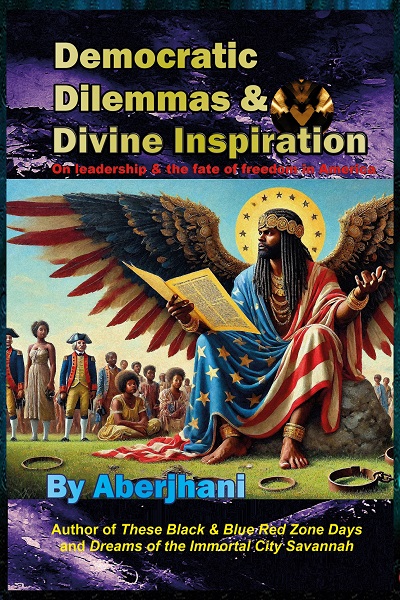
Democratic Dilemmas and Divine Inspiration examines the significance or relevance of the idea that the U.S. Constitution was, as many believe, divinely inspired. How much did that belief matter to founders of the nation and how much does it matter no
Democratic Dilemmas and Divine Inspiration examines the significance or relevance of the idea that the U.S. Constitution was, as many believe, divinely inspired. How much did that belief matter to founders of the nation and how much does it matter no