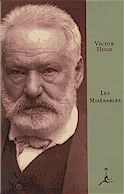
Despite the immortal status of Victor Hugo's classic novels and poems, there is much about the man that has remained untold, particularly outside of his native France. Yet his life was as dramatic as the plight of his famous characters. He was plagued with terrible tragedies, swept into a revolution, exiled from his country, and hailed as a hero upon his return during Bismarck's siege of Paris.
THE STRANGE LIFE AND VISIONS
OF VICTOR HUGO
by Theodore J. Nottingham
Despite the immortal status of Victor Hugo's classic novels and poems, there is much about the man that has remained untold, particularly outside of his native France. Yet his life was as dramatic as the plight of his famous characters. He was plagued with terrible tragedies, swept into a revolution, exiled from his country, and hailed as a hero upon his return during Bismarck's siege of Paris.
Most importantly, his writings, and particularly his powerful poetry, are filled with profound insight into the spiritual dimension of human existence. His words are still vital for our time and universal in scope. In the agonies he endured, the excesses he indulged in, and the states of consciousness which burned his soul with mystic awareness, Victor Hugo remains an inspiring figure for humanity in search of meaning.
Like most of us, Hugo was a man of a thousand faces. Some of them have become caricatures carried down through the years to the detriment of the great man's legacy. But those who have judged or mocked him for that voracious appetite for the opposite sex which obsessed him even as an octogenarian have failed to deal with the mighty paradox of his existence. Hugo was a man of colossal mystic visions and one who was immersed in an intense life of prayer. Yet this paradox was also wrapped in a riddle, for this deeply spiritual genius rejected the Church of his time and despised its priests.
This herculean ego who relished raw meat and spent nineteen years on a rugged isle in the North Sea, refusing to leave his exile even after the Emperor had permitted his return, was also the sensitive poet whose odes, ballads, and lyrical prose are among the finest ever penned. The author of the savage horror story Han of Island was also the writer of Contemplations, a work of stirring spiritual poetry.
Those who can read the original French know that Hugo is the Bach-Beethoven-Mozart of prose till wrapped into one. Those who have wandered through the landscape of his monumental fiction will agroe that every sentence was forged by a heart that bled for the agonies of the world and truly loved humankind. Those who have stepped into the dark light of his poetry, particularly the epics of his later years such as The Legend of the Centuries, God, and The End of Satan, know that their creator was a soul radiant with a rare consciousness of other worlds.
With all of these extremes present in one individual, Hugo stands in history as a classic case of the sinner/saint paradox. His life was a giant tension between light and darkness arid it spilled out onto paper with thunderous impact.
"Creation enters into the invisible and the imponderable, and disappears for you, vile flesh, lighting Infinity with a dazzling world, mirror of the darker one ... Know that She begins in the worlds of mystery, the worlds of terror and abandonment. And that She comes, among pale visions, from the precipice where slither larvaes and crimes. For beneath us, in the horrible plenitude we believe empty, evil disgorges a monstrous vapor that lives! There, engulfed in floods of disasters, the hydra Universe writhes. There all floats and sinks in an obscure shipwreck. In this gulf without edge, all that has lived rains endlessly in ashes. And one sees at the very bottom, when the eye dares to descend that far, beyond the noise of existence, a horrible black sun from which radiates the night!"
Victor Hugo achieved success early on and was acclaimed as a literary genius before the age of twenty. Even as a youth, his words vibrated with a luminous vision:
"I hate the noise of this world and I fear its dust. Seclusion, peaceful and proud, demands and independent heart. I wish no slave, I wish no master! Let me dream alone in the desert of my being. There seek I the burning bush."
He was the undisputed leader of the Romantic movement, gathering in his parlor the likes of Alexandre Dumas, Delacroix, Franz Liszt. His fame climaxed with his theatrical presentations, most notably with the play Hernani which revolutionized the world of theater and ushered it into the realism of our time. One of the great solliloquies of the play, spoken before the tomb of Charlemagne, already foretold the spiritual depths toward which Hugo was headed.
"What then? To have been Prince and Emperor, and King. To have been sword and law. A greater to have been than Hannibal or Attila, as great as was the world. Yet all rests here! For Empires strive and strain and see the dust that makes an Emperor!"
These fiery verses rose out of a roaring vortex within which led to painful consequences in day to day living. His marriage to his childhood sweetheart, Adele, cracked under the pressure of his sexual hunger. The young poet had kept himself pure until his wedding day, releasing the floodgates of his gigantic energies to such an extent that he apparently made love to her nine times on that first night. After four children, she called it quits and Hugo turned his ravenous nature upon young actresses who surrounded him by the dozen.
Among them, he met the love of his life, Juliette Drouet. This unsung heroine stood at his side to the end of her days, copying all his manuscripts, enduring the humiliation of living adjacent to his family home, and findin.'s him making love to her maid Blanche even after he had taken an oath on the head of his dying son that he would restrain himself. Hugo eventually admitted that his exile from France ordered by Napoleon III brought him back to himself and turned his mind from his frivolous indulgences to his timeless insights.
For nineteen years, he would wander four hours a day along the rocky coast of the isle of Guernsey, contemplating untamed nature. From this isolation came his greatest masterpieces, among them Les Miserables and his visionary poems. He was finally in touch with his true destiny.
"Dreamers are terrible. They forever have their gaze lost in the deep. Do not seek to reach in the darkness for these mysterious madmen led by a glow, these thinkers, these demons who wish more than to live! They have for mission to grasp the Unknown. They know that the pure, the absolute, the sacred, the real, have mysterious entryways!"
He reached heights of mystic experience which lifted his art to new levels.
"I have died. In Thy breath of fog and of light I vibrate, Heaven, as if bearing in me the filament of creation. As if all the invisible threads of being were entwined in the cosmos filling my breast!"
At the same time, he became involved with the spiritualism of his time, namely, seances and moving tables. He claimed to have contacted through. a medium his daughter Leopoldine who had died as a newlywed in a tragic boating accident. His encounter with mysterious forces became a daily,reality and his nights were tormented with overpowering dreams.
"We spy upon noises in the dismal void. We listen to a breath as we wander in the gloom. And at times, we see, brightening with overwhelming gleams, the window of Eternity! All is full of souls! All has consciousness! All speaks!"
One terrorizing night, feeling the presence of spirits all around him, Hugo brought his hands together in prayer. He left us the testimony that his hands were pulled apart by these oppressive powers. Nevertheless, he maintained a deep faith in the Christian God of compassion and love.
"My God is one whom religions do not make or destroy, with no face and no outline. One who has more love than the summer has light. One who speaks through the voice of the elements,who is invisible because of His immensity, One who is perceived in all and grasped in nothing. One who gives duration to Suns and patience to hearts, who is light outside of us and conscience within its. The eternal principle, simple, boundless."
The tragedies of his life never broke his faith in such a divinity. This phenomenon alone witnesses to the saint's strength of spirit which sustained him throughout his Job-like experiences. Consider the litany of his woes: His younger brother Eugene, who was jealous of his writing skills and in love with Adele, went insane on Hugo's wedding night; Hugo learned of his daughter's drowning from a newspaper while on a trip with his mistress; his second daughter fell in love with a young soldier who had no interest in her and she followed him across the oceans only to be returned to her family with a broken mind and spend the rest of her days in an asylum.
Hugo outlived both of his sons, one of whom died of a bloody apoplexy in a carriage outside of the restaurant where his father awaited him. From the wounded core of his battered soul, Hugo cried out in one of the most moving poems ever penned, "A Villequier" (the place where his daughter died):
"I come to you, 0 living Father! I no longer resist what happens to me by Your will. All that man sees is short, useless, and fleeting. A 1ways you make solitude return about our footsteps. I know that Creation is a great wheel that cannot move without crushing someone! In your Heavens, beyond the spheres, perhaps You make unknown things in which the sorrow of man enters as ingredient. You throw my cries away like a child tossing a stone into the sea! Death has its revelations. The great blows which open the heart also open the mind. Light enters us together with grief. 0 Death! Obscure mystery! Somber necessity!"
Hugo's outpour of verse and prose was so great that it would years after his death before everything had been publi-shed. He attributed this creative torrent to his sexual energy as he made clear to his grandson when the boy caught him making love to the maid. The old man is reported to have cried out "this is the stuff genius is made of."
The paradoxes of his life did wreck havoc in his heart, despite his rejection of religious morality and his firm belief that love transcended all standards. He found his equilibrium in the midst of these opposing forces only in his certainty of the goodness of the divine powers. And in the last years of his life, he reached a serenity equalled by only a few who have walked this earth.
"We are the bad man that I am, that you are. We throw ourselves on pleasures, on whirlwinds, on festivities. We try to forget the bo-ttom, the end. An unknown wind throws us at the threshold of Heaven. We arrive man, mourning, icycle. We feel ourselves melt and live. And, filling with ecstacy, all our being quivers from the strange defeat of the monster who becomes, in the Light, an angel."
On his deathbed, he whispered to his beloved grandchildren the synthesis of the understanding he had forged in his long and pain-filled life: "Love, seek love. Give happiness, and take it, in loving as much as you can." The dramatic mystic that he was left us with an enigma as mysterious as his own nature which lie slipped over to the other side: "I see black light."
The saga of his life covered nearly a century of historic turmoil, from the era of Napoleon through the bloody revolts in Paris so poignantly documented in Les Miserables, to the city's siege where he climbed the ramparts and harangued the invaders. In the midst of countless affairs, humiliations and glorious successes, death and despair, Hugo maintained his search for the transcendent and his message to humanity remains one of hope and vision:
"Oh, how all the harmonies will sing, how the blessed spheres will glow, how the heavens will melt in ecstacy, when matter finally loosens its hold, dissolving all misery, inundating night with beauty! The depths will say to the heights - I love you, when the banished return! Toward God, each will carry his brother and sister. Arms will open out to them, crying out - "It is you!" The tears will dry. Sorrows will vanish in the shadows below. An angel will cry -- the Beginning!"
|




Thank you for such an elegant and vivid painting of a fascinating life.