The narrative opens as Anatole, the happiest, most content mouse in the world, contemplates his world. Anatole lives in a small mouse village near Paris, France. Anatole and his wife Doucette are the happy parents of six lovely children.
During evenings Anatole, his chum Gaston and the other men mouse of the village pedal on their bicycles to Paris where they enter the homes of humans through secret entrances.
The men mouse are looking for food for their families. One night Anatole is horrified to overhear the humans talking.
The humans are upset that the mice are coming to take the food. Anatole, an honorable husband and father, knows he cannot continue to creep into homes looking for food. Anatole has a plan, he will find a job.
And, Anatole knows just where to locate the perfect job; he will go to the Duval Cheese Factory. Who knows more about cheese than mice? Into the cheese tasting room he went where he began tasting the cheese and leaving notes as to the taste.
The next morning M’sieu Duval himself came into the cheese tasting room where everyone pondered the strange little notes and wondered who this Anatole might be. When M’sieu Duval tasted the Roquefort and found that Anatole’s note that a little more orange peel was needed, big changes were at hand.
Duval followed Anatole’s suggestions, his business began to flourish, and Anatole felt he was earning his cheese in a most honorable manner. Anatole’s whole family were so proud of their respectable business-mouse. And, Gaston was most happy to be included in Anatole’s secret work.
When I began teaching over three decades ago children LOVED Anatole, and they love him just as much today.
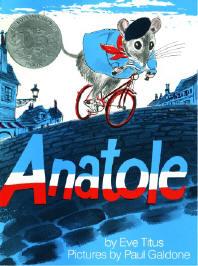
My resident critics, during my 2 year tenure in not K 1, fourth grade - Osage Co, Ok - Elementary, eyed the cover of this anniversary edition, were impressed by the rendition of the Caldecott medal on the cover and settled in for listening.
The class gave rapt attention as they always do when I am reading a book ‘received for review.’ They know their opinion is going to be added to the review. The students had high praise for the tale, ‘oh no, it is not too young for us, but little kids will like it too.’
They were delighted with Paul Galdone’s illustrations.
The class was impressed that Anatole was able to understand a problem, find a solution and better his life and that of his family and his best friend.
They enjoyed the ‘French words’ dotting the narrative and were intrigued at the depicted street scenes.
Eve Titus, who dedicates her work to her own child, presents children with an enduring favorite. First published in 1956 the book has lost none of its charm or appeal for children in the K – 4 group.
A read to for the younger set my 4th grade is able to take the book from the shelf and read it for themselves, and to take it to read to the 'little kids' in the Kindergarten classroom.
Paul Galdone, illustrator extraordinaire, created the perfect mouse in Anatole.
Black and white pen drawn illustrations are filled with evocative details, splashed with a little color of the French Flag; a dab of blue is added to several cheeses, furniture and trees while red highlights various clothing, rooftops or chimneys.
Anatole was a winner when introduced in 1956 and endures to today. Enjoyed the read, happy to recommend.
Reviewed by: Molly's Reviews
molly martin
30+ years classroom teacher
Genre: Children’s book
Author: Eve Titus
Illustrator: Paul Galdone
Line/Publisher Knopf, Random house, Alfred A Knopf
ISBN: 13: 9780375839016



Regis
love Tinka
Blessings,
Joyce Bowling