Collector's Guide Depression Era Kitchen Collectibles
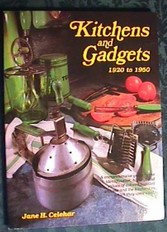
Kitchens and Gadgets 1920 to 1950 by Jane H. Celehar a comprehensive guide to the identification, history and values of colored handled gadgets and the kitchens in which they were used. I have collected Depression Era kitchen glassware along with gadgets, gizmos and thingamajigs for many years. Some I noticed in use in the kitchens of my grandmother and aging aunts. Others I have discovered at garage sales, in jumble shops, and estate sales. Some of the pieces I own are suspended from ceiling hooks, or rest on the walls in my kitchen and breakfast nook, and, some are in use when I slice a tomato or open a can. This particular paperback is my own and has proven itself vital over the many years I have scanned its pages searching for yet another captivating doohickey whose name and function may be as yet unfamiliar to me. This work with 136 pages chockfull with explanations and portrayals of numerous of the many items created during the Depression era is rightly a worthy resource for the serious accumulator of green handled kitchen gadgets. Many of us who accumulate soon recognize that we need to confine our fervor to a solitary paint, there were red and black and green and other colored handles of gadgets produced. I chose to collect green. Or. we will need to choose a single element to collect, from among the many kitchen gadgets just waiting to be lifted from a dusty shelf to be taken home by an eager collector. I find this exacting edition to be a prized resource. Acknowledgements and introduction are presented on 1 single page each. The author specifically notes that Ekco Housewares Company provided occasion for Celehar to examine A & J and Ekco catalogs from the 1920s to 1950s and provided catalog pages for use illustrating pages in the paperback. Illustrations are most beneficial when trying to identify a particular item, use, handle type and the like. For decades the kitchen was the step child of the home. It was frequently a small, cramped chamber unseen at the back of the house, or, was often an unattached small structure near the back door. At the turn of the century when wood both heated homes and provided fuel for cooking; just preparing a meal during summer tended to heat food, home and everyone concerned. As character of the kitchen and use of the room and its trappings began to transform; came a need for contraptions used for preparing foods and garnishes. The kitchen developed into a pivotal arena of the home providing a locale for rallying and dining and conversation. Where a knife for cutting and a large spoon for beating once epitomized much of the tool ware found in kitchens suddenly there were Baking Tools and Knife Sharpeners, Bottle Openers and Mixing Tools. And, there was color. The Table of Contents lists pages, and classes of items available for collectors as well as showing some of the development from the single Hoosier Cabinet to the expansive array of gizmos produced. Table of Contents lists American Kitchens 1920 – 1950 with pages in color as well as black and white; Manufacturers from A to Z, 8 pages; A Guide to Trademarks covers 6 pages, and proves invaluable for the serious collector; Finding and Purchasing Kitchen Tools provides cautionary notes including that as antique kitchen gadgets become less available, prices soar and how to care for these gems so that the price paid is not diminished with handling or improper washing technology. Background, Color and Dating information is 9 pages, filled with information regarding when, by whom and what was being produced. Dating and Patent Numbers is presented as a single page. Then the gadgets themselves are listed: Baking Tools beginning on page 68 lists cookie cutters, cake and sandwich cutters, biscuit cutters, revolving cookie cutters note: how anyone made cookies with these things I have yet to deduce, I have one and a more gnarly gizmo I have yet to attempt to use, but it looks good hanging up near the ceiling in the kitchen. Dough blenders, Pie Crimpers, Pastry Blenders that appear much as a lifter might to the uninitiated, as well as rubber scrapers, rolling pins and an interesting pie lifter are all shown and described in detail over 5 pages. Beaters and Whippers beginning on page 73 includes spiral whisks resembling modern gizmos, as well as flat wire whips in various oval to round design with green or other colored wooden handles as well as a series of vari shaped whisks and a one hand automatic eggbeater are detailed. More recognized egg beaters of the handle, rotating wheel and blades in the bowl are shown over 4 pages. Beater and Bowl, or Ptcher Sets and even an electric powered glass bowl and beater, 1933, rounds out the section. I will admit I have too many egg beaters, and a Beater and Bowl or two as well as several of these whisks. Bottle, Can and Jar Openers, Lifters and Wrenches begins on page 82 and specifies varied gadgets provided for removing corks and/or lids from bottles, in addition to lids removed by hand powered, stab in the point and move the can opener around the top of the can gizmos. These lethal devices did remove lids from cans, I suspect at times to the tune of a good bit of swearing and reaching for bandages, I have several of the things, and on occasion have used one or the other for removing a lid. Cut was never particularly true or smooth, but somehow lids did get removed and meals were prepared. A & J and Ekco began production of Miracle™ Can openers, the design continues in production to today. Handheld openers and wall mount openers also were introduced during the depression era, many continue in use to the present. Jar Lifters devices used then and now by home canners for lifting hot jars filled with fruit, jams or vegetables from pots filled with boiling water. The early lifters proved an outstanding archetype; the ones accessible on the shelf at the big box store for home canners today has changed little from those offered during the 1930s. Jar Openers and Wrenches are used for releasing or tightening metal screw type lids and caps. Once more, the design presented during the depression era is used today for the same use. Choppers and Mincers are hand powered, bladed mechanical and rotary cutting and shredding devices. Some are a simple blade with wooden handle while others are a mite more elaborate, all deliver the result, and maybe save fingers from scrapes and cuts as onions or other items are hacked into miniscule bits using something other than a sharp kitchen knife. I have choppers and mincers, they spend most of their time hanging on the wall. I do have a glass cup or jar and chopper devices too. Choppers include devices using up down movement to raise and lower the bladed end of the device in the glass cup or bowl, others, particularly convenient for chopping nutmeats, have handle or key turn chopping gizmo which fit onto top of glass jar. Rotary Mincers offered by numerous companies were used for narrow chopping, creating strips, of meats, fruits, vegetable, orange rind, parsley and homemade noodles. Cutting Tools (Other Than Knives) begins on page 94 and specifies fruit and vegetable ballers or scoops, butter curlers, corers, and parers, grapefruit corers and French Fry Cutters, Fruit pitters, and garnishers, graters in several different designs as well as ice cream scoops and ice picks of many designs. Parers, peelers, slicers and graters are included in this section. Juicers begins on page 102 and includes Juice O Mat™, Orange Flow™, Speedo Super Juicer™ and KwikWay™ are shown and detailed. Also included are the Handy Andy, and Universal fruit juice extractor. While I do have a number of glass reamers, I do not collect many metal juicers. The ones I have are mainly display items. Knives and Knife Sharpeners beginning on page 105 includes Bread knives, Cake and Pie Servers, and grapefruit knives, fruit knives, paring knives, spatulas, Utility Knives, and spatulas along with Knife sharpeners. I have several knife sharpeners, and have yet to be able to sharpen a knife using one of them. Sharpening Stones and Rods are also shown, these I can use for sharpening. Mashers, Pounders, Ricers, Food Presses, and Food Mills begin on page 109 and feature many designs of mashers including round, mesh and one with spokes. Pounders are wooden while meat tenderizers resemble axes with blades and ax type head. Ricers includes a whisk type, a push through mesh and one design that has continued to today with a perforated basked and pull down pressure panel. Measuring Tools begins on page 113 and details measuring cups, scoops, spoons and scales. My own collection of measuring tools is mostly glass. Mixing and Cooking Tools beginning on page 116 features beaters resembling lifting tools and slotted spoons as well as a Foley Fork, strainer resembling a lifter and a slotted mixing spoon. Coffee pots show a Drip O Later™ while a hand powered Toddy mixer with clear glass tumbler reads A meal in a glass. Popcorn poppers, the handled basket for holding over flame type are detailed as is an early electric popper. Also noted are egg poachers for cooking eggs sans shell in boiling water, these are used by submerging the gizmo with egg into the water. Egg lifters resembling ones seen today had wooden handles. Two and three tine forks for lifting and holding or stabbing meats and vegetables. I do have several of these with green handles, and use often for lifting and holding turkey and the like during holiday meals. Ladles and strainers, pan drainers, basting spoons and scrapers are all discussed. At one point I embarked upon search for into electric appliances and treasure my few toasters. They take up a lot of space on the shelf, nonetheless I was pleased to see one of the very early ones shown in the book, and its twin sitting in my breakfast nook. Lifters, often referred to as pancake turners came with wooden handles and slotted, pierced and dotted blades. Early electric waffle irons were a far cry to the ones we enjoy today. I have none, they too take up too much shelf space. Sifters and Strainers beginning on page 124 commence with Rotary Sifters. While any dry ingredient might be sifted, we called the one used in Mama’s kitchen a flour sifter. The basic design has changed little, a circular metal tube, mesh at the bottom, turn handle and a wire or other device for moving the flour through the mesh. Depression era sifters had wooden handles for turning. I have several used mainly for deco along wall area just below ceiling in kitchen. Horizontal Sifters feature a shaker type, to and fro sifting while trigger action sifters were used via a squeeze handle. Arthritis in my hands precludes my using mine for sifting, it hangs on the wall. I do use one having a green rotation type handle. Tea and Coffee Strainers used to separate liquids from solids by pouring through wire mesh featured wooden handles and perforated metal or mesh bowl. Strainers can be found in a variety of sizes. This book also discusses a few other specialty items, ones I do not collect, including curing iron, heated on stove, non-electric; various brushes and mops, and shows a green handle, electric clothes iron. Children during depression era as now enjoyed toys similar to those mom used, and various toy kitchen collectibles can be found. I do not collect these. Writer Celehar offers a 2 page Bibliography. And closes with an A - Z index. On the whole this is a well-researched edition describing many of the gadgets and devices obtainable during the Depression era. For the novice or serious collector this book helps guide understanding for use, appeal and purpose of the many items we can discover, perhaps use and fill our shelves, walls, cupboards, rooms, barn … Prices are shown for items, a note of caution, because a price is shown as the going rate today may or may not mean a thing in the market place. Items in a dusty box may be marked as .25 each and show in the book as $2.50, buying the item with a notion that a quick profit is to be made may or may not come to fruition. Prices vary from state to state, collector to collector and economy of the country, condition of the item, etc. I buy only things I like, and have a set price I am willing to pay in mind before I go to the sale, shop or whatever. If the seller will not haggle and the price is too great, I walk away. Knowing what you are looking at may be a huge advantage. I take my book along when I go on a foraging mission. My book published many years ago is still timely, the items showcased have not changed, only prices listed would be different in a newer edition. I will continue to use mine despite loose pages and notes penned in margins. Well written, well researched, good resource Happy to Recommend Kitchens and Gadgets 1920 to 1950 by Jane H. Celehar. Pages were not stapled or sewn into book, and after 3 decades plus of usage some pages are falling out. Even so, I still do not plan to replace. Product Details Paperback: 156 pages Publisher: Wallace-Homestead Book Co Language: English ISBN-10: 0870693581 ISBN-13: 978-0870693588 Product Dimensions: 10.7 x 8.3 x 0.4 inches
|





Regis
Ron