David Christianson, Horological historian has been a certified Master Watchmaker for more than twenty five years.
Note: Horology is the science of time, timekeepers and timekeeping. Writer Christianson brings his knowledge to bear with his publication.
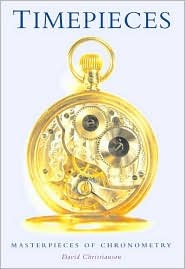
TIMEPIECES Masterpieces of Chronometry.
Timepieces Masterpieces of Chronometry is a work of 176 pages and even has a timeline depicting the commercial evolution of the watch set onto the inside and back cover pieces.
A Table of Contents begins on page 6.
Eight chapters, beginning on page 18 and continuing to page 161, is followed on page 162 with a Glossary.
Page 173 begins a section having Sources and Further Reading for the interested.
Acknowledgements and Index features a two page spread 174 – 175, and Picture Credits are provided on page 176.
The Celestial Clock, the natural timekeeper in the sky relating the passage of time is explained.
The chronicle is embellished with many graphics representing some of the approaches early man used to show the passage of time. From water flow to sun dials to astronomer priests, to armillary spheres and more, humans have wanted to track time from the earliest days.
Chapter 1: A Call to Prayer, monastery bells long measured every part of the day for the Christian community. Other religions including Judaism and Islam have long called for prayer during the day, nature regulates some of the times, sunup and dusk etc. for determining when to pray.
At other times devices are called into play. This chapter, too, is jam-packed with many visuals presenting ancient time devices including astronomical compendium, clockwork gearing, early clocks some dating to 945, a 1345 astrarium and more.
Chapter 2: The Priceless Possessions of a Few chronicles early domestic clocks of the 14th century. These size reduced versions of the massive clocks of previous days became widespread as many of the ruling class developed interest in the devices.
Watchmaking guilds came into being. Sumptuous clocks became all the rage. With the origin of the pendulum, tracking time became more precise.
Chapter 2 is awash with illustrations, photos and the like of early clock makers, along with, some of the clocks they fashioned.
Chapter 3: From Tabletop to Waistcoat and Beyond records the launch of the coiled mainspring during the 15th century as well as the influence that coil had on time pieces.
Craft guilds prospered in England and throughout Europe. Guilds were begun to shelter guild members from competitors, as well as to control wages, market prices and the market itself.
Chapter 3: features many illustrations including a duplicate of an oil painting, the portrait shows a wealthy man holding a pocket watch circa 1558.
Numerous watches are shown with case open to permit the early balance wheel and hairspring to be seen. A progression of watches allows the reader see how the watch has changed.
Chapter 4: The Craft Era in Watch Making. Watch Making dissimilar from clock making was concentrated in a small area for the first 300 years of its history.
Beginning in central Italy during the 15th century watch making began expanding near the turn of the 18th century. Small transportable timepieces, to be carried in the pocket developed into highly ornamental pieces.
Graphics featuring everything from a 17th century clockmaker’s shop, to many pocket watches, to table top models are scattered in the pages of Chapter 4.
Also included is a copy of the Geneva Rules of 101 (Abridged) with rules and regulations governing the Corporation of Watchmakers.
Watches featured run the gamut of very early to modern.
Chapter 5: The Industrial Revolution brought inevitability for the work force to be in the factory or other place of work at a particular time.
If the whistle from the factory’s steam engine did not waken employees, then factory bosses sent window tappers to get the workforce awake and on their feet.
Timing all through the Industrial revolution propelled mass production methods for manufacturing many watches with various shops responsible for turning out specific portions of the whole.
Eli Terry, master clockmaker of Plymouth Connecticut turned out 4,000 wooden gear clocks between 1807 and 1810; this was the first successful mass production America of a product having interchangeable parts.
Graphics include wood cuts showing factories producing watches and watch parts, as well as a copy of a painting of Eli Terry.
A photo of an Eli Terry mass produced wooden gear movement, mantle clocks, watches, and even a, 1896 photograph showing a group of workmen hard at work in the press department of the movement shop belonging to Wm. L. Gilbert Clock Company’s factory in Winsted, Connecticut are included.
Chapter 6: A Mountain Industry Explodes specifics re how families began specializing with each working on specific watch components in the mountain range forming the boundary between Switzerland and France.
From copies of watch factories to pocket watches, this chapter is filled with beauty, and detail. While most of the early paintings, wood cuts and the like display only men producing watches or other time pieces, Women have had a role in watch making during nearly the whole of the history.
Especially during the Industrial Revolution women and children too began working in the factories. During the 20th century women were accepted fully and began to seek training and pursue employment as watchmakers.
Chapter 7: The Standardization of Time and the requisite for unravelling the scientific problem regarding how to decipher exact position at sea came to the fore.
With the advent of the first sextant crafted by John Bird, 1757, and the steadfast dedication of John Harrison, who is pictured with his H-4 chronometer which could keep time so accurately at sea that a ship’s longitude could be determined; the conundrum plaguing seafaring nations began to become more manageable.
Many copies of paintings showing various of the early inventors, sea farers and such are intermingled into the text where they add much to the narrative.
Chapter 8: The Quartz Revolution was a time of much advancement in the perfecting of precision timekeeping. 1928 Bell Telephone Laboratories in New York State saw the development of the first quartz crystal clock by Warren A Marrison.
For four centuries the standard of portable timepieces had been the balance wheel, and then, in 1960 Bulova Watch Company developed a vibrating tuning fork, the invention of Swiss engineer Max Hetzel.
Smaller size and economical cost have caused timepieces, once available only to the wealthy, to become common place.
From many beautiful watches showcased in detail to carefully drawn gears and the like labeled How the Mechanical Watch Works, and the similarly detailed How the Electric Watch Works, this chapter is a treasure trove for those enjoy the minutiae and history of stuff.
I do.
The multi-page Glossary begins with Analogue display and ends with Zodiac. The glossary as well is filled with photographs, tables, and drawings.
The Bibliography allows the reader to follow more investigation should that be a desired option.
The Index allows the reader to uncover specific areas of interest.
I found this tome to be filled with lots of scientific evidence presented in a straight forward, easily read manner.
I enjoyed reading the book, and envisaging the evolution of time pieces from earliest days to the present.
Knowing that Writer Christianson is a respected, skilled craftsman who has served as president of the American Watchmakers and Clockmakers Institute, that he not only educates regarding clock and watch restoration, and is a Fellow of the British Horological Institute, but that he also writes for Professional Jeweler and Watchmaking publications; lends much to his credibility.
TIMEPIECES Masterpieces of Chronometry is a lovely work filled with the dedication to detail, and result of research presented by a renowned craftsman.
Fascinating read Happy to Recommended 5 stars
---------------------------------------------------------------
Title: Timepieces Masterpieces of Chronometry
Author: David Christianson
Hardcover: 160 pages
Publisher: Firefly Books (November 21, 2002)
Language: English
ISBN-10: 1552976548
ISBN-13: 978-1552976548
Reviewed by: Molly's Book Reviews molly martin



I'm just grateful that my TV cable company and my computer operating system provides me with correct time, at least while the power is on.
Ron