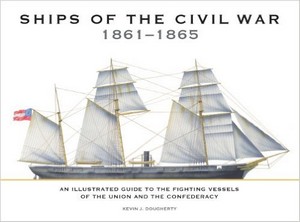
Although this tome is not a sit on the verandah in the shade, sip tea and read volume; it is significant as a helpful go to work explaining background of many of the vessels used by both sides of combatants during the War Between The States.
Kevin J Dougherty’s SHIPS OF THE CIVIL WAR 1861 – 1865 rather than a story book is a reference type work. Although this tome is not a sit on the verandah in the shade, sip tea and read volume; it is significant as a helpful go to work explaining background of many of the vessels used by both sides of combatants during the War Between The States. Organized by style of ship; this work helps the reader recognize that while the land encounters fought during the war are often well known, naval actions were correspondingly an essential component of the time. Warfare entered a pioneering and ongoing setting for combat by use of everything from river boats driven by paddle wheels to ram ships, cruisers, steam driven ships and the introduction of ironclads. This Illustrated Guide To The Fighting Vessels Of The Union And The Confederacy is an exceptional background book for the history buff, serious researcher, or one having some, but perhaps not a lot of cognizance or acquaintance for that bitter period in our nation’s history when the reverberations of armed struggle resonated through much of the country. This well researched work of 224 pages commences with a Table of Contents listing the Introduction, followed by varieties of ships included in the work. Ironclads, Gunboats, Raiders, Cruisers, Blockade Runners and Submarines are described in depth with the name of the ship, year, facts regarding the vessel on the left page in addition to a large illustration of the ship on the right. The arrangement of the book permits the book to be entirely open with facing pages lying side by side. The full color illustrations are done by hand; and are not photographs. In the introduction author Dougherty details first The Federal Navy strength and activities, numbers of naval personnel at the beginning of the war, 1861, and explains who Secretary of the Navy Gideon Welles was, and what his function was. The blockade of Southern ports was a major concern for the Union, Navy, closely followed with capitalizing upon Southern vulnerability via large rivers leading into the heart of the Confederacy. Early photographs as well as paintings are added in the Introduction. The Confederate Navy faced the formidable undertaking of building and effecting a Navy beginning with 5 ships brought into the Confederacy by seceded states and growing to 130 vessels. The Confederacy lacked industrial shipbuilding capability to equal that of the Union shipbuilders. The listing of ships commences with Ironclad, CSS Manassas, 1861 a Confederate vessel originally built in 1855 as a twin screw towboat in Massachusetts, converted to ice breaker, and used during the war as a Ram. Specifications include displacement, dimensions, armament, armor, machinery, the Manassas was powered by steam, and manned by a crew of 36. The text portion of the ships’ narrative begins with an account concerning when and where a vessel was built, anticipated use of the ship if built before the war as a non-war vessel, and how it was transformed to war usage. I like that many of the ships are shown flying either the first national flag of the Confederacy, The Stars and Bars, or the Union’s Old Glory. Many of the crafts are shown as the only one on the page, as is the CSS Arkansas; while some are shown with another of the same type as is the CSS Atlanta built in Scotland, launched in 1861 as a merchant steamship the Fingal. When the blockade prevented her leaving US waters she was cut down to the waterline, rebuilt as an ironclad ram went into battle was run ashore and captured by the US Navy. After repair the Atlanta was recommissioned as the USS Atlanta where she joined other ships in the blockade of Southern ports. On the same page is a description of another ram, the CSS Texas. One illustration was particularly thought-provoking; The USS Essex is shown in cutaway providing the reader with a view to the interior of the vessel. The Ironclads are a group of 44 vessels including rams, blockade vessels, riverboats, combat boats in the Western Theater, some were converted side wheel steamers, others were powered by a diversity of steam engines powering single or twin screws, at least one bore sails in addition to horizontal direct-acting Mazeline engines driving twin screws, while another utilized two vibrating lever engines representative of the wide diversity of vessels used by Union and Confederate naval personnel. Gun boats listed pages 88 – 162 show the power of federal naval power with 27 vessels to the 7 confederate ships and others used by both sides at differing times. Gunboats, armed with a variety of guns, were used as blockade, fighting, river patrol and defensive vessels powered by sail, side wheel steam, horizontal direct acting engines, and a further diversity of mechanisms. I found one gun boat listed to be particularly remarkable, the USS General Bragg, impressed into Confederate service, transformed into a cotton clad ram… double pine bulkheads were filled with compressed cotton. Raiders are listed on pages 162 – 183. These are the ships often shown in movies dodging and running the blockade of southern ports. Most of the raiders shown are those commissioned by the Confederacy. English ship yards produced a number of vessels for the Confederate effort, all in all 10 Confederate raiders are depicted while only 1 USS is shown. On the pages beginning 204 -212 the Blockade Runners includes the Teaser, in essence the first air craft carrier, a wooden hulled, screw tugboat purchased by Virginia, April 1861; the Teaser was used during the Seven Days’ Battles by balloonist Lt. Col Edw Porter Alexander. Tethered to the deck of the Teaser, Col Alexander observed Federal movements. Closing out the naval vessels portrayed in this book is a small selection, 3 CSS and 1 USS forerunners of the Submarines which are an important part of modern naval contingents. The CSS Pioneer propelled by a crank shaft, carried a crew of 3 men, 1 of whom propelled the craft by turning the manual crank of the screw. Armed with a clockwork torpedo, the cigar shaped vessel had a conning tower, manholes in the top and small, and circular glass windows in the sides. The CSS Hunley privately built in spring 1863, in Alabama was discovered, underwater, off Sullivan Island, she was recovered in 2000. In 1999 the remains of 4 of her crew were located in a Confederate Cemetery during renovations at the football stadium at the Citadel. The remains of the 8 man crew recovered when the Hunley was raised were buried in Magnolia Cemetery in Charleston with full military honors in 2004. Page 220 offers a Select Bibliography as well as a small glossary of terms used in the specifications regarding weaponry, propeller, in naval terms screw and engines. An index closes out the work. I bought this book as a gift for my husband. Husband and I share an interest in US history in general, and the War Between the States in particular. We each have a pretty fair understanding of many of the land battles, have visited many of the battlefields, and have a fairly sizable home library filled with books written about the era. While we, as nearly everyone who has even passing understanding of the war, were well aware of the Merrimac and the Monitor; we did realize these were not the only ships of the era. However, we were both a bit surprised to learn there were so many. Writer Dougherty, a professor at The Citadel, has created an estimable volume highlighting a well-rounded mixture of ships detailing capabilities, strengths and short comings found in ships used by Federal and Confederate leadership. Written in unmistakably understandable language, details of the vessels are easily understood, type of ship, name, reason for the name if known, captain, battles and uses are all set down. Some of the vessels survived the war and are now on exhibition as is the USS Cairo today displayed at Vicksburg National Military Park. Others as did the CSS Louisiana did not survive battle, she was cast adrift towards the Union fleet, burst into flames and did not survive. Some sank and have been recovered, some were sold for scrap. I found the introduction jam-packed with a wealth of information especially for the observant reader who may be interested; but has not yet become steeped in the details of the 1861-1865 era. I am always desirous to add to my own understanding of the period, and found fascinating that Mare Island in California was one of the Union’s eight navy yards. I was born in the Bay Area, California, and grew up on stories my Dad told of driving materiel and the like to or from Mare Island during WW2. Photographs and paintings add much to the text forming the introduction. Challenging, inspiring read, Happy to Recommended, 5/5 stars.
Reviewed by: molly martin Title: Ships of the Civil War Genre: non fiction Author: Kevin J Dougherty Illustrator: various historic photographers and illustrators Hardcover: 224 pages Publisher: Sterling (2013) ISBN-10: 1435145925 ISBN-13: 978-1435145924 Product Dimensions: 12.1 x 9.1 x 1.3 inches Available Amazon
|


Ron