Foreword -Vanderbilt Professor Emeritus, James R. Lent, sets the tone for the volume with his opening statement, ‘there is something different about this book: It is useful, really useful.
Gill relates that in 2001 when this book was copyrighted, she had been teaching, for the better part of 2 decades during which time she had spent quite a bit of time defending the vocation and offering suggestions to assist careworn teachers be successful; which activity has led to her setting down her notions in a paperback destined to make available gear and courage to permit teachers to pursue their best intuition regarding what to do in the classroom.
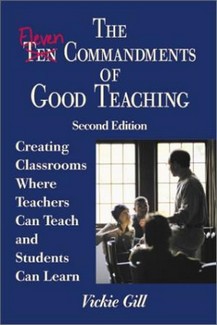
Vickie Gill’s The Eleven Commandments of Good Teaching 2d edition, Creating Classrooms Where Teachers Can Teach and Students Can Learn includes a Table of Contents for trouble-free examination of the variety of topics Writer Gill showcases as essential for setting the pitch of a classroom.
Gill’s conviction that educaor’s teach people not subjects, are amongst an influential group of people who truly can effect change in the world, and are a carefully observed role model who communicates more by what they do than by what they say; is totted up under her first chapter title Thou Shalt Have a Calling to Teach.
Gill’s impression that Thou Shalt Demonstrate and Project the Joy of Learning is an outgrowth in large part for the reason that it seems that many people who do not teach apparently have the fancy that teaching is a lackluster, joyless profession. She reminds us as teachers that we need to take time to keep in mind just it was that drew us to teaching including remembering the kinds of things performed by our own favorite teachers.
Uniqueness of educated persons, in writer Gill’s opinion, include educated people can learn what they need to know, they share a familiar body of knowledge with other educated people that helps them in discerning what they need to know and they are inquisitive; in short, educated people tend to be lifelong learners. When deciding what to teach Thou Shalt Keep Your Eyes on the Prize; producing educated persons is the prize.
Thou Shalt Be Organized and Accountable Gill observes that it is incumbent upon each teacher to provide evidence regarding what is taught in his/her classroom. The perception that every teacher and every classroom is a reflection of all others is not a very purposeful idea. Every class is singular because needs of each student must be considered along with state and local teaching standards with reference to what must, should, will be presented in the classroom.
Preparing lesson plans, using those plans, and preserving records illustrating the progress of each student is simplified to accomplish when the teacher is organized, accountability is easier to create when documentation is kept showing what was taught and what learners produced as a result of the teaching.
Gill notes Thou Shalt Ask and Ye May Receive, which was one of the first things I was taught during my first teacher preparation, college class. If you require something for your classroom ask, and be primed to clarify how you will use whatever it is, and why you hope to use the whatever.
Thou Shalt Be Fair and Prepared and Thou Shalt Use Some Common Sense seem to be self-explanatory and to be expected for all educators in every classroom or other teaching situation. Groundwork is the basis of successful teaching whether the teacher is using a commercial lesson plan book, used by many teachers across the nation, in which he/she writes hourly subject notes concerning the lesson to be taught day by day or simply sets out lists with standards and materials for each class activity.
Evenhandedness is expected by teachers and students alike. Common sense, or the lack thereof, guarantee whether success or failure will be the conclusion for every teacher. Gill points out that ‘children like to know there is someone in charge, someone who has their best interests at heart.’ No matter how vexing they may find rules; children do know that they are not proficient or mature enough to make what may be life changing decisions'
For equanimity teachers do well to remember Thou Shalt Be Open-Minded and Flexible one of the most imperative sentences I find in this chapter reads ‘Schools are filled with all types of personalities and styles’. What works well in one classroom may not in the one across the hall. Find your inimitable style and, so long as students are showing progress, you as a teacher are comfortable with the style and progress; instigate it. The chapter finishes with another sentence worth remembering; ‘because we, teachers, work with people, we have to be ready to embrace the unexpected and make it work.’
Thou Shalt Not Work in Fear help new teachers and seasoned ones too recollect that while our triumphs provide us more self-reliance and raise our standing in the eyes of fellow teachers; it is the failures that are the best teachers for refining our modus operandi.
For the reason students come to the classroom with diverse degrees of want to and can do it is important for teachers to remember Thou Shalt Raise Your Expectations. Gill points out that people fall pretty much into 3 types, the ones who make things happen, those who watch things happening, and those who ask what happened. Students are apt to function up to realistic standards, or down to standards set lower than they need.
Thou Shalt Keep Things in Perspective Gill helps novice and seasoned teachers keep in mind that in large part we each are the masters of our own destiny. Things happen in life, we can modify some and some we cannot. Repair what we can, realize what we cannot, and move forward.
My well used copy of The Eleven Commandments of Good Teaching 2d edition, Creating Classrooms Where Teachers Can Teach and Students Can Learn demonstrates the fact that I too found, as did Professor Lent in the Foreward, ‘there is something different about this book: It is useful, really useful.
While my calling of nearly 4 decades was spent in K-1 and Writer Gill for the most part taught high school English; her easily read book is overflowing with down to earth proposals for setting up a working classroom sponsoring a learning atmosphere, and clarifying the need for careful planning including proposals regarding how to go about devising lessons. Whatever the grade level, age of students or subject matter planning, learning environment and lessons are something all teachers do.
I read The Eleven Commandments of Good Teaching 2d edition, Creating Classrooms Where Teachers Can Teach and Students Can Learn cover to cover more than once during my almost 40 years, kept the book in my rolling bag taken to the classroom each day and read individual chapters again, and again as I felt I needed a nudge in one direction or another.
I come from a family of teachers, grandfather taught, my two sisters taught, their husbands were also teachers.
I particularly enjoyed reading Gill’s individual teaching moments, while hers were a bit dissimilar to mine because our students were widely apart in age, all teachers have tales of classroom happenings and take pleasure in remembering their own and hearing those of fellow teachers whatever their classroom makeup.
Excellent gift for a new teacher, student teacher, any teacher.
Interesting, educational read, happy to Recommend 5 stars
=========================
Reviewed by: Molly’s Reviews
molly martin
http://www.AuthorsDen.com/mjhollingshead
30+ years classroom teacher
=============================
AMAZON About the Author
Vickie Gill has taught high school English, reading, and journalism for 30 years in both California and Tennessee. Gill has won several teaching and community service honors and was a finalist for Tennessee State Teacher of the Year 2000. She is currently teaching part-time and works as a consultant for a school district in central California. She has a BA in English from San Jose State University and an MEd from Vanderbilt University.
Author Biography
I have been teaching high school students how to read, write, and think for almost 30 years. I love my job. If I could afford it, I’d do it for free. So it always distresses me when each year I encounter an increasing number of new teachers who are ready to quit the profession after a couple of months or veteran teachers who are literally enduring until retirement. Their frustration and misery are passed directly on to their students.
If you’re good at it, teaching is the best job in the world. If you’re not good at it, it can be a nightmare that affects your mental and physical health. My books are not for those who go into teaching to have their summers free or because they think being a teacher will give them the power they lack in other areas of their lives. My books are for those who fell in love with teaching because they love children and because they truly believe they can positively affect a child’s life.
Title: The Eleven Commandants of Good Teaching
Genre: Education
Author: Vickie Gill
AMAZON Product Details
Product Details
Paperback: 104 pages
Publisher: Corwin; 2nd edition (April 27, 2001)
Language: English
ISBN-10: 0761978100
ISBN-13: 978-0761978107
Product Dimensions: 9.8 x 5.8 x 0.3 inches



thank you both for your input!!!
Ronald, i think gill's educaor’s teach people not subjects, means address the lessons to the students, and not just drone on about subject matter, we DO have state and local standards for subjects to be met and kids are expected to show progress in subject matter
My undergraduate school was a teacher's college. I observed so many mediocre students becoming teachers because they had a "calling." But their poor understanding of subject him himmatter like basic English and mathematics made them poor teachers. Mediocre teaching mediocre leading to more mediocre.
The United States strength in science and technology is now the result of immigrants who have been taught the subjects in their countries, not because they are easy or mediocre, but because they are hard. I am glad my niece has given up environmental engineering to teach science in high school. It is sorely needed if we are to progress as a people.
Gill's other commandments seem to be in the right direction of strengthening and empowering teaching for those with the temperament to be able to do it.
Ron