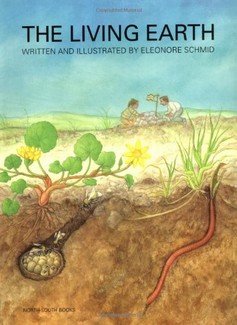
With it’s eye-catching covering featuring children playing, grasses growing and vines sprouted whilst below the surface of the topsoil a whole new environment populated with a with a nest of yellow jackets and a busy earthworm cleaning up the remains of a rotted bit of vegetation; THE LIVING EARTH WRITTEN AND ILLUSTRATED BY Eleonore Schmid is a marvelous Science oriented book written for the younger set.
The original paperback cover whets the appetite for what lies on the pages to come. Below the earth’s surface is a wondrous world inhabited with myriad animals, organisms and roots.
The work filled with two page spreads high lighting various features of our earth’s crust and what is located below begins with a showing a vista of hills and fields, towns and sea coast and rivers emptying into the sea.
Each spread provides text at the bottom of the spread and a detailed graphic of the particular concept introduced. Topics include an explanation of the various layers found below the earth’s crust, details of topsoil, organisms living just below the surface, the role of earthworms for maintaining the health of soil, below ground dwelling mammals along with those who go from on the crust to below the surface, forests and their purpose.
Other topics include how the earth contributes to food production for human consumption, chemical and artificial fertilizers, resources such as coal for heating, and electricity, stone for building and oil and natural gas, a glimpse of huge cities with much cement and little open area for plantings. The culminating spread offers the comfort of knowing that if we take care of her and do not misuse her; the earth will continue to give us everything needed for our survival and that of the many plants and animals we have.
I used this excellent book in my K 1 classroom for many years. I found K 1 students never grew weary listening as I talked, turned pages, and related the narrative of our earth as a precious living thing.
Children, as a rule, are fascinated with everything science. This book opened many doors for discussion. While my students were always interested in the whole book, there were some special pages they enjoyed in particular.
Writer/Artist Schmid’s excellent art work illustrating her narrative helps clarify how our earth is made of many layers. My students were always amazed that the topsoil where we live, walk and play is so thin when compared to the rest of the layers. A two page spread with cows grazing, bushes and a tree as well as an underground river is one that always held student attention while evoking many questions.
The spread regarding topsoil explains makeup of the soil layer, and provides an above and below soil level view of grases, flowering plants and critters that live among them. Below the soil line is found roots, bulbs and just sprouting seeds.
The page spread featuring the artist’s rendition of living organisms, fungi, single celled animals, bacteria, algae and the like is a page Little Learners found especially enthralling.
An explanation of the important role earthworms play in renewing the soil helps Little Learners gain a greater appreciation of the creature sometimes thought to be slimy, icky or a variety of other terms six year old use before they begin to understand the role each of us plays, and that touching worms may leave a little residue, however, we are washable and sanforized.
And the illustration of topsoil living on and in the top layer of our earth’s crust is a busy one with worms and grubs below, birds, beetles, snails, ants and the like spread across across the two pages. Viewing the worm poop always causes a bit of gasping and horror, however, when castings are seen first as a part of a picture on the page and then scooped up with plastic spoons to carry into the classroom where it is observed to be nothing more than dirt before being added to the small pot holding a philodendron start; the poop becomes far less icky, and far more understandable in the cycle of life.
The illustration of small mammals living underground in dens, their tunnels and rooms always prove fascinating. Above ground writer illustrator Schmid shows a vista filled with deer, trees, a lake, grasses, a fox carrying a hapless critter for her hungry kit waiting nearby, rabbits gambol, and badger sow with two cubs. Below ground level we see the badger tunnels leading to the nursery and three infant badgers, and a storage room filled with food.
Moles and their long tunnels weave in and around the badger and mother rabbit in her nursery where her infants are sleeping.
Other pages show the result of careful forestry, food production on farms and ranches, cities and large scale farms. The author warns that while artificial chemical fertilizers and the like may be used, they can be harmful to the soil. A picture of strip mining is shown, and narrative includes mention of rock, and coal, and so much that humans find valuable and necessary for life.
A large city street with most of the soil covered in cement is shown along with a stalwart dandelion finding a foothold in a crack in the cement. Our human need for gardening is evident as we view a lady tending her plants on a balcony several stories above the street level. Through windows we can see plants in offices or homes. While down on the street itself trees grow in special areas in sidewalks or large planting pots.
I especially like the spread showing a garden, and the bare feet of mom and child. Nasturtiums grow alongside the onions and radishes providing a perfect opportunity to explain that chemicals that can harm us and the soil will kill many of the pests who might come to eat our foods, the nasturtiums will deter pests, provide us pretty flowers for a vase and leaves and flowers can be eaten!
While I purchased my paperback book many years ago from a book store, it is now out of print; however, thrift stores, and other sellers may have a copy.
Amazon offers a hard cover version of the book. The cover for the hardcover version is plain, however, a copy of the original paperback cover is found upon opening the book.
I am happy to recommend this excellent book filled with child friendly illustrations and easily understood narrative.
Attention-grabbing work, happy to Recommend for home or classroom use
-------------------------------------------------
Reviewed by:MOLLY’S REVIEWS molly martin
http://www.AuthorsDen.com/mjhollingshead
35+ years Public School classroom teacher
-------------------------------------------------
BIOGRAPHY via internet reveals a little of this writer artist.
Eleonore Schmid born in Lucerne, Switzerland in 1939 died in 2001. She was a prolific author and illustrator of children’s books.
Some of the published credits of Eleonore Schmid include Hare's Christmas Gift (A Michael Neugebauer Book), Living Earth and more .
AMAZON PRODUCT DETAILS
Interest Age Range: 5 and up
Read to 4 – 8 year olds
Read with Emergent Readers
Read Alone strong 2d – 3d grade vocabulary
Paperback: 32 pages
Publisher: North-South (March 1, 2000)
Language: English
ISBN-10: 0735813159
ISBN-13: 978-0735813151
Product Dimensions: 8.6 x 0.2 x 11.4 inches
Hard cover, Paperback



Ron