The edition is illustrated by Chris Lyon and Paul Sullivan, edited by Caroline Young and designed by Jane Felstead. Usborne Guide Calligraphy From Beginner to Expert was produced by Susan Hufton.
Fellow of the Society of Scribes Susan Hufton acted as consultant.
‘Calligraphy is the art of beautiful writing’ I found the section What is calligraphy to be especially thought-provoking. Interestingly; the rudimentary techniques of the calligrapher are the same today as they were centuries ago.
Filled with colorful bits and pieces beginning with cave paintings depicted against a tan background are dated back to 38,000 BC and relate the stories of the earliest men living on earth. Pictographs and hieroglyphics were used prior to introduction of cuneiform 2,500 BC when marks were made in clay with wedge shaped tools.
Chinese characters, Phoenician alphabet of 22 letters was adapted in part by the Greeks who added some vowels, the Romans adapted the Greek alphabet and during the 1st to 10th centuries AD added 3 more letters to produce an alphabet of 26 letters.
The beginnings of calligraphy occurred around 6 AD when monks used a style of lettering, Unicals to write stunningly decorated religious books. As more people began to write and read, slimmer lettering to fit more letters on a line began to be used, and the baroque, somewhat difficult to produce, Gothic style of lettering was developed.
Toward the end of the 1400s AD, the italic style of writing which is simpler to produce than Gothic, but retains the beauty and style desired by scholars in Italy began to flourish.
The first printing press was set up in Germany during 15th -19th centuries AD, letters were based on the Gothic calligraphy style.
As books began to be produced using printing presses; calligraphy became less important, but, was retained as a technique for creating stunning lettering for missives.
Edward Johnston, about 1900, revitalized the art of calligraphy. He taught the historic styles including one developed by himself and based on a 10th century manuscript.
The section identified as Starting Out presents illustrations of basic equipment needed along with explanatory notes. Pens and Nibs is a section my fourth-grade students, 2 years sandwiched between many years teaching K 1 classes, found especially fascinating for youngsters who had grown up with plastic ball point pens.
I often use fountain pens for daily writing; the students were fascinated with them; which led to my looking for book such as this Usborne Guide Calligraphy From Beginner to Expert.
Lettering begins on pages 8 – 9 with particulars regarding how to form the letters.
Lettering is introduced with both capitals and minuscues, or lower-case letters. A striking, foundational alphabet, with each letter stroke numbered is shown.
I like the foundational letters, letters are both good-looking and inspiring, while they are also pretty simple for kids even as young as the ten-year-olds in my 4th grade classes, and for arthritic old fingers of their teacher to produce.
My own sons were introduced to calligraphy and other decorative writing formations during their 4th grade classes spent in California Public Schools by a teacher who inspired as well as taught. My oldest son in particular went on to become a graphic artist, and retains use of decorative handwriting into his adult years.
The appearance of even simple calligraphy lettering causes a simple paper, mass produced, reading or math certificate to become more special to the recipient of the document.
Because I have taught K 1 for so many decades; manuscript lettering is my standard form of writing. I have adapted an italic alphabet as my signature and note taking lettering technique.
I like the sections pertaining to uses of beautiful lettering today, and see use for teaching same in the classroom as middle grade and older students begin to think of one day entering the adult job market.
As a handy introduction to the art and beauty of calligraphy this borne Guide Calligraphy From Beginner to Expert is excellent. As with most activities and experiences in the 4th grade; every student expressed some interest in the art of beautiful lettering. Not all retained enthusiasm for long.
As a gift for a teacher who wants to add a little dash to ‘store bought’ certificates, or a garden or jam making crafter who presents gifts labeled in ‘fancy’ lettering to family and friends and to the youngster interested in hobby art, Usborne Guide Calligraphy From Beginner to Expert is a good choice.
I enjoyed the read from beginning pages and right on to the end. There are some lettering techniques I may never use, but for the middle grade and beyond student who may have an artistic bent not yet fully developed; this guide may spur interest and provide hobby or employment possibility as yet not considered.
Happy to recommend for the home library shelf, classroom, art room, and school library.
Note: while my guide was purchased as a stand-alone item, I see that Amazon and other outlets also offer the guide as a part of book and implement package.
I buy pens, inks, papers and the like from the local Hobby Lobby.
------------------------------------------------------
Reviewed by: MOLLY REVIEWS BOOKS molly martin
------------------------------------------------------
36+ years classroom teacher


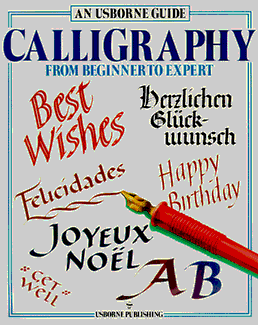

With today's long list of fonts, only a few stalwarts will take up calligraphy. And, I understand, that cursive writing is being eliminated from grade schools to the dismay of many.
I often recall over the years noting that my mother's handwriting was almost a perfect match to those cursive alphabets placed over the top of grade school chalkboards in my youth. While I worked on my architectural/engineering lettering most of my career, my twin brother was much better at it. Even though I had acquired a doctorate, I felt it much more important to write a legible signature rather than one that was highly stylized or unreadable like so many. As a college teacher, I found that I could read almost all of the scribbles of my students.
It wasn't until I was in my doctoral program where a fellow student shared his skill with calligraphy with us when it came to documents and diplomas from our program. We are still in touch, but he does not go out of his way to select some special font for his emails to me.
Ron