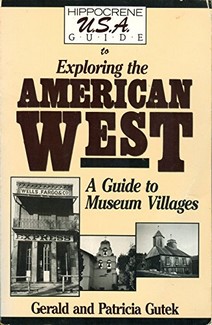
Author Historian’s Gerald and Patricia Gutek'sUSA Guide to Exploring Mid-America A Guide to Museum Villages published in 1990 is a fine work of 172 pages in addition there are a dozen or so black and white photos.
Museum Villages offer History Buffs and others a step back in time to a period when our country was new and life was infinitely different from that of today.
I have long enjoyed these edifying and delightful glimpses into earlier times and the people who lived or worked in the structures maintained for us all to appreciate.
USA Guide to Exploring Mid-America A Guide to Museum Villages caught my eye as I moved along the walkways in the local jumble shop.
This detailed edition allows readers to grow comprehension regarding our area within the inner most of the country concerning by-gone days in the area west of the Mississippi River.
The narrative is divided into two sections, Part 1 presents locations found in the region of Upper Great Plains, while Part 2 lists attractions sited in Lower Great Plains.
Realistically; a book having 170+ pages, cannot list every possible momentous site, nonetheless the book does serve to sharpen awareness for those who may have an approaching outing planned to visit one or more of the sites set aside by the National Park Service and private citizens alike.
Part 1, Upper Great Plains; includes Iowa, Kansas, Nebraska, Minnesota, and North and South Dakota. Explicit historic locations preserved as museums include Amana Colonies, in Iowa, Fort Larned National Notable Site in Kansas, and Fort Snelling in Minnesota as well as four sites in Nebraska; to wit Fort Hartsuff Historic Park, Stuhr Museum of the Prairie Pioneer, Harold Warp Pioneer Village and Fort Robinson State Park.
North and South Dakota locations cited are Bonanzaville USA, Pioneer Village and Museum, Fort Abraham Lincoln State Park, Fort Totten State Historic Site and Prairie Vllage.
Part 2 Lower Great Plains lists locations found in Arkansas; including Arkansas Territorial Restoration, Old Washington Historic State Park and Prairie Grove Battlefield State Park. Fort Gibson, Indian City USA ad Tsa-La-Gi found in Oklahoma and Lyndon B Johnson National State Historical park, and Lyndon B Johnson State Historical Park, and San Antonio Missions National Historic Park and The Alamo located in Texas round out the work.
Each entry offers information designed to foster consciousness concerning the sites, which, if after reading can be followed with visits to local libraries and on-line searches to make available for those who appreciate history; alertness required to plan an extensive vacation, day trips or just more cognizance that every community has areas of interest. And perhaps in particular for those living in the area and may be unacquainted regarding the importance of their own surroundings.
I particularly like that individual sites, Iowa Amana Colonies is one, starts with contact information. The book was published in 1990, if readers would like to visit one or more of these seven German communal colonies begun and continued during an almost century span beginning in 1854; an internet search can offer information, needed for making trip to the Amana Colonies during festival times, or not, as the visitor wishes.
Some of the local history of the site is included to help visitors put into context why the location was developed as it was. The Amana Colonies, for instance, was initiated by German migrants fleeing religious intolerance.
Most of the historical museum villages provides tours the area, some self-directed, others have docents in period dress explaining how buildings, devices and tools were used.
Fifteen black white photos are included near the middle of the book.
On the whole I am very pleased with the Gutek’s USA Guide to Exploring Mid-America A Guide to Museum Villages. It provides adequate data to cause readers to perhaps plan a trip to the state to visit one or more of the sites cited. And as well, whet interest for visiting the state, study more of the history of the area and perhaps even visit more than just the one or two sites listed for a particular state.
The War Between the States was a time of rancorous conflict. Not every historical site in the target areas can be included, however there are a number of sites I would especially like to see included in future works. Kansas; Fort Scott, supply depot, where many original building have been restored ; Battles fought at Baxter Springs, and Carthage, are important, in fact Carthage was site of the first actual battle of the war. As war was being voted on in DC; the battle was waged.
Arkansas; Battle of Pea Ridge and Prairie Grove Battle Field, Oklahoma; battles fought at Bird Creek, Honey Springs, and Cabin Creek (2) all provide historians and visitors with reconstructed lands, plaques, monuments and at Honey Springs in particular buildings to deepen the awareness of visitors for the time and worry experienced by many of our forebears.
Only Prairie Grove with restored buildings and walking paths are available; is mentioned in this book. Perhaps another trip to the local jumble shop will allow me to discover a book cataloguing even more of our communal history.
Happy to commendGerald and Patricia Gutek’s USA Guide to Exploring Mid-America A Guide to Museum Villages for history buffs, personal, high school and public libraries, and, as a gift for one who enjoys books designed to broaden our historical awareness.
I find Gerald and Patricia Gutek’s USA Guide to Exploring Mid-America A Guide to Museum Villages to be an informative interesting Read , well worth the read, Happy to recommend.
-------------------------------------------------
Reviewed by: MOLLY REVIEWS books molly martin
-------------------------------------------------
http://www.AuthorsDen.com/mjhollingshead
35+ years classroom teacher
------------------------------------------------
INTERNET BIOGRAPHY
Gerald Lee Gutek is a professor emeritus of education at Loyola University Chicago, where he taught, with a joint appointment in history, from 1963 to 1997 and also served as dean of education from 1979 to 1985.
He has been a visiting professor at Loyola University of Los Angeles (now Loyola Marymount), Michigan State University, Northern Michigan University, Otterbein College, and the University of Glasgow in Scotland.
He is the author of more than twenty books in the history of education, biography, philosophy of education, and historical travel.
He and wife Patricia have coauthored a number of works.



But there are more recent additions to the history like the RV Hall of Fame created about 2005 off Interstate 80 (Indiana Tollway) near Elkhart Indiana. Just two days ago I received a letter from Eric Flora requesting funds for the Flora Historical Society to be constructed in honor of the founders of Flora, Indiana, John and Sarah Flora, Old Order Amish. On my mother's side, my ancestors are Replogles, also Old Order Amish, who settled there from Pennsylvania in the early 1800s.
Ron